


Public Comments
Comments provided on: January 7, 2020
Comments provided to: National Institutes of Health, Bethesda, Maryland
Comments provided on: January 7, 2020
Comments provided to: National Institutes of Health, Bethesda, Maryland
Developed on: December 2022
Developed by: Joint Task Force for Clinical Trial Competency / Mahidol University, SICRES (Siriraj Institute of Clinical Research), NCGM (National Center for Global Health and Medicine)

Presented on: August 13, 2018
Presented at: Disclosure and Transparency for Clinical Data Summit, Philadelphia, PA
Published on: June 2022
Developed by: MRCT Center Return of Individual Results Task Force

Additional Resources, maintained on our project specific
Return of Individual Research Results website:
IRB Approval Checklist for Returning IRR
Healthcare Provider Contact Form Template

The participant populations enrolled in clinical trials should reflect the populations of those affected by the disease or condition for which the intervention is being tested. Representation in research is basic, good science. Everyone should be able to “see themselves” in clinical trials and research data and to know whether approved vaccines, therapies, devices, and medications (including medication doses) are right for them. Without appropriate representation of the people who will use the tested products, we don’t know how safe or effective those products are for different people (e.g., people with varying body types, genetic backgrounds, co-existing health conditions, income levels, environmental exposures, and/or life stages).
Despite efforts, there is still a great deal to learn as we work toward greater access to clinical trials and improved health outcomes. The barriers that potential participants face in finding and accessing clinical trials differ, as do the approaches that might mitigate these challenges. And, while the MRCT Center released guidance and tools to address representation in research early in the COVID pandemic, we continue to learn more about the specific ways that people from different populations can best be supported to participate in clinical research.


April 29, 2026


January 30, 2026


September 18, 2025
August 6, 2025

May 30, 2025
May 30, 2025
May 30, 2025


November 25, 2024
November 18, 2024
October 23, 2024

October 20, 2024
September 4, 2024
September 4, 2024
August 28, 2024

March 7, 2024
November 10, 2023
September 30, 2023

May 4, 2023
May 4, 2023
December 15, 2022

December 14, 2022


December 14, 2022
December 7, 2022
September 28, 2022
July 14, 2022

January 1, 2022
December 7, 2021
January 13, 2021
December 20, 2020
December 3, 2020
December 3, 2020
December 3, 2020
November 10, 2020
October 28, 2020
October 14, 2020
September 29, 2020
September 23, 2020
September 22, 2020

August 1, 2020
December 4, 2019
October 29, 2019
October 8, 2019
October 3, 2019

December 5, 2018
November 15, 2018

Principles of health literacy provide a basis from which to adopt and integrate health literacy practices into clinical research.

Everyone benefits from clear communications that promote audience understanding and empowerment, including members of the clinical trial ecosystem. Clear research communications that are understandable to patient and participant communities are especially critical to inclusive, representative research studies.
As such, the MRCT Center launched an effort in 2018 to develop clinical research-focused health literacy resources with a workgroup of diverse representatives to support the integration of health literacy strategies across the clinical development life cycle. The resulting Health Literacy in Clinical Research website launched in October 2019.
Click Here to access our interactive project-specific website >

Extending from this, our plain language, patient-centric Clinical Research Glossary, which was piloted in 2020 and adopted as a CDISC global standard in 2023, continues to grow via a collaborative consensus-building workgroup and public review process. New terms and definitions are released every September. If you’d like to be notified when new terms are available, please fill out this form.
Other recent Health Literacy in Clinical Research efforts include a suite of Data Literacy Infographics, a virtual Health Literacy Training and Checklist for IRBs, and an ongoing project to update the Health Literacy in Clinical Research website content.
For Health Literacy in Clinical Research project, please link here.
For Clinical Research Glossary, please link here.
January 30, 2026
March 31, 2025
October 23, 2024
October 20, 2024
April 1, 2023
December 15, 2022
December 14, 2022
June 1, 2022
February 4, 2022
February 1, 2022
January 1, 2022
August 1, 2021
December 20, 2020
April 17, 2020
February 24, 2020
January 21, 2020
January 15, 2020
December 4, 2019
October 1, 2019
October 1, 2019
October 1, 2019
October 1, 2019
October 1, 2019
October 1, 2019
October 1, 2019
October 1, 2019
October 1, 2019
October 1, 2019
October 1, 2019
October 1, 2019
October 1, 2019
October 1, 2019
October 1, 2019
October 1, 2019
October 1, 2019
October 1, 2019
October 1, 2019
October 1, 2019
October 1, 2019
September 12, 2019
April 11, 2019
December 5, 2018
December 5, 2018
December 5, 2018
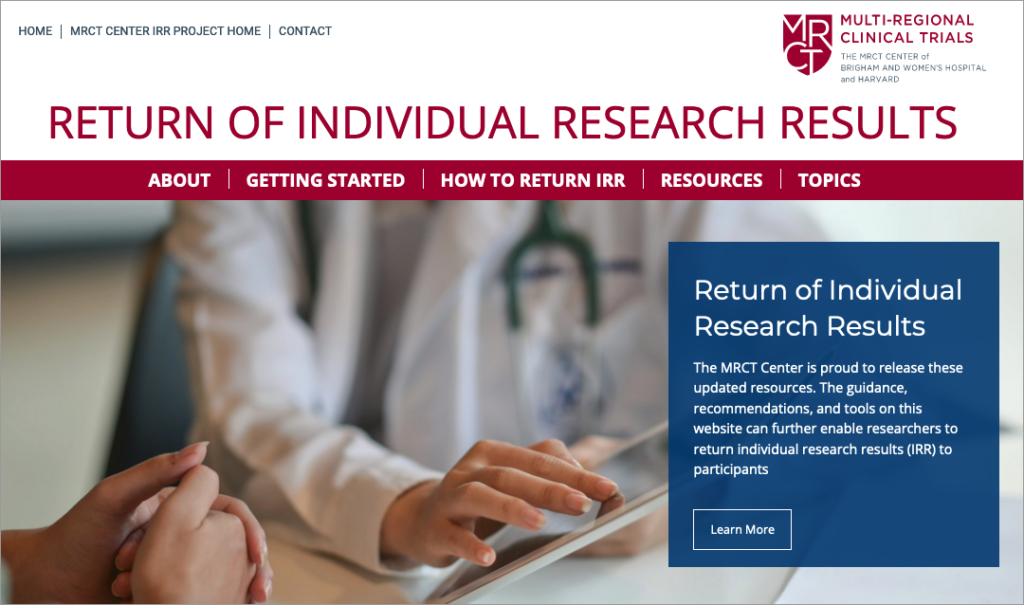
The guidance, recommendations, and tools on this website can further enable researchers to return individual research results (IRR) to participants.

Returning individual research results (IRR) is consistently described by research participants as a desired and expected practice. It can benefit individuals, communities, and the research enterprise by increasing trust and transparency in research, and by adding value to research participation.
The MRCT Center first convened a workgroup in 2015 to address the absence of standard guidelines and criteria related to returning IRR. SACHRP provided initial guidance for return of individual research results in 2016, and the MRCT Center released recommendations in guidance and toolkit documents in 2017.
Despite significant attention and effort, as well as consensus on the importance of returning individual research results, adoption of the practice continues to lag. Updated resources were released in 2022, followed by a series of case studies to highlight scenarios where individual results and data were successfully returned to participants.
To continue growth and development in this space, and partly in anticipation of a new NIH policy on the return of individual results, the MRCT Center recently launched a new industry workgroup focused explicitly on implementation. Anticipated deliverables include a dedicated playbook, practical case study, and commitment statement.
Click Here to Access Project-Specific Website >
January 30, 2026
March 27, 2023
March 27, 2023
December 15, 2022
May 22, 2022
December 7, 2021
January 1, 2021
December 20, 2020
September 25, 2018
August 13, 2018
December 7, 2017
December 7, 2017
November 1, 2017
July 25, 2017
December 7, 2016
December 16, 2015
December 3, 2014
Developed on: June 2022
Developed by: MRCT Center Return of Individual Results Task Force

Additional Resources, maintained on our project specific website:
Return of Individual Results
IRB Approval Checklist for Returning IRR
Healthcare Provider Contact Form Template
Developed on: June 2022
Developed by: MRCT Center Return of Individual Results Task Force

Additional Resources, maintained on our project specific
Return of Individual Research Results website:
IRB Approval Checklist for Returning IRR
Healthcare Provider Contact Form Template
Developed on: June 2022
Developed by: MRCT Center Return of Individual Results Task Force

Additional Resources, maintained on our project specific
Return of Individual Research Results website:
IRR Information Sheet for Participants Template
Informed Consent Sample Language