The fourth conference in the series, “Facilitating Pediatric Medicines Development: Models of Global Cooperation,” focuses on global regulatory cooperation with an eye to building on existing models to strengthen the global regulatory ecosystem for pediatric drug approval.
This two-part webinar will take place on 29 November 2022 at 9-11:30am ET and 30 November 2022 at 9-11am ET. We encourage you to attend both parts of this virtual meeting as part two builds on part one.
Developed by: Joint Task Force for Clinical Trial Competency / Mahidol University, SICRES (Siriraj Institute of Clinical Research), NCGM (National Center for Global Health and Medicine)
The participant populations enrolled in clinical trials should reflect the populations of those affected by the disease or condition for which the intervention is being tested. Representation in research is basic, good science. Everyone should be able to “see themselves” in clinical trials and research data and to know whether approved vaccines, therapies, devices, and medications (including medication doses) are right for them. Without appropriate representation of the people who will use the tested products, we don’t know how safe or effective those products are for different people (e.g., people with varying body types, genetic backgrounds, co-existing health conditions, income levels, environmental exposures, and/or life stages).
Despite efforts, there is still a great deal to learn as we work toward greater access to clinical trials and improved health outcomes. The barriers that potential participants face in finding and accessing clinical trials differ, as do the approaches that might mitigate these challenges. And, while the MRCT Center released guidance and tools to address representation in research early in the COVID pandemic, we continue to learn more about the specific ways that people from different populations can best be supported to participate in clinical research.
Describe the obstacles potential participants are facing in accessing U.S. and multi-regional clinical trials, including scientific, ethical, and geographical challenges; and generate and share lessons learned about potential approaches for effective communication, recruitment, and retention of participants from a variety of backgrounds.
Support engagements and sustainable partnerships with community champions, organizations, and referring providers, and workforce development of clinical research personnel. Develop and disseminate actionable and scalable solutions (“tools”) to support representation in research, greater access to clinical trials, and improved health outcomes.
April 2021 – July 2021: Leaning In webinar series “Driving Inclusion in Clinical Research” emphasizes how to plan for inclusion, implement recommendations, and sustain progress.
The MRCT Center is guided by the fundamental belief that communicators are responsible for sharing information in ways that are designed to promote audience understanding and empowerment. Clear research communications that are understandable to patient and participant communities are critical to inclusive, representative research studies.
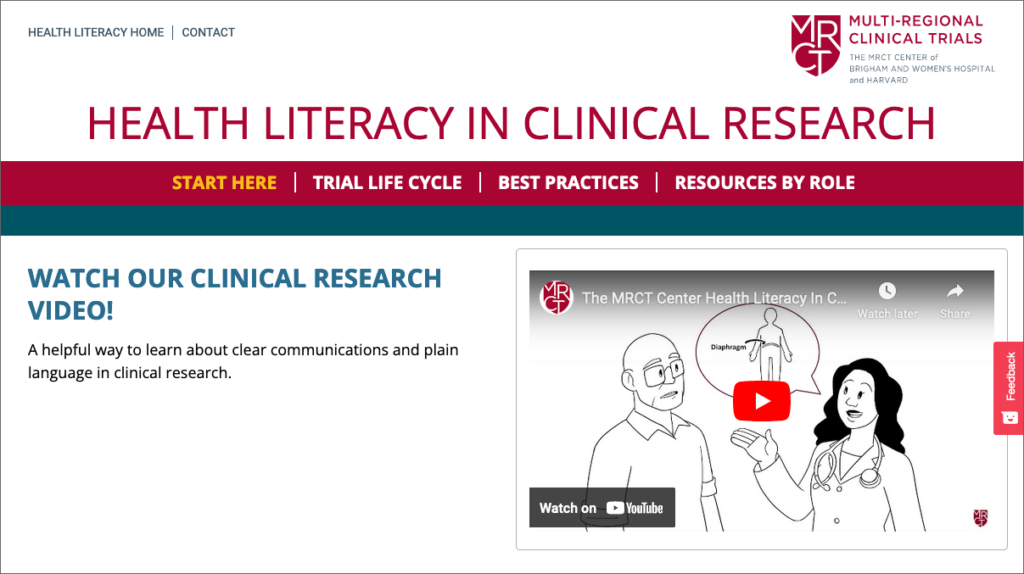
As such, the MRCT Center launched an effort in 2018 to develop clinical research-focused health literacy resources with a workgroup of diverse representatives from across the research ecosystem that would support the integration of health literacy strategies across the clinical development life cycle. The resulting Health Literacy in Clinical Research website launched in October 2019.
All of us here at the MRCT Center strive to develop tools and resources that promote understanding, especially when the audience includes patients, participants, and caregivers. Our plain language, patient-centric Clinical Research Glossary, which was piloted in 2020, continues to grow via a collaborative consensus-building workgroup process, and was adopted as a CDISC global standard in April 2023.
The most recent version of the Clinical Research Glossary includes 216 words and definitions, customized images, and additional details and resources that provide users with valuable background information. New terms and definitions are released every September. If you’d like to be notified when new terms are available, please fill out this form.
Other Health Literacy in Clinical Research efforts include the 2025 release of a suite of Data Literacy Infographics, an ongoing virtual Health Literacy Training and Checklist for IRBs, and a newly initiated project to update the Health Literacy in Clinical Research website content.
Objectives
Establish and support initiatives that increase the use of health literacy best practices when developing clinical research-related communications for patients, participants and their caregivers.
Develop and share resources with sponsors and funders, investigators and their study teams, and institutional review boards that maximize their efforts to integrate health literacy principles throughout the clinical trial life cycle from recruitment and informed consent through close-out and return of results.
Promote the use of plain language in clinical research via a harmonized, patient co-developed Clinical Research Glossary that can be used across the research industry, and used by research professionals and potential participants to foster clear, bi-directional information exchange.
The practice of returning individual research results (IRR) has been identified consistently by research participants as desired and, often, expected. Returning individual research results can benefit individuals, communities, and the research enterprise by increasing trust and transparency in research, and by adding value to research participation.
The MRCT Center first convened a workgroup in 2015 to address the absence of standard guidelines and criteria related to returning IRR. SACHRP provided initial guidance for return of individual research results in 2016, and the MRCT Center released recommendations in guidance and toolkit documents in 2017.
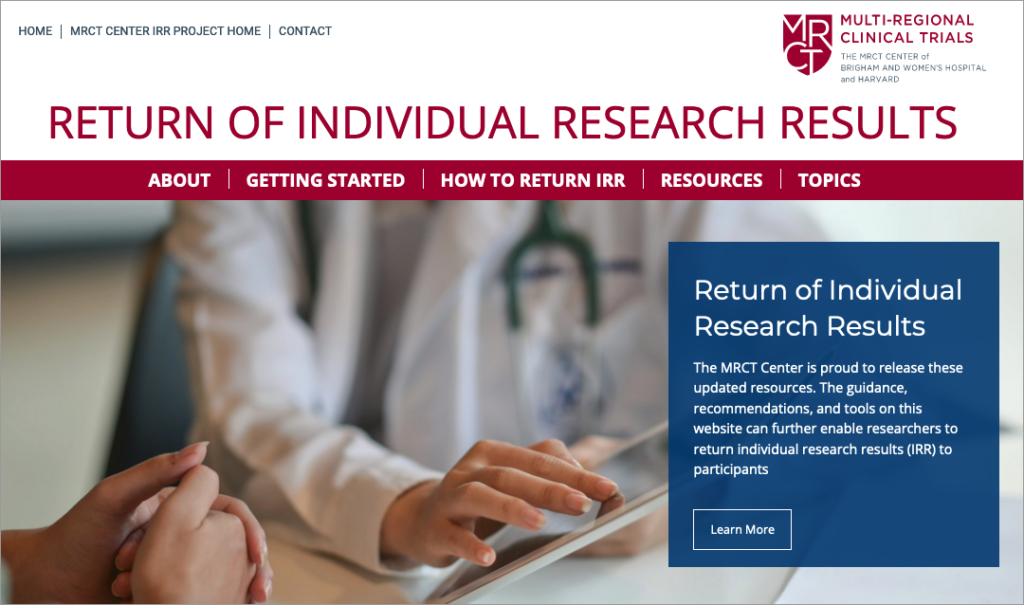
Despite significant attention and effort, as well as consensus on the importance of returning individual research results, adoption of the practice continues to lag. To respond to this need, the MRCT Center convened a taskforce to further detail the challenges associated with returning IRR and create guidance to specifically address and move beyond those challenges. These updated resources were released in 2022, followed by a series of case studies to highlight scenarios where individual results and data were successfully returned to participants.
The MRCT Center invites the research community to consider how to start returning individual results and data back to participants, and to share their experiences of using the updated Guidance and Toolkit.
June 2017: “Return of Individual Results to Participants: Principles” Version 2.1 released
February 2017: “Return of Individual Results to Participants: Principles” released
January 2017: Genomics Sub-Group launched to expand on genetic/genomic sections of Individual Return of Results Guidance Document and Use-Case Sub-Group launched to develop simulations to test the workgroup output in real life situations
December 2016: Draft Recommendations Document, Toolkit and Principles presented at MRCT Center Annual Meeting
April 2016: Task Force on Communication of Research Results launched to (1) understand current practices in communication of research results to clinical trial participants and (2) develop recommendations to guide communication processes between clinical investigators, primary care physicians, and study participants
December 2015: Launched Return of Individual Results Working Group
Project leadership & Staff
Original project (2015-2017) was co-chaired by:
Barbara E. Bierer, MD. Faculty Director, MRCT Center
Debra Mathews, PhD, MA. Assistant Director for Science Programs, Johns Hopkins
David Pulford, PhD. Genetics Therapy Area Head, GSK
Sandra Prucka, MS. Clinical Innovations, Eli Lilly and Company
Carmen Aldinger, PhD. Project Manager, MRCT Center
Taskforce for the project update (2020-current):
Barbara E. Bierer, Faculty Director, MRCT Center
Sylvia Baedorf Kassis, Program Manager, MRCT Center
Linda Coleman, Director of Human Research Protection Program, Yale University
Anna Kang Liu, Director, Pre-Approval Access and Bioethics, Genentech
David Leventhal, Senior Director, Clinical Trial Experience, Pfizer