Clinical trials are vital to advancing medical knowledge and care, yet participation can impose significant financial burdens on participants and their families—from travel and time away from work to uncovered medical and ancillary expenses.
This webinar examined the sources and impact of these costs and highlighted emerging strategies to reduce financial hardship for research volunteers. Presenters also introduced tools, checklists, and other resources developed through the EACT Project, a collaborative forum advancing financial neutrality in clinical research participation.
Long-term follow-up (LTFU) studies of gene therapy recipients are crucial for understanding the overall benefit-risk profile of these innovative products. However, LTFU studies are challenging to design, conduct, and execute, and pose significant burdens on both patients and sponsors.
In September 2024, the MRCT Center launched an LTFU Working Group. The committee comprises patients, as well as representatives from patient advocacy organizations, industry sponsors, academic medical centers, clinical research organizations, and human oversight protection organizations, each bringing diverse perspectives and complementary scientific, medical, regulatory, and ethical expertise.
On November 4, 2025, the MRCT Center released the Toolkit for Supporting the Design, Conduct, and Reporting of Long-Term Follow-Up Studies as a draft for public comment. The Toolkit provides practical guidance regarding best practices for LTFU studies for both investigational and approved gene therapies. It aims to balance the generation of critical long-term safety and efficacy data with the need to reduce burdens placed on participants, caregivers, sponsors, and investigators.
This webinar introduced the Toolkit’s 𝘀𝘁𝗿𝘂𝗰𝘁𝘂𝗿𝗲 𝗮𝗻𝗱 𝗰𝗼𝗻𝘁𝗲𝗻𝘁𝘀, including: 🔹 𝗚𝘂𝗶𝗱𝗶𝗻𝗴 𝗣𝗿𝗶𝗻𝗰𝗶𝗽𝗹𝗲𝘀 🔹 𝗖𝗼𝗻𝘀𝗶𝗱𝗲𝗿𝗮𝘁𝗶𝗼𝗻𝘀 𝗮𝗻𝗱 𝗥𝗲𝗰𝗼𝗺𝗺𝗲𝗻𝗱𝗮𝘁𝗶𝗼𝗻𝘀 🔹 𝗟𝗼𝗼𝗸𝗶𝗻𝗴 𝗙𝗼𝗿𝘄𝗮𝗿𝗱
It also highlighted additional practical resources: 🔹 𝗞𝗲𝘆 𝗱𝗲𝘀𝗶𝗴𝗻 𝗲𝗹𝗲𝗺𝗲𝗻𝘁𝘀 of LTFU studies for FDA-approved gene therapies 🔹 𝗜𝗻𝘁𝗲𝗿𝗻𝗮𝘁𝗶𝗼𝗻𝗮𝗹 𝗿𝗲𝗴𝘂𝗹𝗮𝘁𝗼𝗿𝘆 𝗴𝘂𝗶𝗱𝗮𝗻𝗰𝗲 🔹 𝗚𝗹𝗼𝘀𝘀𝗮𝗿𝗶𝗲𝘀 𝗮𝗻𝗱 𝗯𝗮𝗰𝗸𝗴𝗿𝗼𝘂𝗻𝗱 𝗶𝗻𝗳𝗼𝗿𝗺𝗮𝘁𝗶𝗼𝗻 on types of LTFU studies
𝗠𝗼𝗱𝗲𝗿𝗮𝘁𝗼𝗿: Carolyn Riley Chapman, PhD MS – Lead Investigator, Brigham and Women’s Hospital; Member of the Faculty, Harvard Medical School
On October 30, the MRCT Center hosted a webinar on Applied Health Literacy: Using Teach-Back in Conversations About Clinical Research. The session focused on how the Teach-Back method can improve participant understanding, support safe and equitable clinical research, and strengthen communication throughout the research process. The recording, slides, and a list of resources discussed during the session are provided below.
Overview
The webinar reviewed the essential elements of the Teach-Back method and discussed how study teams can simplify complex information, confirm understanding, and foster dialogue with participants and caregivers during recruitment, informed consent, and ongoing study engagement. Presenters emphasized the role of Teach-Back in enhancing clarity, reducing burden, and supporting participant-centered, high-quality research.
Speakers
Mary Ann Abrams, MD, MPH – Physician and Health Literacy Expert, Nationwide Children’s Hospital; Assistant Professor of Pediatrics, The Ohio State University College of Medicine
This webinar focused on how to responsibly integrate AI into the design, conduct, and oversight of clinical research, introducing two rapidly evolving applications:
Digital twins – simulated models of individual patients designed to predict disease trajectories and treatment responses, with the potential to enhance statistical power, optimize design, and reduce the number of participants assigned to control arms.
Synthetic data – artificially generated datasets that mirror the statistical properties of verified clinical data, with potential use in trial design, conduct, analysis, and regulatory submissions.
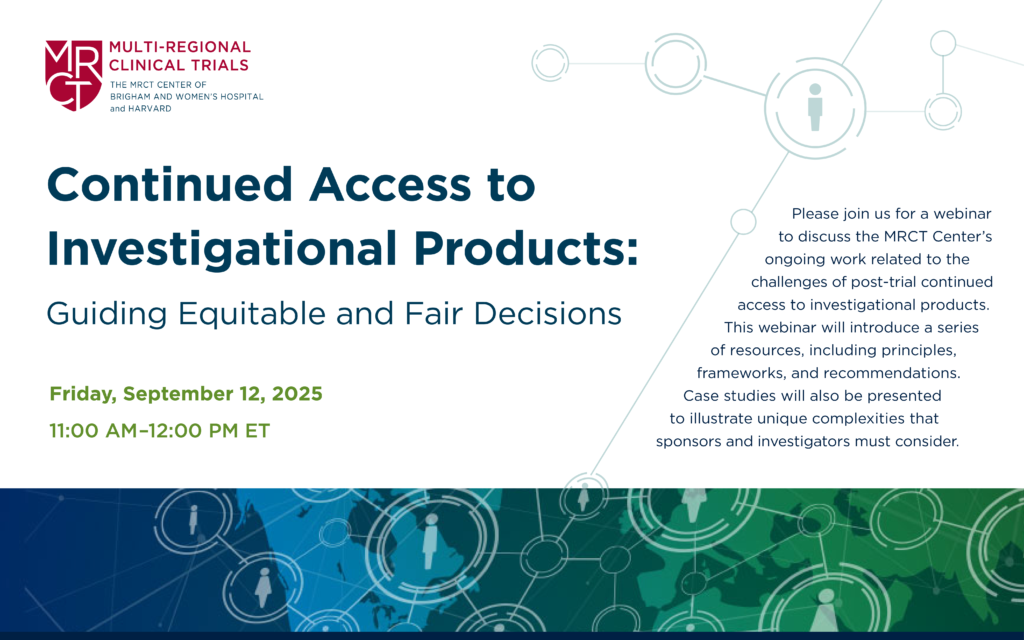
This webinar explores the MRCT Center’s work addressing the challenges of post-trial, continued access to investigational products. Post-trial access is a shared responsibility that should be planned before a trial begins. Even with careful planning, complex situations may arise, requiring sponsors to balance competing priorities and the needs of diverse stakeholders.
The MRCT Center’s Post-Trial Continued Access Task Force has developed principles, frameworks, and recommendations to guide equitable and fair decision-making about the continued provision of investigational medicines or the maintenance of significant-risk investigational devices after a trial ends.
The session includes a case study examining a scenario in which a trial’s primary endpoint is not met, but a subpopulation benefits, illustrating the difficult decisions sponsors and investigators must navigate in determining whether—and how—to provide post-trial, continued access.
Speakers:
Karla G. Childers, BA, MSJ, MSBE – Vice President, Bioethics, Policy & Partnerships, Johnson & Johnson
Brandy Ellis – Lived Experience Advocate
Ben Rotz, RPh – Associate Vice President, Global Medical Policy, Strategy, and Operations, Eli Lilly & Company
Moderated by: Sarah White, MPH, Executive Director, MRCT Center
This on-demand webinar, presented on June 26, examines the FDA’s recommendations for long-term safety monitoring of gene therapy recipients—recognizing both the transformative benefits and potential health risks—and highlights the critical need to design follow-up studies around patient needs and preferences to minimize burdens. Building on prior discussions of platform trials and registries, this webinar emphasizes strategies to reduce burden and enhance participant-centered practices. Perspectives include insights from a foundation tackling patient loss to follow-up, expertise on embedding patient-centric culture change into study design, and a patient advocate’s lived experience emphasizing the power of patient voices in shaping compassionate, sustainable LTFU frameworks.
This webinar launched the MRCT Center and WCG’s Review Framework for Protocols Involving Artificial Intelligence (AI). This framework supports Institutional Review Boards (IRBs) in reviewing research where AI is part of the intervention. The framework was developed through a multi-disciplinary task force, and these actionable tools offer both (1) structured guidance grounded in U.S. regulations and (2) ethical considerations to assist IRBs in evaluating benefits and risks while ensuring oversight and transparency across the AI development lifecycle. This session introduced a practical decision-making resource intended to help IRBs determine when and how to apply appropriate and proportionate oversight to protocols involving AI.
Key Topics:
Introduction to the IRB review framework focusing on aligning review practices with existing regulations and ethical standards.
Structured questions IRBs can use to assess risk, benefits, and ethical considerations when AI is used as a research intervention.
An expert panel discussion on navigating ethical considerations and the question of “AI Exceptionalism” during IRB review.
Learn about the MRCT Center’s Clinical Research Glossary, a collaboratively developed plain language resource designed to enhance understanding of clinical research terminology. Discover how you can participate in the annual Public Review—an essential step toward making these terms a CDISC global standard. Your involvement ensures the glossary remains accurate, inclusive, and effective for informed decision-making in clinical research. Now open through July 5.
Key Topics:
The terms and definitions going through Public Review
Why your voice matters in Public Review
How to easily participate and submit feedback
The role of Public Review in shaping global clinical research standards
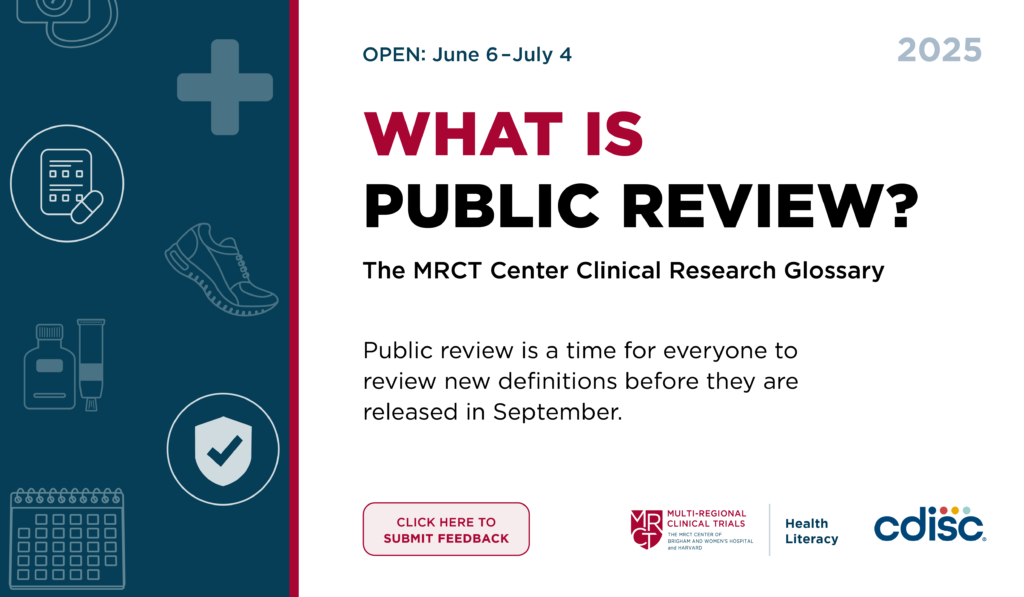
Public Review is a Critical Part of the Clinical Research Glossary process.
Part of being a CDISC global plain language standard means all new terms and definitions, plus change requests we received throughout the year, go through a public review process.
Public Review of the Clinical Research Glossary happens every June.
After definitions are developed by the Clinical Research Glossary team, Public Review ensures the definitions get an extra review by people who were not involved in the project. This helps us be more confident that the definitions are clear and easy to understand.
Send us your feedback using the MRCT Center Public Review process.
The MRCT Center’s process uses a simple survey to collect feedback.
This process will not require reviewers to create an account, but we do ask for name, organization and email address. Collecting this information allows us to validate the entry and follow-up with each person to let them know how the comment was addressed.
You can send us feedback on already posted definitions all year round and suggest new words for us to consider whenever you want. Click here to contact us.
The CDISC Public Review process is also an option if you know how to use JIRA
This works great if you already have a CDISC login and are familiar with the process. Individuals will need to create accounts to provide comments via JIRA.
CDISC has kindly provided video instructions here.
A common misconception is that plain language is only needed in select situations. In reality, applying health literacy best practices—such as using clear, thoughtfully designed language—benefits everyone, including professionals working in highly technical fields like data science.
In this on-demand webinar, originally presented on May 8, 2025, leaders from the Society for Clinical Data Management (SCDM), the Clinical Data Interchange Standards Consortium (CDISC), and the MRCT Center explore the essential role of plain language tools, such as the Clinical Research Glossary, in advancing understanding and engagement. They share how their organizations are fostering a culture of health literacy that supports both industry professionals and the broader research community, including patients, participants, and caregivers.