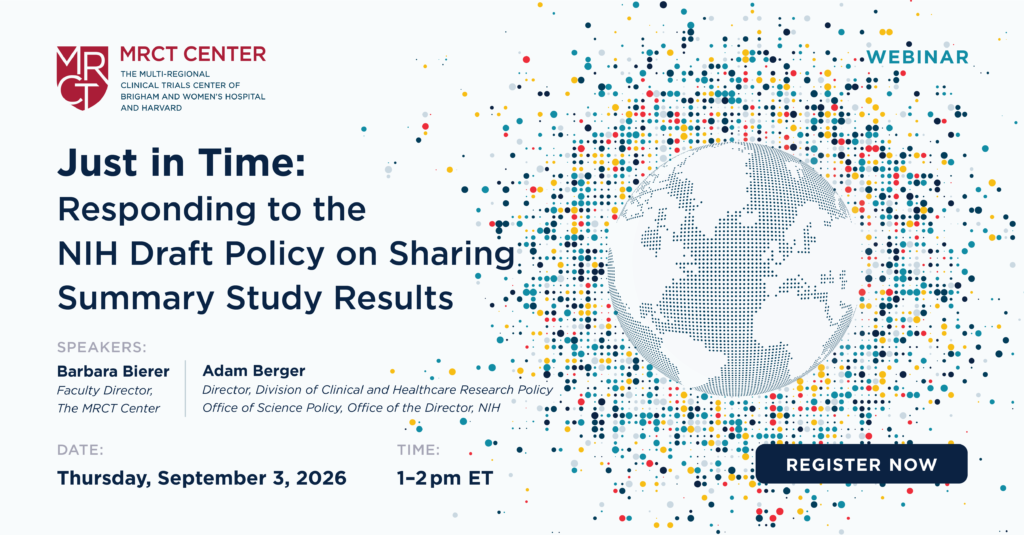
On August 27th, the NIH released its Draft Policy for Sharing Summary Level Study Results with Clinical Research Participants, with public comments due on October 26. This important draft would ensure that participants in NIH-funded clinical research receive the results of the studies in which they participate. On September 3, 2026, from 1- 2 p.m., MRCT Center Faculty Director Barbara Bierer will present the current landscape, the draft policy, considerations for institutional implementation, and open questions to which the community should respond. Dr. Bierer will share the MRCT Center’s perspectives and invite comments from others.
The Research, Development, and Regulatory Roundtable (R3) is a forum to discuss pre-competitive issues in drug and device development, regulatory oversight of clinical trials, and human subjects research. Meetings convene policymakers, legal counsel, academicians, industry representatives, and global regulators. The R3 is a cooperative endeavor coordinated by the MRCT Center and Ropes & Gray LLP.
This hybrid meeting is open to sponsors of the Research, Development, and Regulatory Roundtable.
Topic: Operation Trialblazer
Abstract: On June 22, 2026, the U.S. Department of Health and Human Services (HHS) announced “Operation TrialBlazer”, a coordinated, department-wide initiative to restore U.S. leadership in clinical research and development (the “Initiative”). The Initiative spans multiple HHS divisions: the Food and Drug Administration (FDA), the National Institutes of Health (NIH) (including the National Center for Advancing Translational Sciences (NCATS) and the National Cancer Institute (NCI)), the Advanced Research Projects Agency for Health (ARPA-H), the Office of the National Coordinator for Health Information Technology (ONC), and the HHS Office of Inspector General (OIG).
In this meeting of the R3, we will explore the policy underpinnings of the Initiative along with its most salient features, include the following:
1. Motivations for the Initiative, including geopolitical and competitive concerns with the expansion of clinical trials in China and other ex-U.S. geographies
2. HHS OIG’s request for information on Anti-Kickback Statute and Beneficiary Inducements CMP Exceptions for clinical trial participant remuneration
3. Cross-agency collaboration on clinical trial participant-facing financial barriers
4. Single IRB reform
5. Electronic health record-based clinical trial recruitment
6. FDA’s proposed expedited IND pilot program
7. FDA’s revised draft guidances on substantial evidence of effectiveness and master protocols
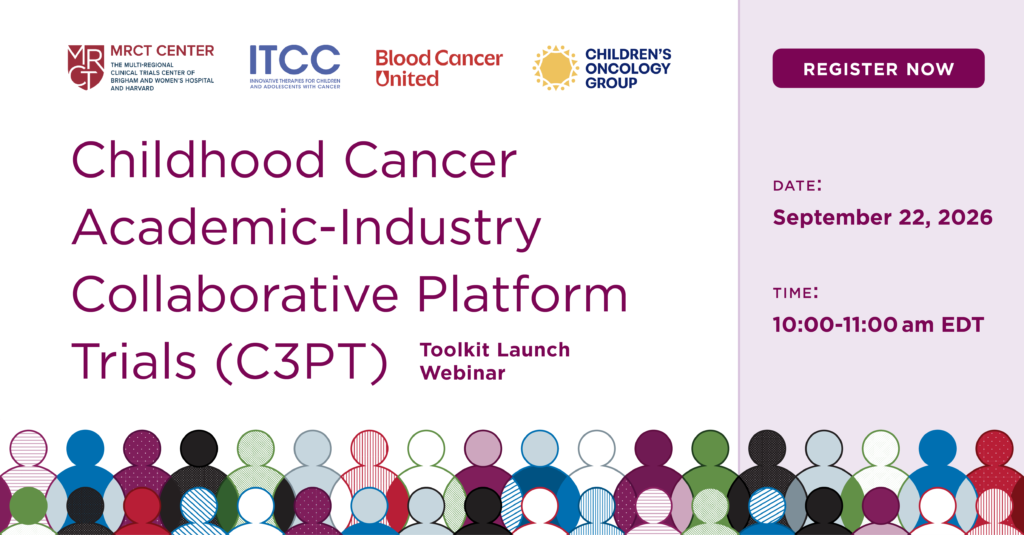
This webinar will explore key challenges, opportunities, and best practices for successful partnerships between academia and the pharmaceutical industry to design and deliver platform trials for children and adolescents with cancer.
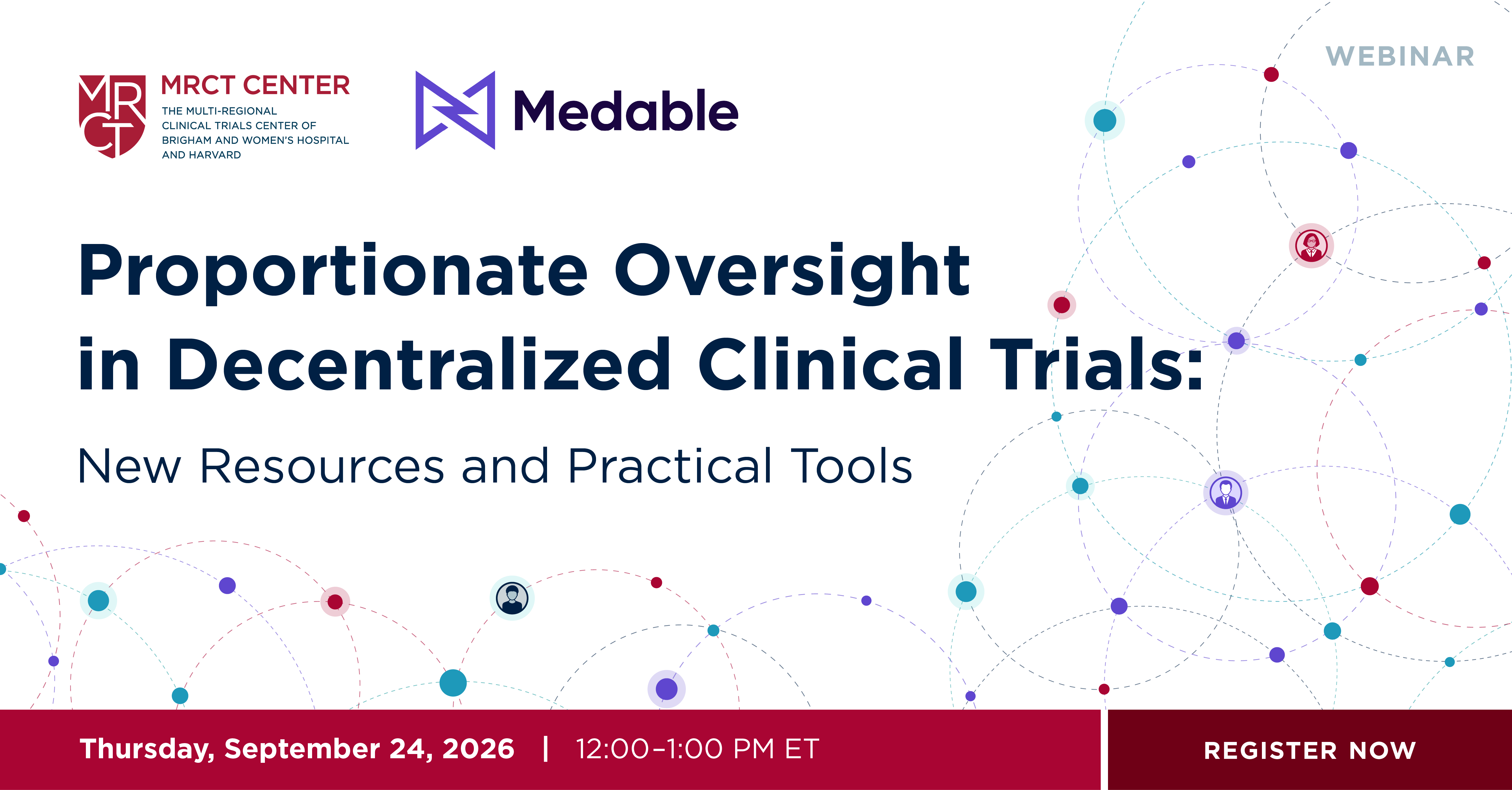
The Investigator Oversight in Decentralized Trials project builds on the MRCT Center and Medable’s prior IRB/EC Considerations for DCT Review. As data capture and trial activities increasingly occur outside traditional trial sites, the characteristics of decentralized trial conduct have created uncertainty about Investigator oversight and how it should be structured when the PI has no supervisory or contractual role with others collecting data and conducting trial activities.
To help close that gap, the MRCT Center and Medable developed four new resources for investigator oversight in clinical trials with decentralized elements (DCTs), with input from the Investigator Oversight in DCT task force. These resources include a proportional oversight framework, an approach to optimize DCT elements, a model instruction sheet for local healthcare providers, and a set of illustrative scenarios covering roles and responsibilities in common clinical situations from withdrawal requests to serious adverse events.
On Thursday, September 24, 2026, from 12:00 PM – 1:00 PM ET, the MRCT Center and Medable will host a webinar to release the resources and walk through their intended use and how they fit together.
Topic: What’s Mine Is Mine and What’s Yours Is Mine: Data Ownership and Sovereignty
Abstract: As big data and AI become more widespread, concerns about data privacy and security have intensified, with many countries restricting access to their citizens’ data (and, in some settings, to data stored in those countries, regardless of citizenship). International ethical guidelines, such as the Declaration of Taipei, state that individuals are entitled to control the use of their personal data. But most people fail to appreciate how much of their data is already publicly available, how much of their data they can no longer control, and how extensive their digital footprint is. When they do learn, individuals feel excluded from decisions about their information and express the desire to determine how their data is accessed and used. Are data ownership, consent, and permissions to control one’s existing data still realistic? Are there other ways to demonstrate respect when obtaining consent is not possible? Are there data governance models that can provide oversight for participant concerns or wishes? What actions, beyond consent, should be taken to respect or benefit the participants who contributed their data?
This meeting is open to sponsors of the MRCT Center Bioethics Collaborative and select invited guests. For more information about the Bioethics Collaborative and how to become a sponsor, click here.
The MRCT Center 2026 Annual Symposium returns to Boston on Wednesday, October 21, 2026, to be held at the offices of Ropes & Gray in Boston. Join us for a full day of discussions and presentations on ethical, actionable, and practical solutions to today’s global clinical research challenges.
We look forward to announcing our fantastic keynote speaker in the next couple of weeks. Following the keynote address, panels include:
Response to the Keynote: Ideation to Implementation – at Scale
Returning Summary Results to Participants: Lessons from the EU and UK Experience: Optimizing for US Application
Post-Trial Obligations: An integrated decision model for global clinical trial placement
MRCT Center Updates: Select initiatives from across our portfolio
On Thursday, October 22, the MRCT Center leads a day dedicated to data sharing, co-organized with Vivli.
The symposium is hybrid, in-person in Boston, and online, and it is free and open to all. Registration is now open. Attend one day or both, in person or virtually. The keynote and full agenda will be announced in the coming weeks.
Register today to secure your spot and help drive responsible innovation in clinical trials.
This webinar will focus on returning aggregate study results to participants as a patient-focused best practice that centers health literacy. After an introduction to the newly released NIH policy, contextualized within the global history of returning results, the panel will feature academic researchers discussing the essential elements of sharing their findings with participants, including why and how they do it, and what they have learned along the way. Attendees will come away with lessons they can incorporate as they consider their own return of results processes.
The Research, Development, and Regulatory Roundtable (R3) is a forum to discuss pre-competitive issues in drug and device development, regulatory oversight of clinical trials, and human subjects research. Meetings convene policymakers, legal counsel, academicians, industry representatives, and global regulators. The R3 is a cooperative endeavor coordinated by the MRCT Center and Ropes & Gray LLP.
This hybrid meeting is open to sponsors of the Research, Development, and Regulatory Roundtable.
The Joint Task Force for Clinical Trial Competency (JTF), anchored at the MRCT Center, develops and disseminates standards and practices for the global clinical research workforce. By fostering a cohesive and collaborative approach, the JTF ensures that professionals have the competencies to conduct clinical trials ethically and effectively.
Our international team of investigators, educators, and clinical research professionals has developed and/or utilizes a framework that defines the knowledge, skills, and attitudes necessary for conducting safe, ethical, and high-quality clinical research.
This meeting is open to sponsors of the MRCT Center Bioethics Collaborative and select invited guests. For more information about the Bioethics Collaborative and how to become a sponsor, click here.