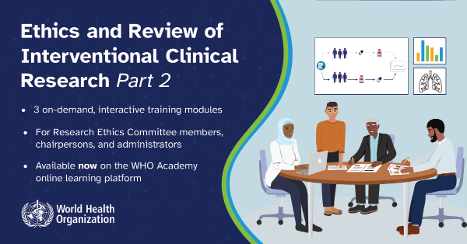
Across 3 video-based modules, paired with interactive case studies and activities, learners will gain practical, in-depth guidance on providing ethical oversight of health-related research involving human participants. By the end of the course, learners will be able to explain how a Research Ethics Committee (REC) provides oversight from initial review through study closure; articulate why robust Standard Operating Procedures (SOPs) are essential to REC operations; describe the roles and responsibilities of other stakeholders involved in clinical research oversight; and identify methods to assess and strengthen REC operations.
Good Clinical Practice (GCP) is an international, ethical, scientific, and quality standard for the conduct of trials that involve human participants. The MRCT Center developed and designed this course in collaboration with the ICH E6(R3) Expert Working Group (EWG). This course consists of 5 modules introducing and explaining the key concepts of the E6(R3) guideline. This training is intended for anyone involved in the conduct of an interventional clinical trial. The course links will take the learner to the ICH Training Library website. Courses are free for all registrants.
Currently available is:
Module 1: Introduction and Foundational Concepts, published in October 2025
Developed by: MRCT Center, in collaboration with ICH, the International Council for Harmonisation of Technical Requirements for Pharmaceuticals for Human Use.
The MRCT Center is pleased to announce the availability of an introductory video for the ICH E8(R1) Guideline – General Considerations for Clinical Studies. Posted on the International Council for Harmonisation of Technical Requirements for Pharmaceuticals for Human Use (ICH) website, the MRCT Center developed this introductory video to provide an overview of the general principles in clinical research and quality by design.
The MRCT Center is currently developing a series of in-depth training modules to complement the video.
Developed by: MRCT Center, in collaboration with the World Health Organization
Description: This course was developed in partnership with the World Health Organization and aims to meet the growing demand for a training on the scientific and ethical aspects of interventional clinical trials. This course is tailored to research ethics committee members, chairs, administrative staff, and others who review clinical trial protocols. It will also benefit regulators, investigators, study staff, care providers, and others involved in clinical trials. This course is available free of charge worldwide.
These training modules are in PowerPoint format. They can be taken on-demand by individuals or utilized by organizations (with permission from and credit to the MRCT Center) to conduct group training sessions on Accessibility 101 topics.
Module 1 provides introductory information about disability data, ableism (and non-discrimination), disability rights, the AbD Toolkit, emerging topics in accessibility in clinical trials, and a scientific and business case for collaborating with people with disabilities on universal design.
Module 2 provides a brief background on the participant journey, from accessing transportation to a site to getting into a site to navigating medical offices and equipment within the site. The module then brings users through an exercise where they are asked to see a series of pictures that illustrate different parts of the participant journey in different settings (e.g., fixed sites, mobile sites, virtual apps). For each picture, the module user must consider the challenges for that scenario from the perspective of people with hearing, visual, mobility, cognitive and intellectual, or other disabilities.
“Creating Alt Text” is the third module in the Accessibility 101 Training series that the MRCT Center has developed to complement the Accessibility by Design (AbD) in Clinical Research Toolkit. In this ever-virtual world, we all create materials like PowerPoints and social media posts that include images, and therefore need to know how make those images more accessible for people with low vision or blindness. Module 3 provides a background on Alt Text, instructions on how to create Alt Text so that images can be “read” by screen readers, and an exercise to test the user’s facility with Alt Text.
“Assessing Color Contrast” is the fourth module in the Accessibility 101 Training series that the MRCT Center has developed to complement the Accessibility by Design (AbD) in Clinical Research Toolkit. We all need to know how to make images more accessible for people with visual disabilities. One part of that universal design is using Alt Text, described in Module 3. Another is making sure that images and text boxes have sufficient color contrast between the text color and the fill (or background) color. Module 4 provides a background on color contrast, instructions on how to assess color contrast, and an exercise to test the user’s facility with assessing color contrast and adjusting colors.
“Using Plain Language” is the fifth module in the Accessibility 101 Training series that the MRCT Center has developed to complement the Accessibility by Design (AbD) in Clinical Research Toolkit. Module 5 provides a background on plain language, instructions on how to adapt complex language into plain language (including how to test the grade level for the language), and an exercise to test the user’s skills with plain language.
“Developing Accessible PowerPoints” is the sixth module in the Accessibility 101 Training series that the MRCT Center has developed to complement the Accessibility by Design (AbD) in Clinical Research Toolkit. Module 6 provides a background on PowerPoints and usage in the expanding world of webinars, instructions on how to develop accessible PowerPoints and an exercise to test the user’s skills with plain language. The “how-to” section of the training starts with defining the intended purpose and audience for the PowerPoint; describes design for mental processing, readability, and sensory processing; reviews elements described in other modules (e.g., Alt Text, color contrast, plain language/inclusive language); and concludes by highlighting considerations to support accessibility while the PowerPoint is presented (e.g., closed captioning).