
Proportionate Oversight in Decentralized Clinical Trials (DCTs)

Decentralized clinical trials (DCTs) can reduce participant burden and broaden access, but they also raise critical questions about oversight, roles, and responsibilities. Developed by the MRCT Center and Medable, with input from the Investigator Oversight in DCT Task Force, these practical tools help sponsors, investigators, and local healthcare providers (HCPs) apply a risk-proportionate approach to trial oversight. The resources and tools support oversight across decentralized clinical trial activities, from protocol design and site-level oversight to the participant visit itself.

Project background

In May 2023, the U.S. Food and Drug Administration (FDA) released its guidance, Decentralized Clinical Trials for Drugs, Biological Products, and Devices, providing recommendations for the conduct of clinical trials that include decentralized elements.

Shortly after, the MRCT Center and Medable convened a multi-stakeholder discussion to explore the implications of the guidance, with particular focus on investigator responsibilities and oversight in decentralized clinical trials (DCTs). Participants included representatives from the FDA, the Office for Human Research Protections (OHRP), academic institutions, sponsors, and contract research organizations (CROs).

The challenge

As clinical trial activities and data collection increasingly occur outside of traditional research sites, questions emerged regarding the scope and implementation of investigator oversight. Key challenges included:

  • Clarifying investigator responsibilities and oversight expectations in decentralized clinical trials.
  • Defining how oversight should be implemented when investigators do not have direct supervisory or contractual relationships with individuals conducting trial activities or collecting study data.
  • Distinguishing the respective roles and responsibilities of investigators, sub-investigators, delegated study team members, and local healthcare providers involved in trial conduct.

Why This Work Matters

The rapid adoption of decentralized trial approaches has created new opportunities to improve trial accessibility and participant engagement. At the same time, it has introduced uncertainty regarding oversight, accountability, and role delineation. To address these challenges, the MRCT Center and Medable launched a collaborative initiative to develop practical tools and resources that support appropriate investigator oversight in trials with decentralized elements. Together, these tools and resources represent a coherent, integrated system for decentralized trial conduct—sponsor-driven design, investigator-calibrated oversight, HCP-executed delivery, and a clear escalation structure when reality diverges from plan.

Project Tools:

How These Four Documents Work Together: A Practical Guide for Sponsors, Investigators, and HCPs

We recommend first reviewing our How These 4 Tools Work Together document before accessing the Oversight in DCTs Framework and Tools.


Optimizing Decentralized Elements in Clinical Trials (DCTs)

A practical guide to help investigators understand sponsors’ responsibilities when designing and implementing trials with decentralized elements.


Proportional Oversight Framework for Clinical Trials with Decentralized Elements

A decision-support framework that helps investigators, sponsors, and other trial stakeholders align investigator oversight with critical-to-quality factors and identified risks in trials with decentralized elements.
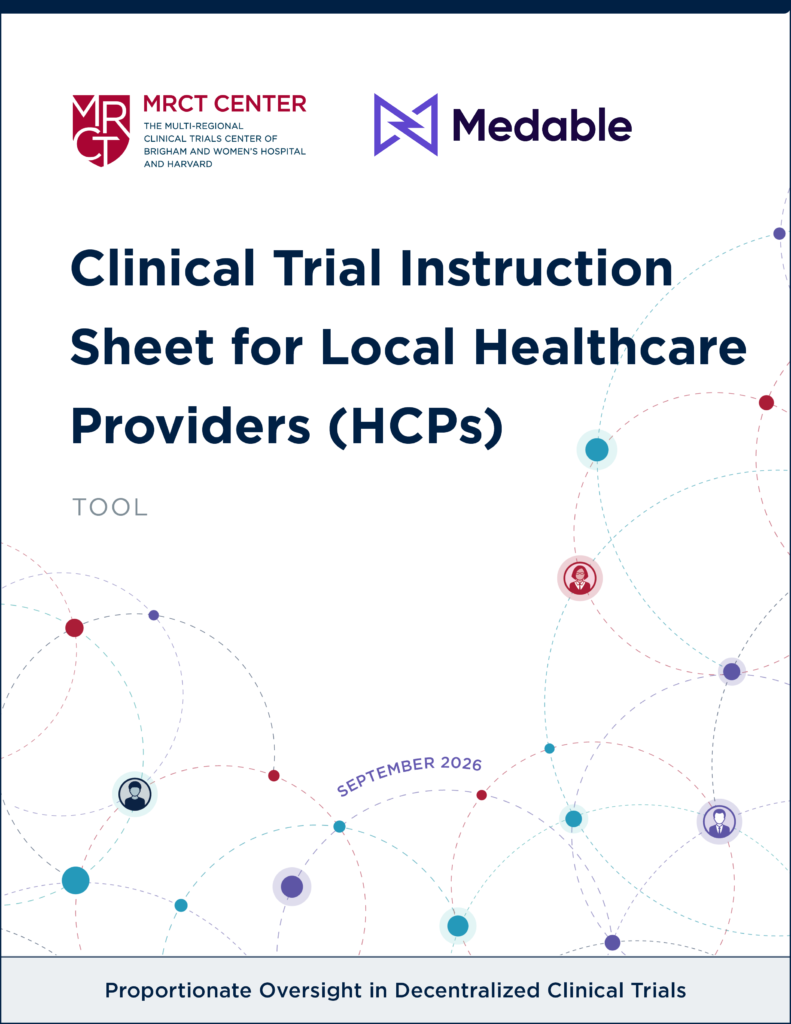

Clinical Trial Instruction Sheet for Local Healthcare Providers (HCPs)

This model HCP Instruction Sheet is meant to be pre-filled by the sponsor and the site, so the local health provider knows what is being asked of them.


HCP Check-In Questions for Participants

A consistent way to ask how a participant is doing between visits, with worked responses to nine situations, ranging from a withdrawal request to adverse events.


Related Events & Resources

Proportinate Oversight in DCTs Toolkit Launch Webinar | September 24, 2026 
COMING SOON — The On-Demand Webinar Recording


Childhood Cancer Academic-Industry Collaborative Platform Trials (C3PT) Tools

Released on: September 22, 2026

Explore the C3PT Blueprint comprising a multi-stakeholder Position Narrative, and practical implementation tools designed to strengthen academic-industry collaboration in pediatric oncology platform trials. Together, these resources provide a roadmap for overcoming barriers, streamlining partnerships, and accelerating the development of innovative therapies for children and young people with cancer.

The C3PT Blueprint

You can click on the labels below to open each tool in a new tab


Check out the C3PT project page to learn more:

Framework for Review of Clinical Research Involving AI

Framework

Date: June 24, 2025

Abstract

As part of the MRCT Center’s AI and Ethical Research project, the Framework for Review of Clinical Research Involving AI was co-developed by the MRCT Center and WCG, in collaboration with a diverse, multi-stakeholder task force.

This resource offers institutional review boards (IRBs) and other oversight entities a structured, practical approach to evaluating protocols that involve artificial intelligence in research with human participants. The framework addresses emerging ethical and regulatory challenges specific to AI—such as algorithmic bias, adaptive learning, data identifiability, and the need for human oversight—while aligning with foundational ethical principles and applicable U.S. regulations. Through tools including a decision tree for regulatory applicability, developmental stage-specific review guidance, and targeted ethical considerations, the framework supports consistent, thorough review processes that protect participants and promote the responsible use of AI in clinical research.


Framework: Post-trial, Continued Access Responsibilities to Investigational Significant-Risk Devices – Scenarios that require further consideration

Framework

Date: April 25, 2025

The Post-Trial, Continued Access Responsibilities to Investigational Significant-Risk Device Framework: Scenarios that Require Further Consideration outlines five key milestones, specific scenarios, and considerations to support organizations in making equitable and transparent decisions regarding continued access to investigational significant-risk devices. A companion framework addressing investigational medicines is also available. Both frameworks are intended to be used alongside the Principles of Post-Trial Responsibilities – Continued Access, a set of 12 foundational principles that define the shared obligations of stakeholders in ensuring appropriate post-trial, continued access.

To learn more about the Post-Trial Responsibilities – Continued Access, click here.  

Framework: Post-trial, Continued Access Responsibilities to Investigational Medicines

Framework

Date: November 13, 2024

The Post-trial, Continued Access Responsibilities to Investigational Medicines Framework: Scenarios that Require Further Consideration comprise 5 milestones, specific scenarios, and considerations that organizations can utilize to make equitable and fair decisions related to continued access to an investigational medicine. A framework for investigational significant risk devices is also available. The frameworks are designed to be used in coordination with the Principles of Post-Trial Responsibilities, a set of 12 grounding principles that identify the shared responsibilities of post-trial, continued access.

Toward a National Action Plan for Achieving Diversity in Clinical Trials

Framework

Presented on: May 6, 2024

Racial and ethnic minorities comprise a significant portion of the U.S. population, yet their representation in clinical trials remains disproportionately low. Addressing this disparity is crucial for equitable healthcare outcomes. Despite recent legislative efforts to improve diversity in clinical trials, and many individual organizational efforts, a national plan to include diverse patients does not exist.

The Clinical Trials Transformation Initiative (CTTI), Milken Institute’s FasterCures, and the Multi-Regional Clinical Trials Center of Brigham and Women’s Hospital and Harvard (MRCT Center), and the National Academies Forum on Drug Discovery, Development, and Translation coordinated a series of three convenings (June, September, and November 2023) to inform the publication of a National Action Plan to increase diversity in clinical trials. This national action, which includes eight domains and action steps intended to drive system-wide collective action, is now available here. 

Please note, the 4th [hybrid] meeting in this series, entitled “Toward a Framework to Improve Diversity and Inclusion in Clinical Trials,” will be hosted by NASEM in Washington DC on May 20. You can find out more information and register here. This workshop will build on the National Action Plan. We will be focusing on commitment to strategies for equitable participation and innovative trial design to support community investment, engagement, and workforce development.

Related Resources