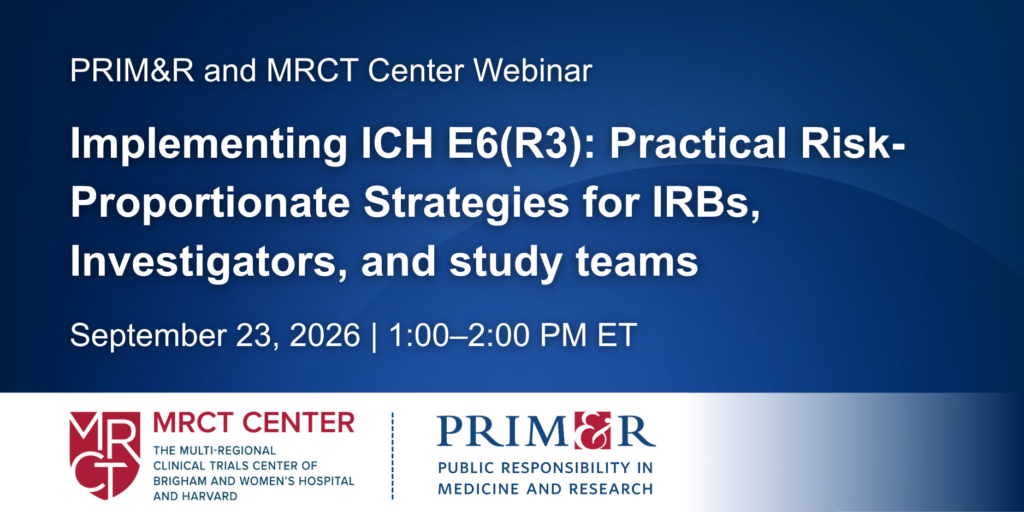
ICH E6(R3) moves Good Clinical Practice toward quality by design and risk-proportionate oversight. This webinar looks at what that shift means for the people who review, run, and document clinical trials: IRBs, investigators, and study teams. The panel discusses what is changing, how the guideline relates to the US regulations that govern IRB review, the move from investigator supervision to investigator oversight, and how to decide which essential records a trial needs. The panel then applies these ideas to a case study: an investigator-initiated trial of an approved drug in a new indication for a rare neuromuscular condition, run at three sites under a single reviewing IRB.
Panelists
David Nickerson, VP, Head of Clinical Quality Management, EMD Serono, and PhRMA Topic Lead for ICH E6(R3)
Rebecca Stanbrook, Founder and Director, RESaltas GmbH, and EFPIA Topic Lead for ICH E6(R3)
Benjamin C. Silverman, MD, Senior IRB Chair, Mass General Brigham
The MRCT Center developed this course with the ICH E6(R3) Expert Working Group. Now available: Module 1 (Introduction and Foundational Concepts), Module 4 (Informed Consent), and Module 5 (Essential Records, new in September 2026). Module 3 (Data Governance) will be released in October, and Module 2 (Responsibilities and Oversight) will follow.
The earlier MRCT Center webinar covers the guideline’s foundational concepts: quality by design, quality management, critical to quality factors, and risk proportionality. Panelists were the ICH E6(R3) topic leads Cheryl Grandinetti (FDA), David Nickerson (PhRMA), and Rebecca Stanbrook (EFPIA).
Description: In their commentary published in the American Journal of Bioethics (AJOB) titled “Inclusion Beyond, And Not Limited To, Consent Discussions,” Willyanne DeCormier Plosky and Barbara Bierer advocate for expanding attention to inclusion beyond the informed consent process, such as in the pre-study processes of developing eligibility criteria and study outcome measures, on-study processes such as planning for communication platforms and associated services (e.g., help desks, concomitant software or tools), and post-study processes such as return of results in accessible formats. They also contend that universal design supporting more user-friendly clinical trial components (e.g., ICFs, patient portals) may be more effectively achieved when the preferences and needs for study communication and participation processes are adapted from minoritized populations to apply to studies involving majority populations rather than using the default “reasonable person” to adapt clinical trial components to anyone other than that default “reasonable person.”
DeCormier Plosky, W., & Bierer, B. E. (2026). Inclusion Beyond, And Not Limited To, Consent Discussions. The American Journal of Bioethics, 26(10), 42–44. https://doi.org/10.1080/15265161.2026.2717109
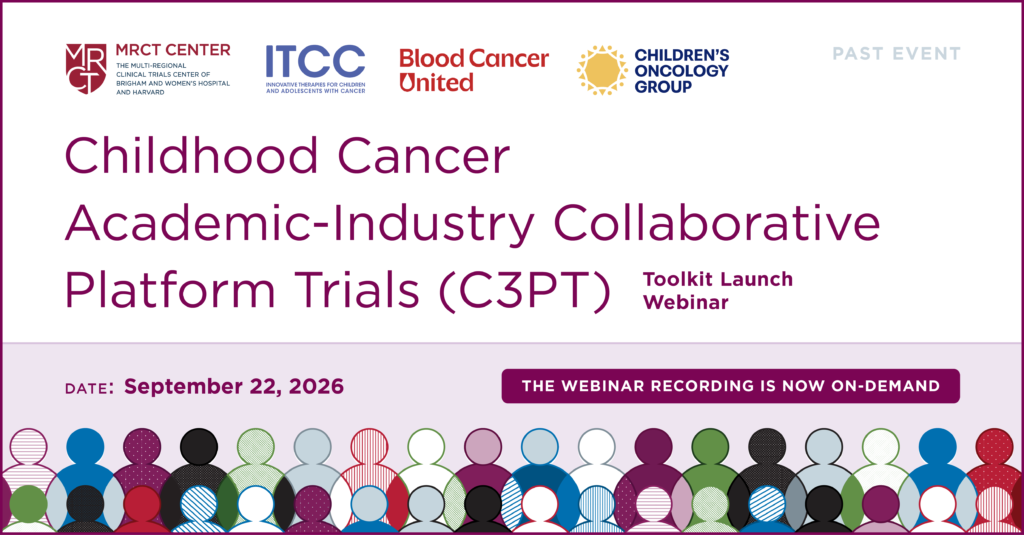
Platform trials that test several therapies for rare childhood cancers under one protocol hold great promise. Their progress depends on academic-industry partnerships, which have historically stalled over asset access, regulatory alignment, contracts, and funding. This webinar launched the Childhood Cancer Academic-Industry Collaborative Platform Trials (C3PT) Blueprint and accompanying Tools. The MRCT Center co-developed it with Innovative Therapies for Children and Adolescents with Cancer (ITCC), Blood Cancer United, and the Children’s Oncology Group (COG). It pairs a Position Narrative with ten tools.
PRESENTER/MODERATOR: Pamela Kearns, OBE, PhD, FRCPCH Emeritus, Professor of Clinical Paediatric Oncology at the University of Birmingham; who co-led the C3PT effort with the MRCT Center
PANELISTS: Patient advocates: Amanda Monteiro, parent advocate, palliative care social worker, and member of the Glo-BNHL Trial Steering Committee; Nicole Scobie, Chair of ACCELERATE and president-emeritus of Zoé4life
Regulators: Dominik Karres, Senior Scientific Officer, Paediatric Medicines Office, European Medicines Agency; Martha Donoghue, Associate Director for Pediatric Oncology and Rare Cancers, FDA Oncology Center of Excellence
Industry: George Kirk, VP Global Franchise Head and lead of the Paediatric Oncology Development Team, AstraZeneca; Kerri Nottage, Senior Director, Pediatric Drug Development, Johnson & Johnson
Academia: Amos Burke, Professor of Paediatric Oncology and Director of the Cancer Research UK Clinical Trials Unit, University of Birmingham, and Glo-BNHL Chief Investigator; Elizabeth Fox, St. Jude Children’s Research Hospital, and Chair of Developmental Therapeutics, Children’s Oncology Group
Explore the C3PT Blueprint comprising a multi-stakeholder Position Narrative, and practical implementation tools designed to strengthen academic-industry collaboration in pediatric oncology platform trials. Together, these resources provide a roadmap for overcoming barriers, streamlining partnerships, and accelerating the development of innovative therapies for children and young people with cancer.
The C3PT Blueprint
You can click on the labels below to open each tool in a new tab
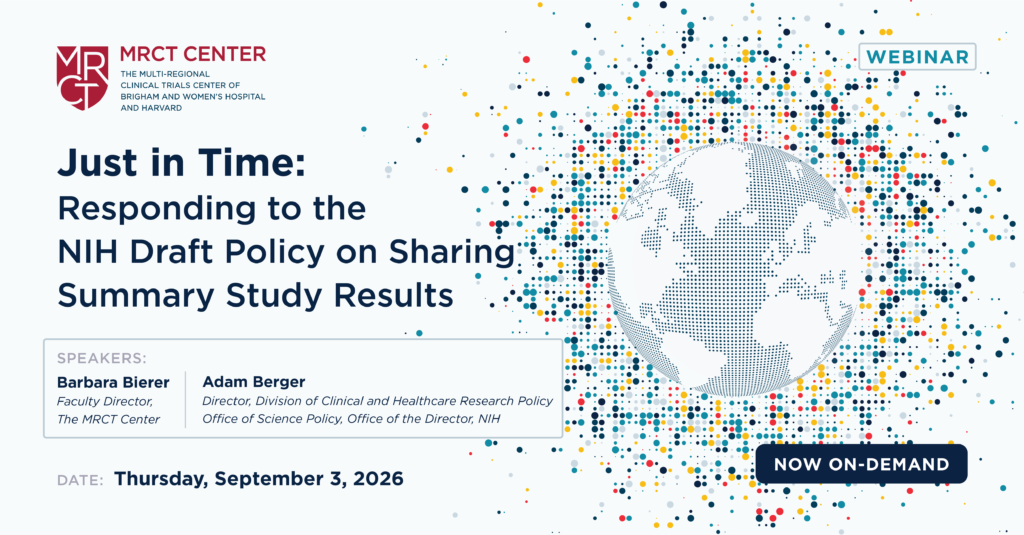
On August 27, 2026, NIH released a draft policy that would require NIH-supported researchers to share summary level study results with clinical research participants in plain language. One week later, the MRCT Center convened this webinar to walk through what the draft policy says, what it would require, and how to comment before the October 26, 2026 deadline.
The draft policy applies to all NIH-supported clinical research, not only clinical trials, regardless of funding level or mechanism. Sharing is the default expectation: where it is justifiably inappropriate, an exception must be requested and approved.
In this session:
Barbara E. Bierer, MD, Faculty Director of the MRCT Center and Professor of Medicine at Harvard Medical School, sets the context: what “summary level study results” means, why returning them is grounded in justice, beneficence, and respect for persons, and how the draft policy fits alongside international standards and regulations, including ICH E6(R3), CIOMS, the Declaration of Helsinki, and EU Regulation 536/2014. She then maps the participant journey from planning and IRB review through preparing and delivering a plain language summary, and raises the open questions the policy leaves to implementation: platform and pragmatic trials, cluster randomized designs, studies that terminate early, registries and repositories, multi-site coordination, and FDA-regulated research.
Adam C. Berger, PhD, Director of the Division of Clinical and Healthcare Research Policy in the NIH Office of Science Policy, presents NIH’s thinking behind the draft. He covers the goal of building trust and transparency in clinical research, the evidence on participant expectations, and the specific requirements under consideration: timelines for clinical trials, extramural research, and intramural research; planning and communication expectations; participant choice; and compliance and reporting.
The session closes with discussion and audience questions.
NIH is seeking comment on the purpose, definitions, scope, requirements, and compliance sections of the draft policy, and on proposed supplemental guidance covering participant preferences and experiences, best practices for researchers, and implementation needs. Each section allows up to 8,000 characters.
Publication:Therapeutic Innovation and Regulatory Science
Date Published: June 18, 2026
Description: “Expertise of European Clinical Trial Units in Conducting and Managing Cross-Border Pediatric Clinical Trials for Rare Diseases,” published in Therapeutic Innovation & Regulatory Science and led by Begonya Nafria of the Institut de Recerca Sant Joan de Déu with co-author Barbara Bierer, surveyed 43 clinical trial units across 17 European countries on their experience managing international participants in pediatric trials for rare diseases. Those units had received patients from 81 different countries, and the good practice they reported most often was providing written and verbal translation of informed consent documents, patient-reported outcome measures, and quality of life scales when these were not available in a family’s native language. The authors also documented 20 cases of discrimination, most stemming from language requirements written into eligibility criteria, and conclude that routine translation, professional interpretation, and dedicated support structures are needed for equitable access regardless of a child’s native language or nationality.
Publication:Therapeutic Innovation and Regulatory Science
Date Published: June 10, 2026
Description: Participants are rarely informed of the possibility that a trial may stop early. Here, Nora Hutchinson, Luke Gelinas, and Barbara Bierer argue that disclosure during the informed consent process would support participant decision-making, temper concerns if termination does occur, and promote transparency and trust in the research enterprise.
Description: The MRCT Center submitted a public comment to FDA on the request for information on the proposed “Expedited Investigational New Drug Pilot Program.” The MRCT Center comments support FDA’s goal of accelerating first-in-human studies but caution that the proposed pilot could unintentionally add complexity, cost, and potential conflicts of interest unless QRI roles, standards, accountability, and interactions with FDA are clearly defined and standardized. The submission recommends a more flexible and inclusive QRI model, stronger safeguards for independence and confidentiality, a centralized review platform, transparent performance metrics, and evaluation based on end-to-end development timelines and participant safety rather than speed alone.
Comments provided to: Office of Inspector General (OIG) and Department of Health and Human Services (HHS)
Description:August 24: The MRCT Center submitted a public comment to the Office of Inspector General (OIG) and the Department of Health and Human Services (HHS) in response to their request for information on examining whether existing fraud-and-abuse regulations appropriately balance the commitment to program integrity with advancing biomedical research and ensuring access to clinical trials. The MRCT Center fully endorsed the adoption of an AKS safe harbor that permits clinical trial sponsors and other funders to provide funds to compensate and cover costs incurred by clinical trial participants without raising AKS or Beneficiary Inducement CMP concerns.
Comments provided to: Office of Management and Budget (OMB)
Description: The MRCT Center submitted a public comment on the Office of Management and Budget’s proposed rule revising the Uniform Guidance for federal financial assistance (2 C.F.R. Part 200), Docket No. OMB-2026-0034. The comment addresses the two provisions that would most affect international clinical research. It agrees that competent U.S. entities should have priority when research can be done well here, but cautions that the proposed “domestic-first framework” would bar the subawards, procurements, and other international elements on which many trials depend for enrollment, biomaterials, equipment, and specialized expertise. It further argues that the proposed prohibition on collaborations with “covered foreign countries” and “covered foreign entities” is undefined and unworkable in practice. Both provisions rest on amorphous terms such as “national interest,” duplicate existing scientific review, and would chill legitimate international collaboration to the detriment of U.S. science and clinical medicine. The MRCT Center urges OMB to give considerably more consideration to the meaning, interpretation, and implementation of any rule of this kind.