The roadmap to integrate diversity, equity, and inclusion in hematology clinical trials: an American Society of Hematology initiative

Publication

Published on: February 12, 2025

Published in: Blood Advances

In a Blood Advances article titled The roadmap to integrate diversity, equity, and inclusion in hematology clinical trials: an American Society of Hematology initiative,” Barbara E. Bierer and co-authors outline a comprehensive strategy to address barriers to diversity, equity, and inclusion (DEI) in clinical research for classical hematologic diseases. These trials face unique challenges, including small sample sizes, methodological limitations, and underrepresentation of diverse populations. Through surveys and five international focus groups with patients, advocates, academia, regulators, industry, and research organizations, the team identified eight priority areas: (1) harmonizing demographic terminology, (2) engaging lived experience experts, (3) mitigating implicit bias, (4) strengthening the role of ethics committees and institutional review boards in upholding justice, (5) broadening eligibility criteria, (6) leveraging decentralized trial designs, (7) improving access to trial information, and (8) increasing engagement of community physicians. Implementing solutions in these areas will foster accessible, inclusive trials and generate representative data to improve research quality, regulatory decision-making, and patient care.

Alice Kuaban, Alysha K. Croker, Jeffrey Keefer, Leonard A. Valentino, Barbara E. Bierer, Stephen Boateng, Donna DiMichele, Patrick Fogarty, C. Michael Gibson, Anna M. Hood, Lloryn Hubbard, Antonella Isgrò, Karin Knobe, Leslie Lake, Iman Martin, Michel Reid, Jonathan C. Roberts, Wendy Tomlinson, Lanre Tunji-Ajayi, Harriette G.C. Van Spall, Caroline Voltz-Girolt, Allison P. Wheeler, Alan E. Mast, Stephanie Seremetis; The roadmap to integrate diversity, equity, and inclusion in hematology clinical trials: an American Society of Hematology initiative. Blood Adv 2025; 9 (4): 687–695. doi: https://doi.org/10.1182/bloodadvances.2024013945

Disparate data retention standards in biomedical research

Publication

Published on: August 6, 2025

Published in: Accountability in Research

In an Accountability in Research article titled “Disparate data retention standards in biomedical research”, Barbara Bierer and Carolyn Lye, Minal Caron, Lauren Walsh, and Mark Barnes discuss disparate data retention standards for biomedical research. The article summarizes the divergent data retention standards set forth by federal agencies, grant programs, and research institutions, as well as other applicable requirements under law, contract, and policy.  The authors also discuss the importance of data retention in the context of research professionalism, data sharing efforts, intellectual property issues, and research integrity challenges, and provide recommendations for both institutions and applicable federal agencies to streamline and clarify data retention standards.

Lye, C. T., Caron, M. M., Walsh, L., Bierer, B. E., & Barnes, M. (2025). Disparate data retention standards in biomedical research. Accountability in Research, 1–28. https://doi.org/10.1080/08989621.2025.2543884

Applied Health Literacy: Using Teach-Back in Conversations about Clinical Research

October 30, 2025 @ 12:00 pm 1:00 pm

October is Health Literacy Month! Please join us on Thursday, October 30, from 12 – 1 PM ET for a webinar to explore teach-back (TB) within the clinical research context. 

We begin with teach-back—its essential elements, how to use it, and why it is important to safe, high-quality, equitable health care and research. We then explore approaches for incorporating teach-back into different types of clinical research conversations.

The session will center on the importance of strong verbal communication skills and the ways teach-back can be used by study teams to foster clear, impactful, and empowering dialogue with patients, participants, and caregivers.  

We will explore how study teams can simplify complex verbal information through plain language, assess and confirm understanding via teach-back throughout the recruiting and informed consent process, and support participant understanding throughout their clinical research experience.  Registrants will receive tips and resources to support incorporating this best practice into their everyday clinical research processes.   

Objectives:

  • Explain what teach-back is, its importance, and why to use it;  
  • Describe approaches that support incorporating teach-back into clinical research conversations across the clinical trial life cycle;
  • Identify and access resources that explain how to use teach-back.

AI Digital Twins and Synthetic Data: Application to Clinical Trials

Webinar

September 30, 2025 @ 11:00 am 12:30 pm

Please join us on Tuesday, September 30, 2025, from 11:00 am–12:30 pm ET for a webinar on the applications of AI digital twins and synthetic data to clinical trials. Digital twins refer to simulated models of individual patients designed to predict disease trajectories and/or treatment responses, offering the potential to enhance statistical power, optimize trial design, and limit the number of participants assigned to a control arm. Synthetic data are artificially generated datasets that mirror the statistical properties of verified clinical data. Both technologies are or are being developed for use in the design, conduct, and analysis of clinical trials, and with the intention of use for regulatory submissions. This webinar will serve as an introduction to these emerging technologies and a starting point for examining their implications, opportunities, and challenges in clinical research.

Key Topics:

  • Introduction to digital twins and synthetic data, including their core functions and how they differ from traditional statistical modeling approaches.
  • Exploration of ethical, statistical, and regulatory considerations for adopting digital twins and synthetic data in the design and conduct of clinical trials.
  • A panel discussion featuring expert perspectives on the evolving role of AI digital twins and synthetic data in clinical research. 


Podcast Episode 4: Clinical Trials in Latin America

Podcast

Presented on: May 13, 2025

Trials Beyond Borders: Clinical Trials in Latin America—Aligning Global Research with Local Realities

Dr. Carla Saenz, Regional Advisor for Bioethics at the Pan American Health Organization (PAHO), speaks with Willyanne DeCormier Plosky, MRCT Center Program Director, to unpack the clinical trial landscape in Latin America.

They discuss:

  • How demographics, healthcare infrastructure, and insurance models shape who can—and does—participate
  • Ethical and regulatory strategies to broaden inclusion
  • The influence of CIOMS and other international guidance on local trial ethics
  • Designing global studies that honor regional contexts without sacrificing scientific rigor

This episode highlights the critical need for equitable access and culturally responsive research in today’s global trial environment.

For more about the MRCT Center’s work on Global Representation in Clinical Trials, click here.

Continued Access to Investigational Products: Guiding Equitable and Fair Decisions

Webinar

September 12, 2025 @ 11:00 am 12:00 pm

Please join us on Friday, September 12 from 11 AM – 12 PM ET for a webinar to discuss the MRCT Center’s ongoing work related to the challenges of post-trial continued access to investigational products. Post-trial continued access is a shared responsibility and should be determined before the trial begins. Even with the best planning, complex situations can arise that require research sponsors to balance various tradeoffs and impacts on stakeholders. The MRCT Center’s Post-Trial Continued Access Task Force has developed resources to guide equitable and fair decision-making related to the continued provision of the investigational medicine, or continued maintenance of the investigational significant risk device after the trial.

This webinar will introduce a series of resources, including principles, frameworks, and recommendations. Case studies will also be presented to illustrate unique complexities that sponsors and investigators must consider.


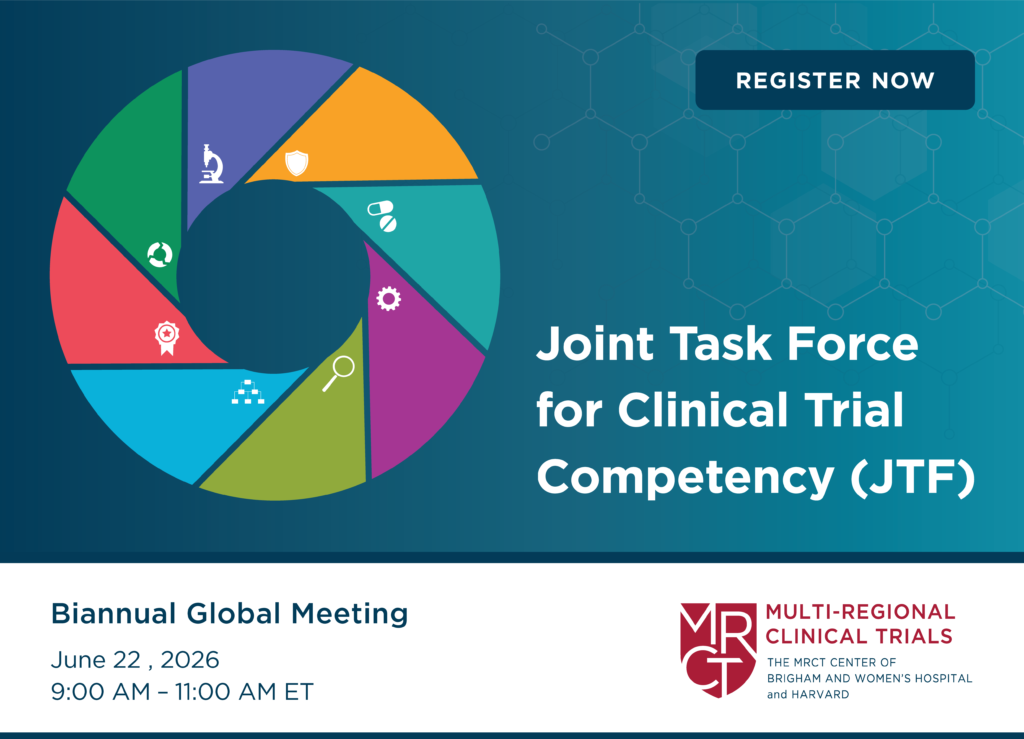
Joint Task Force for Clinical Trial Competency (JTF) Global Biannual Meeting

Meeting

December 10, 2025 @ 1:00 pm 3:00 pm

The Joint Task Force for Clinical Trial Competency (JTF), anchored at the MRCT Center, develops and disseminates standards and practices for the global clinical research workforce. By fostering a cohesive and collaborative approach, the JTF ensures that professionals have the competencies to conduct clinical trials ethically and effectively.

Our international team of investigators, educators, and clinical research professionals has developed and/or utilizes a framework that defines the knowledge, skills, and attitudes necessary for conducting safe, ethical, and high-quality clinical research.

Join us on December 10, 2025, 1:00-3:00 PM for the Joint Task Force for Clinical Trial Competency (JTF) Biannual Global Meeting to hear about global perspectives on implementing the JTF Framework. Updates include:

  • From Translation to Transformation: Advancing Clinical Research Competencies in Pakistan through the Urdu JTF Framework
  • Advancing Professional Standards and Recognition for Australian Clinical Trials Professionals
  • Professional Development of the Clinical Research Workforce in New Zealand Public Hospitals
  • Designing Experiential Learning with a focus on JTF Competencies at North Carolina Central University
  • Using JTF competencies in designing a master level training program in Clinical Data Science

To learn more about the JTF Framework: https://mrctcenter.org/clinical-trial-competency/framework/overview/

All registrants will receive slides and a meeting summary after the meeting. This event is free.

Research Ethics Review: Guidance for Clinical Trials

Tool

Published: July 16, 2025

This guidance document is intended to be used as a tool to supplement the review, discussion, and deliberation of Research Ethics Committees reviewing clinical trial protocols.

This tool was developed by Barbara E. Bierer, MD (The MRCT Center of Brigham & Women’s Hospital and Harvard), Jeffrey D’Souza, PhD (University of Toronto), Caroline M. Kithinji, PhD (Kenya Medical Research Institute), and Winfred B. Nazziwa, MS (Uganda National Council for Science & Technology), in collaboration with the African Vaccines Regulatory Forum (AVAREF).


Defamation Claims Arising from Research Misconduct Cases: Best Practices for Institutions

Publication

Published on: April 21, 2025

Published in: Journal of Law, Medicine & Ethics

 “Defamation Claims Arising from Research Misconduct Cases: Best Practices for Institutions,” published in the Journal of Law, Medicine & Ethics, co-authored by Barbara Bierer and Mark Barnes, as well as Nathaniel Jaffe, Minal Caron, and Lauren Walsh, analyzes nine instances in which defamation suits were employed to obstruct misconduct investigations. It summarizes the legal bases of such claims and key defenses (e.g., Strategic Lawsuit Against Public Participation, truth, opinion), then distills institutional best practices—from calibrated public disclosures to stringent confidentiality protocols—to protect both scientific integrity and institutional resilience.

Jaffe N, Caron M, Walsh L, Bierer B, Barnes M. Defamation Claims Arising from Research Misconduct Cases: Best Practices for Institutions. Journal of Law, Medicine & Ethics. 2025;53(1):47-54. doi:10.1017/jme.2025.37

Managing Multi-Institutional Jurisdiction in Cases of Research Misconduct

Publication

Published on: April 28, 2025

Published in: Journal of Law, Medicine & Ethics

In the article Managing Multi-Institutional Jurisdiction in Cases of Research Misconduct, published in the Journal of Law, Medicine & Ethics, co-authors Mark Barnes and Barbara Bierer examine the persistent challenges of jurisdictional ambiguity when research misconduct spans multiple institutions. Together with Leslie Thornton and Devin Cohen, they outline key gaps in current regulatory guidance and propose a framework for collaborative resolution that safeguards fairness and research integrity. The article calls for clearer delineation of institutional responsibilities and improved mechanisms for inter-institutional coordination in misconduct investigations.

Thornton L, Cohen D, Barnes M, Bierer BE. Managing Multi-Institutional Jurisdiction in Cases of Research Misconduct. Journal of Law, Medicine & Ethics. 2025;53(1):41-46. doi:10.1017/jme.2025.36