

In the Spotlight
New Tools for Pregnancy Privacy Protections for Participants
The MRCT Center has released the first three tools in the Pregnancy Privacy Protections for Participants (P4) Toolkit. These resources inform research teams, IRBs, and participants about data privacy risks if a participant becomes pregnant during a study. The work draws on MRCT Center efforts in data privacy, the Bioethics Collaborative, and Inclusion of Pregnant and Lactating Populations (within the Representation in Research portfolio).
Following the Dobbs decision, the changing landscape of reproductive rights in the U.S. has introduced new challenges for clinical trials, both for studies of pregnancy-related conditions and for any trial involving participants who could become pregnant. Because pregnancy testing and outcomes may be tracked during screening and throughout a trial, it is important to carefully consider how, and how well, clinical trial data can be protected, and how to communicate pregnancy privacy risks to potential and enrolled participants.
The three tools are:
- Local Context: Reproductive Health Information for the Research Team and the IRB
- Recommended Language for Informed Consent Forms: Guidance for Researchers on Pregnancy Privacy Protections
- Privacy Protections: Considerations for Pregnant Participants
The first two are directed toward clinical research teams and IRBs. The third is for research staff to adapt and share with participants; it is written in plain language and highlights terms defined in the MRCT Center’s Clinical Research Glossary. Each tool is a prototype; the introductory page instructs teams to revise content according to their specific study and local legislative and site context.
These issues were first explored in an MRCT Center Bioethics Collaborative forum, “Impact of Dobbs on Reproductive Health: Unintended Consequences for and on Research,” and in the recent NEJM Evidence paper, “Disclosure of Pregnancy-Related Privacy Risks in Clinical Research Post-Dobbs.“
We welcome your feedback as we develop additional tools to complete the P4 Toolkit.
Upcoming Webinars
May 7/8: Clinical Research Competencies to Support Patient Partner Engagement
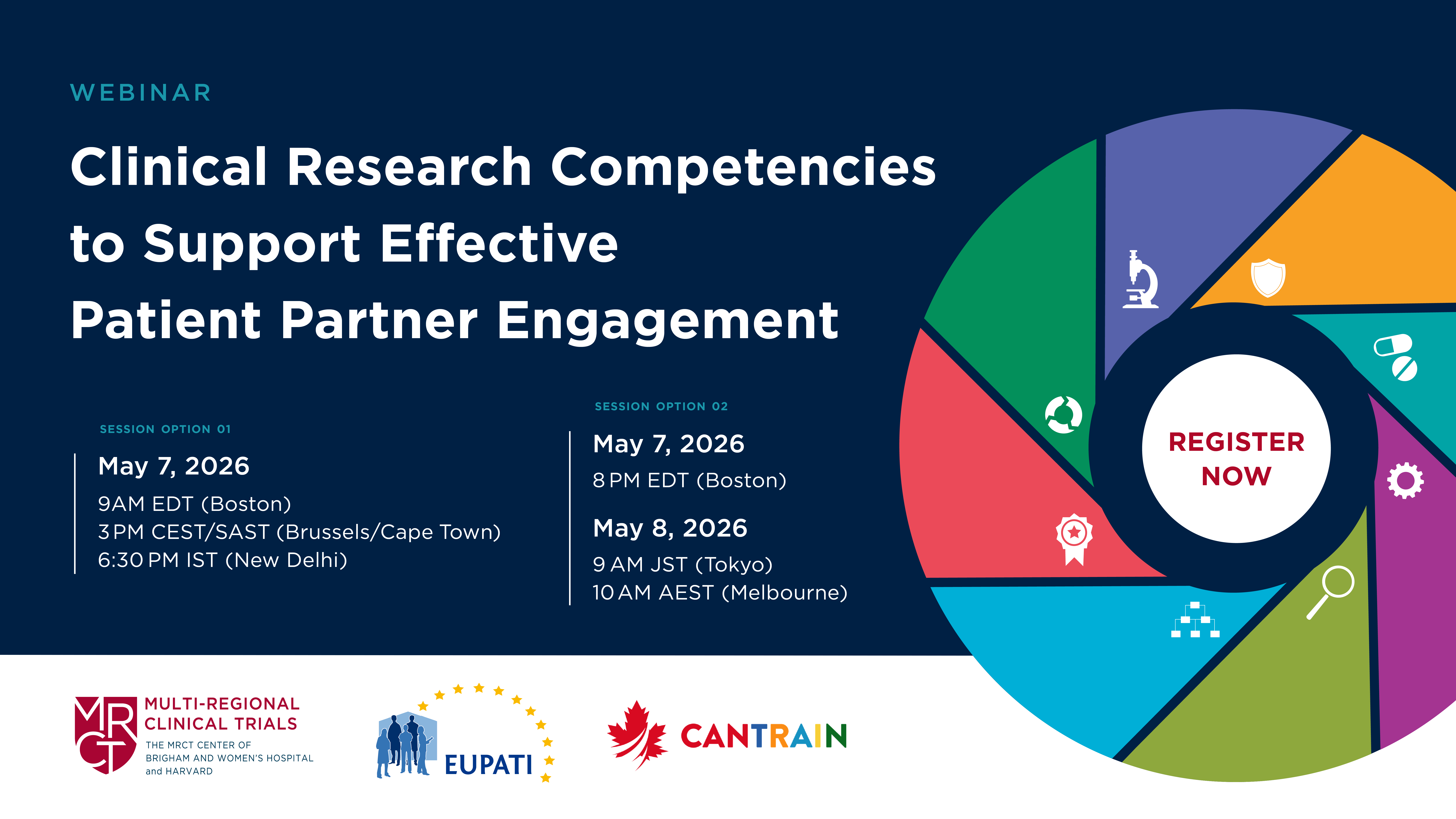
Join the MRCT Center, CANTRAIN, and EUPATI to learn the results of an effort to integrate patient partnership into the existing Joint Task Force (JTF) Framework for Clinical Trial Competency.
The initiative, entitled “JTF-Patient Partner Project – Co-Creating Clinical Research Competencies to Support Effective Patient Partner Engagement Activities,” brought together a representative group of patient and caregiver partners, academic researchers, study staff, industry representatives, and others to imagine what patient partnership within the JTF Framework would encompass.
The proposed update includes a supplementary addendum focused on integrating patient partners into the study team. The results provide a blueprint that is both operational and aspirational, supporting more skilled, inclusive, and equitable clinical research teams to achieve more responsive and impactful trials.
This webinar will be offered twice, with similar content presented by different regional panelists. One registration and one Zoom link cover both sessions.
- Session A: May 7, 9:00 AM – 10:00 AM EDT (Boston/Ottawa); 3:00 PM – 4:00 PM CEST/SAST (Brussels/Cape Town); 6:30 PM – 7:30 PM IST (New Delhi)
- Session B: May 7/8, 8:00 PM – 9:00 PM EDT (Boston/Ottawa); 5-6 PM PST (US West Coast); 9:00 AM – 10:00 AM JST (Tokyo, May 8); 10:00 AM – 11:00 AM AEST (Melbourne, May 8)
May 18: Data Quality, Model Validation, and Governance for AI Digital Twins and Synthetic Data

Please join us on Monday, May 18, from 12:00 – 1:00 pm ET for the fourth webinar in the MRCT Center’s AI Digital Twins and Synthetic Data series. This webinar will focus on data provenance and quality, model validation, and the emerging infrastructure needed to support the clinical and regulatory adoption of these technologies. It will explore how to evaluate whether the models used are credible, whether the data underlying them are reliable and traceable, and whether the outputs can be verified and validated for use in regulatory and clinical decision-making. Panelists will discuss what it means for a model to be “fit for purpose,” how definitional differences among these technologies shape regulatory review, and how clinicians, sponsors, reviewers, and regulators may use, interpret, and deploy these tools. The session will include a moderated discussion and time for audience Q&A.
May 20: Investigator Oversight in Decentralized Clinical Trials
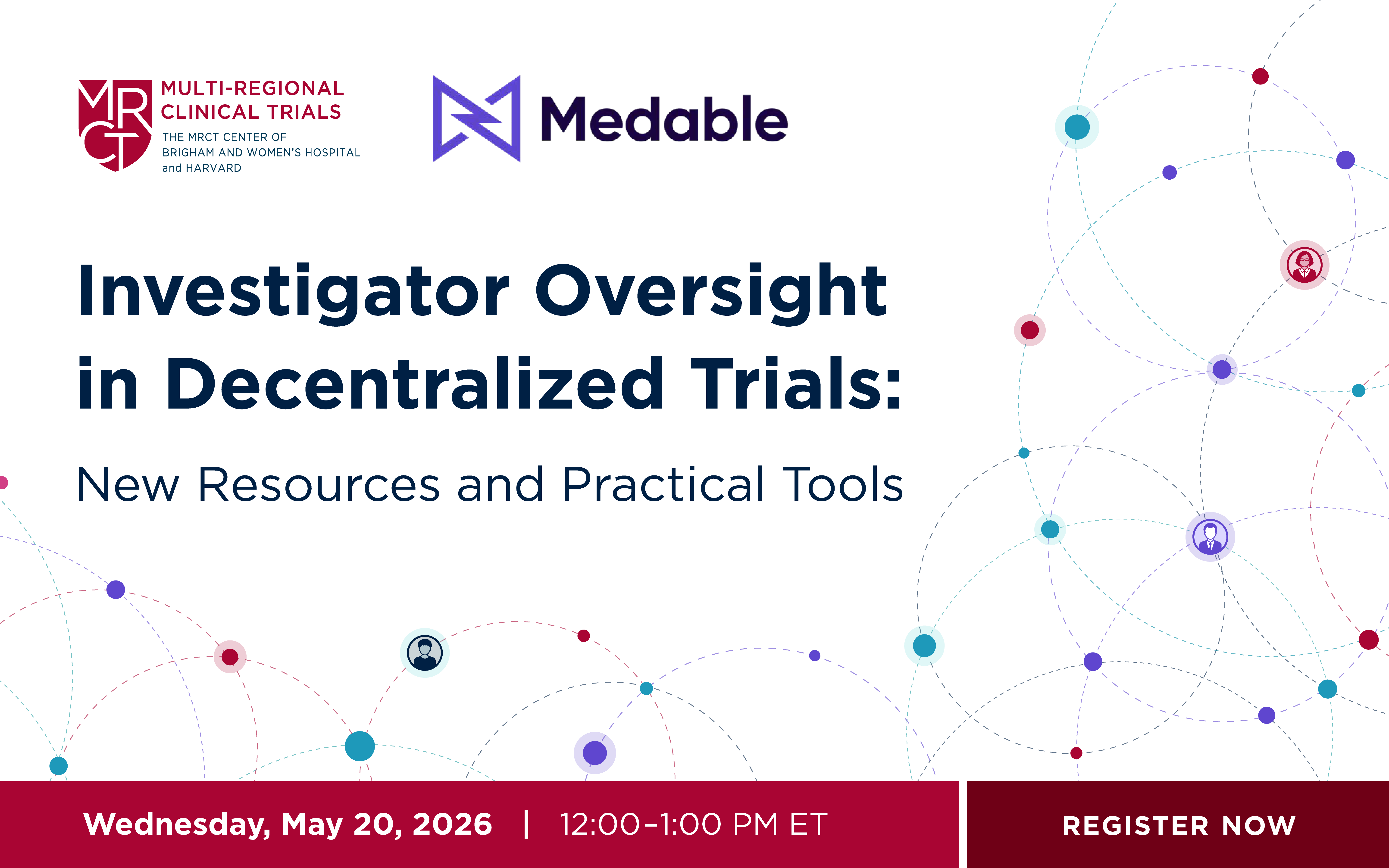
Join us on Wednesday, May 20, from 12:00 PM to 1:00 PM ET for a webinar releasing four new resources for investigator oversight in clinical trials with decentralized elements (DCTs). The MRCT Center and Medable developed this work with input from the PI-Oversight in DCT task force. Barbara Bierer, Faculty Director of the MRCT Center, and Pamela Tenaerts, Chief Medical Officer at Medable, will moderate.
Considerations for the conduct of these trials are now established in FDA guidance and in ICH E6(R3). What sponsors, investigators, and study teams have lacked are the practical tools to apply them. The webinar will introduce four resources designed to close that gap and walk through how they fit together: a proportional oversight framework, an approach to optimize DCT elements, a model instruction sheet for local healthcare providers, and a set of illustrative case studies covering roles and responsibilities in common clinical situations from withdrawal requests to serious adverse events. The session will include time for questions and discussion.
This work builds on the MRCT Center and Medable’s prior IRB/EC Considerations for DCT Review.
May 22: Good Clinical Practice in Practice: Implementing ICH E6(R3)

ICH E6(R3) represents a major modernization of Good Clinical Practice since the original 1996 guideline, building on the risk-based and quality-focused principles introduced in E6(R2). It further emphasizes a proportionate, risk-based approach to trial design and conduct, incorporating Quality by Design and risk proportionality as foundational principles. The guideline expands expectations for data governance and clarifies sponsor and investigator responsibilities. However, guidelines alone do not drive change in practice; effective implementation depends on training and education.
As the ICH training partner selected to develop the ICH E6(R3) training curriculum, the MRCT Center, in collaboration with the ICH E6(R3) Expert Working Group, is producing a five-module course to translate the ICH document into actionable guidance for the people who run trials.
Clinical Trials Week honors trial participants and the workforce whose training and preparation shape their care. In that spirit, join Sarah White and a panel of experts representing the US FDA and industry sponsors, who are also members of the ICH E6(R3) Expert Working Group, to highlight the importance of implementing the ICH E6(R3) guideline correctly and discuss key areas of the ICH E6(R3) guideline that may be challenging to implement.
The session will walk through a practical case example applying Quality by Design principles, including the identification of Critical to Quality factors, and will explore implementation of ICH E6(R3) across key areas, such as data governance, sponsor and investigator responsibilities, and the incorporation of diverse perspectives in trial design and planning. The session will underscore the importance of all individuals performing clinical trial activities in understanding these critical study attributes and how their role contributes to safeguarding them and ensuring they are consistently protected through their day-to-day decisions and actions. It will also spotlight the available ICH E6(R3) training modules. Attendees will leave with an understanding of the foundational concepts in ICH E6(R3), how Quality by Design can be applied to clinical trial design and conduct, and how to introduce and disseminate the training to their teams.
June 16: The Clinical Research Glossary at Work: Adoption, Implementation, and Impact
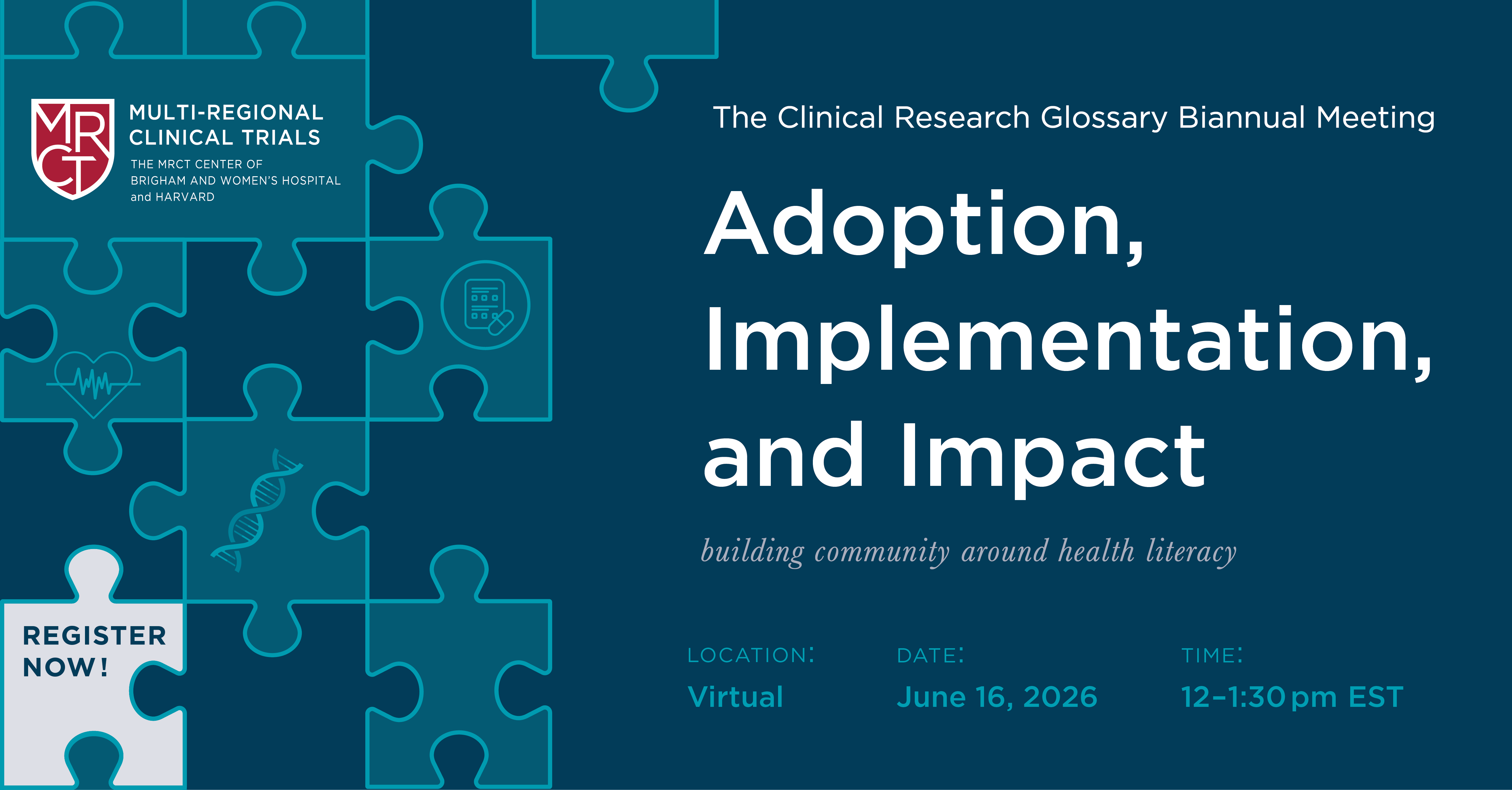
The MRCT Center Clinical Research Glossary, a CDISC global standard since 2023, offers 216 plain-language definitions for clinical research terms used across the research enterprise.
Sylvia Baedorf Kassis, Program Director for the MRCT Center’s Health Literacy portfolio, will host a conversation with panelists from two sponsor organizations and a patient partner on how the glossary is being adopted, implemented, and used in practice.
Panelists include Anna Subrizi, Patient Empowerment Team Lead at Bristol Myers Squibb; Sudipta Chakraborty, who leads the Health Literacy Center of Excellence at Biogen; and Bernard Coley, a patient partner who applies the glossary in his Parkinson’s disease advocacy and education work.
The panel will cover how sponsors integrate the glossary across research and development, commercial, and patient-facing functions, as well as the business case for plain language and its impact within organizations and clinical research studies.
The MRCT Center will also share a preview of the new terms heading into a 30-day public review this June. Public review ensures that the glossary is a living, consensus-driven CDISC global standard. Each new definition is reviewed by researchers, sponsors, patients, and advocates before adoption, so the professionals who design trials have a trusted resource to communicate with participants and help enable informed decision-making. Attendees will learn what public review entails and how to submit feedback through the MRCT Center survey or the CDISC Wiki JIRA process.
Return of Summary Results: Help Shape NIH Policy
On April 27, the MRCT Center and the National Institutes of Health co-hosted “Your Voice Matters: Help Shape a New NIH Policy on Summary Level Study Results,” a public listening session on the responsible return of summary-level results to research participants, communities, and the public. MRCT Center Faculty Director Barbara Bierer presented the current landscape and best practices, drawing on over a decade of MRCT Center work with sponsors, investigators, non-profit entities, medical communicators, and patient and patient advocate communities.
The MRCT Center is deeply grateful to NIH for advancing this work and for the opportunity to partner in it. Returning summary-level results to participants and the public is foundational to transparency, trustworthiness, and patient-centeredness in clinical research, and a thoughtful, well-shaped policy will move the field forward. The webinar recording and slides are available on demand at NIH VideoCast. Broad input is essential to a clear, comprehensive, and practical result, and we encourage every member of the community to submit comments through the NIH Office of Science Policy.
New: DIRECT Collaborative Disability Inclusion in Research Collaboration (DIRECT) is a global and interdisciplinary team of researchers committed to advancing disability inclusion in health research. Willyanne DeCormier Plosky and Barbara Bierer are participating members in the DIRECT Collaborative, as part of the MRCT Center’s work on Inclusion of People with Disabilities. The new DIRECT website currently includes information about the collaboration and a posting for a student intern opportunity. The website will soon feature a suite of resources collected from the members, including the MRCT Center Accessibility by Design in Clinical Research Toolkit and the Accessibility 101 Training Series.
Events & Presentations
April 7: The MRCT Center and Vivli co-hosted an ongoing, invitation-only forum focused on the European Health Data Space (EHDS). This forum continued efforts to guide policy development toward a harmonized and practical data-sharing system for secondary use, discussing an exemplary case study to illuminate current challenges.
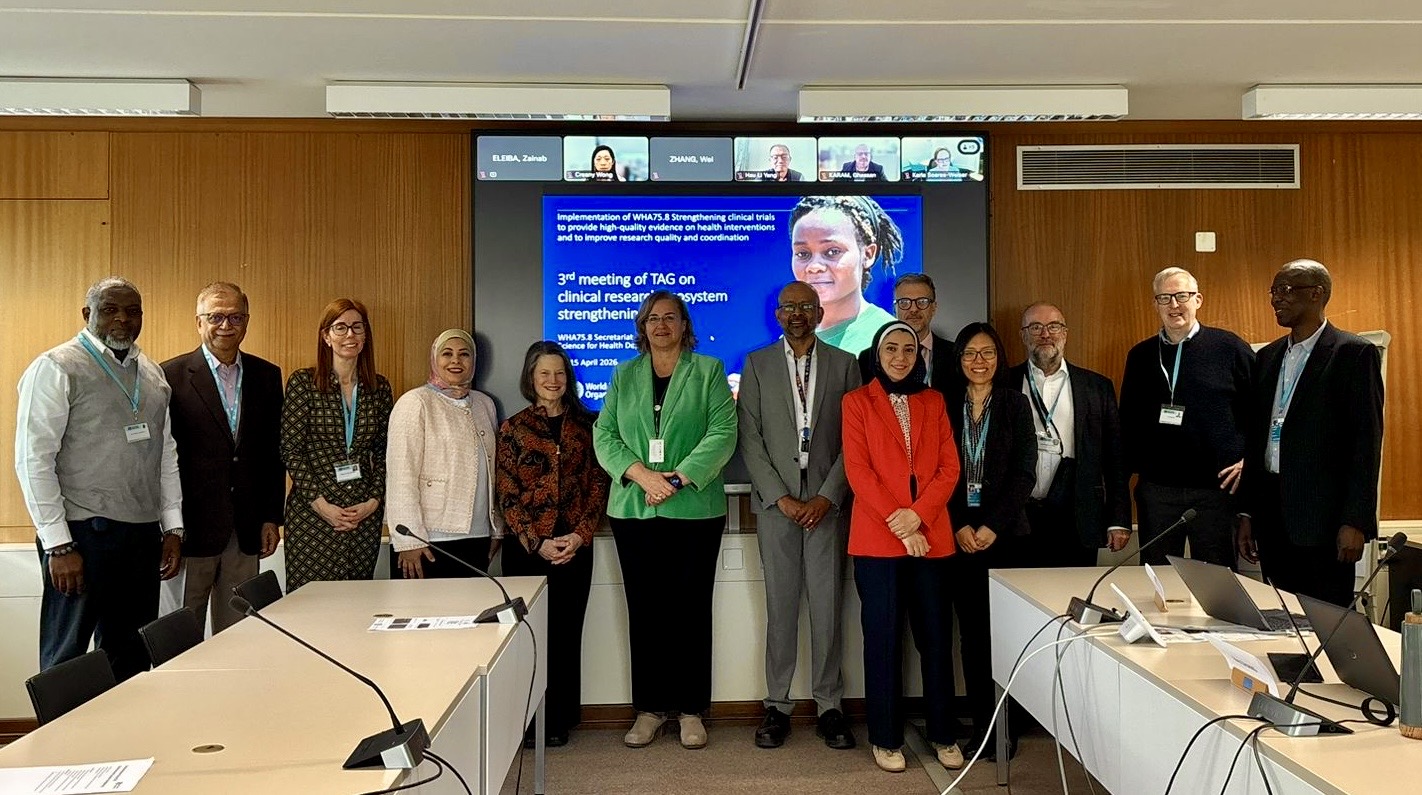
April 14-15: Barbara Bierer participated in the first in-person meeting of the WHO Technical Advisory Group on Clinical Research Ecosystem Strengthening, in Geneva, Switzerland.
April 25: Barbara Bierer joined Morgan Hanger (CTTI), Kevin Bugin (Amgen), and Rob DiCicco (TransCelerate) on a panel moderated by Jennifer Byrne (Javara Research) to present “Embrace the Now, Ignite What’s Next” at ACRP 2026 in Orlando, FL.
April 27: Barbara Bierer presented the keynote opening lecture, entitled “Evolving the Oversight of Research Integrity and Misconduct,” at the conference entitled “THREE I’s Biosecurity and Research Integrity,” hosted by the Maine Regulatory Training and Ethics Center (MeRTEC), the New England Society for Biomedical Research, and the North Carolina Association for Biomedical Research.
April 27: The MRCT Center co-hosted an NIH Webinar on Sharing Study Results with Participants. “Your Voice Matters: Help Shape a New NIH Policy on Summary Level Study Results” – soon available on demand. See Spotlight above.
April 29: Willyanne DeCormier Plosky joined Behtash Bahador (CISCRP) and Eliezar Van Allen (Dana-Farber Cancer Institute) on a panel moderated by Thomas Goetz (The Atlantic; Robert Wood Johnson Foundation; Iodine Software), “The Democratization of Discovery: AI as an Equalizer in Clinical Trials,” at Innovating With Integrity: The Future of AI in Healthcare, an event hosted by AtlanticLIVE in Boston, MA.
May 5: Meeting of the Research, Development, and Regulatory Roundtable (R3). Topic: Use of AI in Clinical Trials – Exploration of Key Legal and Regulatory Issues – Part 1. This meeting is open to sponsors of the Research, Development, and Regulatory Roundtable (R3). For more information about this ongoing forum and how to join, click here.
May 7/8: Clinical Research Competencies to Support Patient Partner Engagement. Presented in two sessions: one registration and one Zoom link. See Spotlight above for session details. Register here.
May 11: Sylvia Baedorf Kassis will be attending the National Health Council Science of Patient Engagement Summit in Arlington, VA, to present the outcomes of the Joint Task Force for Clinical Trial Competency-Patient Partner Project (JTF-P3).
May 19: Willyanne DeCormier Plosky will present at the Arc of Pennsylvania Disability Health Action Network Meeting to share the work that the MRCT Center has been doing on inclusion of people with disabilities in clinical research.
May 20, 12 PM – 1 PM ET: Investigator Oversight in Decentralized Clinical Trials. The MRCT Center and Medable, with input from the PI-Oversight in DCT task force, will present four new resources developed for investigator oversight in clinical trials with decentralized elements. See Spotlight above. Register here.
May 21, 11 AM- 12 PM ET: Barbara Bierer will participate in a discussion with Brandon Brown of the UC Riverside School of Medicine at the AAHRPP Annual conference in Detroit, Michigan. Their session, entitled “When Studies End Early: Ethical Communication, Participant Trust, and the HRPP’s Role,” will explore practical ways HRPPs and IRBs can shape consent language, investigator guidance, and institutional expectations so participants are better prepared if a study ends prematurely. Real-world examples and facilitated discussion will highlight how HRPP leadership can strengthen participant protections while supporting investigators navigating difficult study closures.
May 22, 10 -11 AM ET: May 22: Good Clinical Practice in Practice: Implementing ICH E6(R3. See Spotlight above. Register here.
June 1-2: Barbara Bierer will participate virtually in the third Open Expert Meeting on the Revision of the WMA Declaration of Taipei (DoT) on Ethical Considerations regarding Health Databases and Biobanks, focused on Equity, Global Challenges, and Ethical Considerations, held in Vatican City.
June 1-4: Sarah White and Willyanne DeCormier Plosky will attend the TRACE Project in-person meetings in Harare, Zimbabwe, to review progress and chart the path forward. The TRACE Project (Trial Regulation and Clinical Ethics Optimization) is a multi-country initiative launched in 2025 to strengthen and harmonize clinical trial ethics and regulatory oversight across African countries, beginning with Kenya, Nigeria, Rwanda, Tanzania, and Zimbabwe. The MRCT Center, a core TRACE partner, is leading the capacity building, ethics committee registration and accreditation, ethics reliance frameworks, and sustainable financing mechanisms for national ethics committee and IRB workstreams.
June 4: Meeting of the Bioethics Collaborative. Topic: Digital Doppelgängers: Ethics of Digital Twins and Synthetic Data. For more information about the Bioethics Collaborative and how to join this ongoing forum, click here.
June 4-5: Sylvia Baedorf Kassis will be giving a plenary lecture and participating in panel discussions at the FACILITATE final meeting in Modena, Italy.
June 5: The MRCT Center and Vivli co-host an ongoing, invitation-only forum focused on the European Health Data Space (EHDS). Members will discuss the third round of TEHDAS2 public consultation guidance, to be released in late May, and next steps.
June 8: Meeting of the Research, Development, and Regulatory Roundtable (R3). Topics: Use of AI in Clinical Trials – Exploration of Key Legal and Regulatory Issues – Part 2. This meeting is open to sponsors of the Research, Development, and Regulatory Roundtable (R3). For more information about this ongoing forum and how to join, click here.
June 11: Sarah White will join MRCT Center Executive or Steering Committee representatives Benjamin Rotz (Eli Lilly), Crispin Woolston (Sanofi), and Karla Childers (Johnson & Johnson) on a panel focused on post-trial continued access at the 2026 World Orphan Drug Congress in Boston.
June 15: Sarah White will speak at the DIA Global Annual Meeting in Philadelphia: “Enabling Faster Multi-regional Study Start-Up Through Regulatory Reliance and Harmonization,” examining how regulatory reliance and harmonization—guided by ICH E17 and E5—can streamline global development.
June 16, 12:00 – 1:30 PM ET: The Clinical Research Glossary at Work: Adoption, Implementation, and Impact. See Spotlight above. Register here.
June 17: Carolyn Chapman will join co-panelists Alen Agaronov of NYU Grossman School of Medicine, Pat Furlong of Parent Project Muscular Dystrophy (PPMD), and Dennis Akkaya of My Tomorrows at the DIA 2026 Global Annual Meeting in Philadelphia in the session, “Who Owns Long-Term Follow-Up? Addressing Stakeholder Gaps in Gene Therapy Evidence Generation.”
June 22, 9:00 – 11:00 AM ET: Join us for the Joint Task Force for Clinical Trial Competency (JTF) Biannual Global Meeting to hear about global perspectives on implementing the JTF Framework. Agenda specifics will be posted soon.
Publications
April 9: Mark Barnes, Faculty Co-Director of the MRCT Center and partner at Ropes & Gray, co-authored “More Transparency Needed on Misconduct” in Science with Michael Lauer, former Deputy Director of Extramural Research at the National Institutes of Health and member of the MRCT Center External Advisory Board. The editorial argues that scientists found to have committed research or professional misconduct too often resign quietly and move to new institutions that are unaware of their history, perpetuating a cycle that erodes public trust in science. The authors propose a confidential national scientist databank, modeled on the National Practitioner Data Bank established for the medical profession in 1990, that would require research institutions to report findings of misconduct and query the databank before hiring, enabling transparency without functioning as an automatic bar to employment.
April 10: Barbara Bierer and Trevor Baker of the MRCT Center, with Donna Snyder of WCG and Peter Rentzepis, formerly of Harvard Medical School, published “Use of AI as a Research Recruitment Tool: Ethical Elements, Considerations, and Recommendations” in the American Journal of Bioethics. Recruitment is often the most time-consuming and costly stage of a clinical trial, making it a frequent target for AI implementation, yet formal regulatory guidance and best practices for AI-driven recruitment remain limited. The authors examine AI use across five domains of the recruitment process and advance a framework of ethical considerations and recommendations to inform investigators, sponsors, CROs, regulators, and IRBs as they develop, test, and evaluate these tools.
The MRCT Center provides a unique and trusting community to improve the integrity, safety, and rigor of global clinical trials. Join us in our efforts to develop innovative solutions and aligned approaches to global clinical research.
Learn more about becoming an MRCT Center sponsor.