

Publication
Published on: November 3, 2020
Published in: STAT Pharmalot

Published on: November 3, 2020
Published in: STAT Pharmalot
Presented on: November 3, 2020
Presented at: The Canadian Society for Pharmaceutical Sciences (CSPS) l Health Canada Pediatric Workshop during the Pediatric Clinical Trials session.
Released on: October 20, 2020
Published in: Integrated Health Literacy Research/Practice/Policy Virtual Conference
Webinar: October 19, 2020, 10:30a.m.-12 p.m. ET.
Discussion Topic: “Achieving Diversity, Inclusion, & Equity in Clinical Research” webinar moderated by MRCT Faculty Co-Director Mark Barnes and Ropes & Gray Partner with speakers Dr. Barbara Bierer, MRCT Faculty Director, Dr. Eldrin Lewis, Professor of Medicine at Stanford University and Dr. Paul Underwood, Medical Director at Boston Scientific.
Presented on: October 28, 2020, 11:00 AM.-12 noon. ET.
Presented at: MRCT Center Leaning In Webinar Series
Discussion Topic: An MRCT Leaning In webinar focused on Workforce Development. Moderated by Luther Clark, MD Deputy Chief Patient Officer at Merck, we will be joined by MRCT Center’s Sarah White, MPH to review recommendations made in the Achieving Diversity, Inclusion and Equity in Clinical Research Guidance Document. Guest speakers include Racquel W. Bruton, Senior Clinical Operations Lead at Biogen, and Karen M. Winkfield, MD, PhD, Executive Director at Meharry-Vanderbilt Alliance.
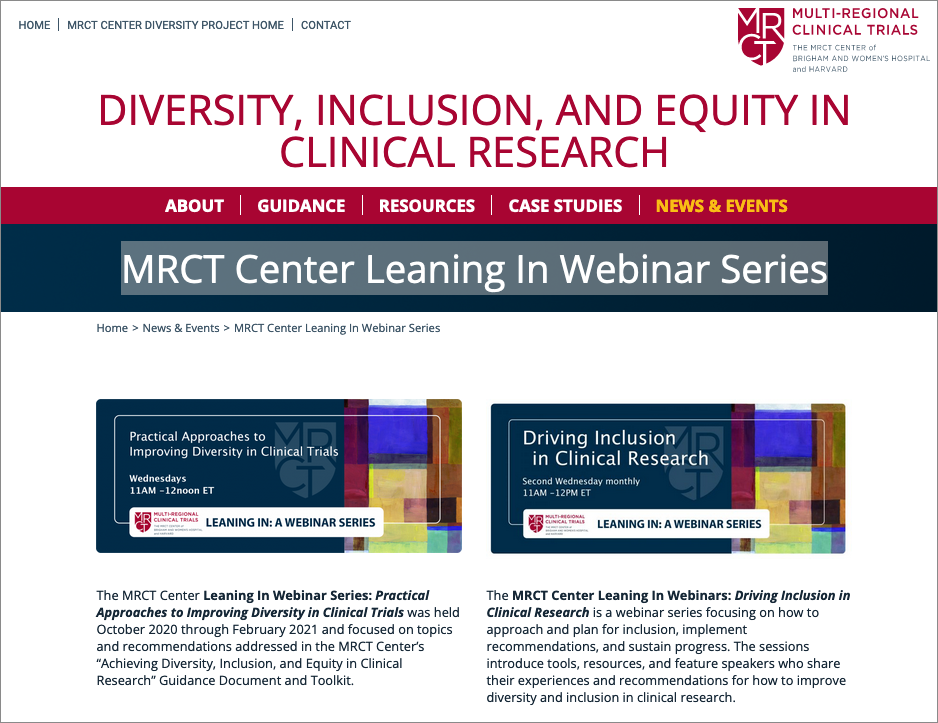
See related Webinars, maintained on our project specific Diversity, Inclusion, and Equity in Clinical Research website:
October 14, 2020: Community Awareness, Access, Knowledge
October 28, 2020: Workforce Development
November 18, 2020: Study Design, Eligibility, Site Selection, & Feasibility
December 9, 2020: Study Conduct (Recruitment, Retention)
January 13, 2021: Data Standards and Analysis
January 27, 2021: Stakeholder Roles and Responsibilities
May 12, 2021: Inducement or Fair Compensation? Impact on Diverse Participation
June 9, 2021: Improving Inclusion of Persons with Disabilities in Clinical Research
July 14, 2021: Simplifying the Complexity of Translation in Clinical Research
Presented on: October 14, 2020, 11:00 AM.-12 noon. ET.
Presented at: MRCT Center Leaning In Webinar Series
Discussion Topic: Participants in clinical research should reflect the population affected by the disease, or those intended to utilize the intervention. Early and active engagement from participants, patients, caregivers, and communities can influence and improve the design and execution of clinical research, including efforts to enhance diversity and inclusion. Further, appropriate and meaningful engagement offers opportunities for outreach to individuals and communities including those underrepresented or underserved in research, addresses priorities that are important for patients and potential participants, and to draws upon the perspectives of the very individuals for whom the research is intended.
See related Webinars, maintained on our project specific Diversity, Inclusion, and Equity in Clinical Research website:
October 14, 2020: Community Awareness, Access, Knowledge
October 28, 2020: Workforce Development
November 18, 2020: Study Design, Eligibility, Site Selection, & Feasibility
December 9, 2020: Study Conduct (Recruitment, Retention)
January 13, 2021: Data Standards and Analysis
January 27, 2021: Stakeholder Roles and Responsibilities
May 12, 2021: Inducement or Fair Compensation? Impact on Diverse Participation
June 9, 2021: Improving Inclusion of Persons with Disabilities in Clinical Research
July 14, 2021: Simplifying the Complexity of Translation in Clinical Research
Published on: October 2, 2020
Published in: Science Magazine

Presented on: September 29, 2020
Presented at: National Health Council’s annual Science of Patient Engagement Symposium (virtual)
Presented on: September 23, 2020
Presented at: September Massachusetts Consortium on Pathogen Readiness Virtual Public Briefing
Presented on: September 22, 2020
Presented at: FDA Office of Minority Health and Health Equity webinar “Achieving Diversity, Inclusion, and Equity in Clinical Research”