

Public Comments
Comments provided on: June 29, 2020
Comments provided to: Food and Drug Administration (FDA)
Comments provided on: June 29, 2020
Comments provided to: Food and Drug Administration (FDA)
Mark Barnes, MRCT Center Faculty Co-Director co-authored a special report in New England Journal of Medicine “Challenges of “Return to Work” in an Ongoing Pandemic.”
Presented on: June 18, 2020
Presented by: Barbara E. Bierer, MD
Presented at: DIA 2020 Virtual Global Annual Meeting
Presented on: June 18, 2020
Presented by: Sylvia Baedorf Kassis
Presented at: DIA 2020 Virtual Global Annual Meeting
In Science Magazine, MRCT Center Faculty Director Barbara Bierer along with her COVID-19 Collaboration Platform colleagues details the need for a home for clinical trial protocols that are available for collaboration.
“To increase the power of RCTs, we have created a pilot repository for RCT protocols led by principal investigators who are open to various levels of collaboration. On the COVID-19 Collaboration Platform (CovidCP.org), researchers can submit their draft or completed protocols and find collaborators.

Published on: January 20, 2020
Published in: Journal of Clinical Epidemiology

Presented on: April 17, 2020
Presented by: Sylvia Baedorf Kassis
Presented at: Tufts University School of Medicine Plain Language Workshop
Presented on: January 24, 2020
Presented by: Sylvia Baedorf Kassis
Presented at: CBI conference on Clinical Data Disclosure, Transparency and Plain Language Summaries
Released on: 2020
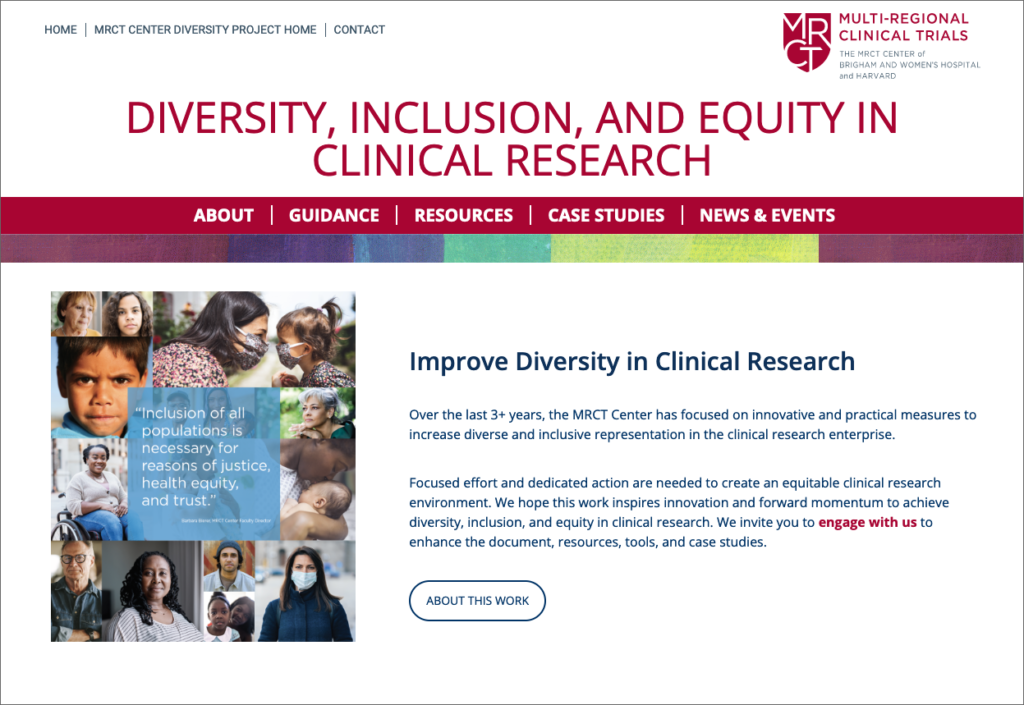
Improve Diversity in Clinical Research
Over the last 3+ years, the MRCT Center has focused on innovative and practical measures to increase diverse and inclusive representation in the clinical research enterprise.
Focused effort and dedicated action are needed to create an equitable clinical research environment. We hope this work inspires innovation and forward momentum to achieve diversity, inclusion, and equity in clinical research. We invite you to engage with us to enhance the document, resources, tools, and case studies.