

In the Spotlight
New Project: Informed Consent, Reimagined
In April 2026, the MRCT Center launched a new project, Informed Consent, Reimagined, to rethink how informed consent in clinical trials is designed, communicated, and understood. This initiative will deliver practical implementation toolkits and resources that institutions can adopt to support new, more effective consent models.
The complexity of current informed consent models limits, rather than supports, patient comprehension. Informed consent forms (ICFs) often reach dozens of pages of dense text, exceed the general reading levels of the general population, and focus on regulatory compliance and institutional liability concerns rather than on participants’ understanding of their rights and the choices before them. The complexity may also contribute to slower enrollment and lower participant retention.
Three workstreams have been initiated: (1) whether and how can one long and complex consent document can be partitioned, separating general research information from study-specific details, (2) the routine introduction of health literacy principles (e.g., plain language, multimedia formats, and AI-supported tools) with human oversight, and (3) agentic AI-enabled decision support and other participant-facing materials. The work begins in the U.S. regulatory context and will expand globally, drawing on input from patients and patient advocates, IRB members, researchers, and industry partners. An Informed Consent Steering Committee (ICSC) will be guiding the work, with an emphasis on participant understanding and regulator engagement.
Related: Barbara Bierer and Trevor Baker of the MRCT Center, with co-authors Rishabh Goel and Sammy Mustafa of Bond Health and Harvard Medical School, recently published “Large Language Models in Informed Consent” in NEJM AI, a scoping review across seven domains of the consent process.
For more information about the Informed Consent, Reimagined project, contact Blythe Chen at bgchen@bwh.harvard.edu.
Upcoming Webinar
June 16: The Clinical Research Glossary Biannual Meeting: Adoption, Implementation, and Impact
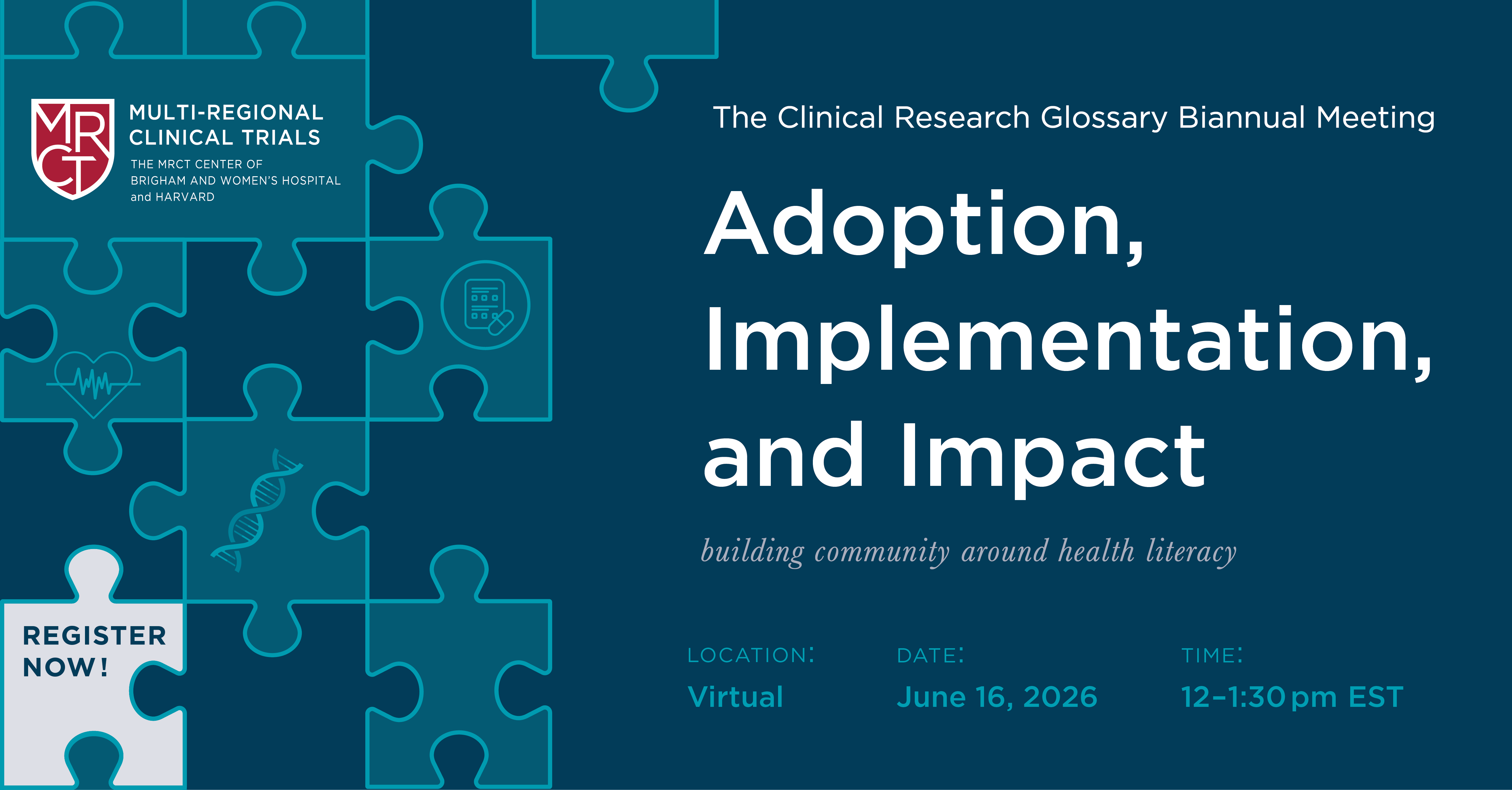
The MRCT Center Clinical Research Glossary, a CDISC global standard since 2023, offers 216 plain-language definitions for clinical research terms used across the research enterprise.
Sylvia Baedorf Kassis, Program Director for the MRCT Center’s Health Literacy portfolio, will host a conversation with Anna Subrizi, Patient Empowerment Team Lead, Bristol Myers Squibb; Sudipta Chakraborty, Health Literacy Center of Excellence, Biogen; and Bernard Coley, a patient partner who applies the glossary in his Parkinson’s disease advocacy and education work.
The panel will cover how sponsors integrate the glossary across research and development, commercial, and patient-facing functions, as well as the business case for plain language.
The MRCT Center will share a preview of the new terms heading into a 30-day public review this June. Attendees will learn what public review entails and how to submit feedback through the MRCT Center survey or the CDISC Wiki JIRA process, thereby ensuring that the glossary is a living, consensus-driven CDISC global standard.
New On-Demand Resources
Data Quality, Model Validation, and Governance for AI Digital Twins and Synthetic Data
Since 2025, the MRCT Center has been building a portfolio of content on the use of AI digital twins and synthetic data in clinical research. The work has developed sequentially, beginning with foundational taxonomy and how models are built (Webinar 1, September 2025), moving to practical use cases and real-world deployments such as reducing control arm size and supporting single-arm trials (Webinar 2, November 2025), and progressing to the use of these technologies in evidence generation (Webinar 3, March 2026). The fourth installment (Webinar 4, May 2026), now available on demand, turns to the question of trust: how the credibility, validation, and governance of these models can be established for clinical and regulatory use.
“Data Quality, Model Validation, and Governance for AI Digital Twins and Synthetic Data” focused on data provenance and quality (e.g., are the data reliable and traceable), model validation (e.g., are the outputs verifiable for decision-making), and the emerging infrastructure needed to support clinical and regulatory adoption of these technologies. Moderated by Barbara Bierer, panelists Daniele Bertolini, Principal Machine Learning Scientist, Unlearn.AI; Tina Morrison, VP of Scientific Strategy, EQTY Lab; and Chao-Yi Wu, Assistant Professor of Neurology at Massachusetts General Hospital explored what it means for a model to be “fit for purpose,” how definitional differences among these technologies shape regulatory review, and how clinicians, sponsors, reviewers, and regulators may use, interpret, and deploy these tools.
The series sits within the MRCT Center’s broader, deepening body of work on AI and clinical research, which includes (1) the Framework for Review of Clinical Research Involving Artificial Intelligence developed with WCG Clinical, (2) a current 2026 initiative mapping the use of AI across the administration of research (from protocol development and trial modeling to site selection, recruitment, data management, and analysis), and (3) continuing engagement with the ethical and regulatory questions these technologies raise. Together, this work is intended as a durable, content-rich resource for the field as it evolves.
Access the recording and slides here.
Clinical Research Competencies to Support Effective Patient Partner Engagement
For more than a decade, the MRCT Center has hosted the Joint Task Force for Clinical Trial Competency (JTF), an international team of investigators, educators, and clinical research professionals that developed and maintains a framework defining the knowledge, skills, and attitudes required for safe, ethical, and high-quality clinical research. The JTF Framework is currently available in thirteen languages. To maintain currency and relevance, the JTF has developed competencies focused on patient partner engagement across the planning, conduct, analysis, and dissemination of clinical research. On May 7, the MRCT Center, in collaboration with CANTRAIN and EUPATI, presented a webinar, now available on demand, to share progress from that work. As the presenters explained, the proposed competencies are both practical and inspirational: a blueprint for building more skilled, inclusive, and equitable research teams that operationalize patient partnership as a core workforce capability and expectation.
In parallel, the JTF has updated the data management competencies (Domain 6 of the JTF Framework), targeted for release later this year. Both proposed updates will be the focus of the next JTF Biannual Global Meeting on June 22, from 9:00 to 11:00 AM ET, which will present the revisions, invite discussion with current users of the JTF Framework, and gather input on any further updates needed in anticipation of integration into JTF Version 4.0. Together, these activities continue the MRCT Center’s broader commitment to advancing workforce capability as the conditions, technologies, and expectations of clinical research evolve. The meeting is free and open to all registrants.
Access the webinar recording and slides here.
Register for the June 22 meeting here.
Good Clinical Practice in Practice: Implementing ICH E6(R3)

On May 22, in recognition of Clinical Trials Week, MRCT Center Executive Director Sarah White convened the ICH E6(R3) Expert Working Group’s regulator and industry topic leads, Cheryl Grandinetti, U.S. FDA; David Nickerson, EMD Serono and PhRMA ; and Rebecca Stanbrook, RESaltas GmbH and EFPIA , for “Good Clinical Practice in Practice: Implementing ICH E6(R3).” The panel walked through the guideline’s foundational concepts (Quality by Design, Quality Management, Critical to Quality Factors, and risk proportionality), grounded those concepts in a working case example using Risk-Based Quality Management principles, and discussed the practical challenges teams are encountering as they translate ICH E6(R3) into protocols, processes, and day-to-day oversight. The recording and slides are available here.
The webinar is part of the MRCT Center’s broader work as the training partner for the revised ICH E6(R3) Good Clinical Practice guideline. In collaboration with the ICH E6(R3) Expert Working Group, the MRCT Center has been developing a five-module course to help sponsors, investigators, and trial teams put the modernized guideline into practice. Module 1 (Introduction and Foundational Concepts) launched in October 2025, and Module 4 (Informed Consent) followed in January 2026. Module 3 (Data Governance) and Module 5 (Essential Records) are scheduled for release this summer, with Module 2 (Responsibilities and Oversight) to follow. The full course is available through the MRCT Center training library and the ICH Training Library.
Publications
May 12: Barbara Bierer and Trevor Baker of the MRCT Center, with co-authors Rishabh Goel and Sammy Mustafa of Bond Health and Harvard Medical School’s Department of Biomedical Informatics, published “Large Language Models in Informed Consent — Opportunities, Evidence, and Challenges” in NEJM AI. Informed consent forms remain lengthy, cognitively demanding, and written at a level beyond most participants’ reading level, contributing to gaps in perceived understanding and recall of key study elements. This narrative review maps the emerging landscape of LLM applications for informed consent across seven domains: glossary generation, plain language rewriting, visual aid generation, accessibility and document formatting, translation, teach-back and comprehension assessment, and chatbot-assisted consent. For each domain, the authors synthesize the available evidence, surface principal failure modes such as hallucination, omission, and demographic bias, and outline mitigation strategies and considerations for integration with research ethics committee review.
Events & Presentations
May 7: The MRCT Center, CANTRAIN, and EUPATI hosted a webinar, Clinical Research Competencies to Support Effective Patient Partner Engagement, to present the results of an effort to integrate patient partnership into the existing Joint Task Force (JTF) Framework for Clinical Trial Competency. The recording, slides, and related resources are now available on demand. (See Spotlight above)
May 18: The MRCT Center hosted the fourth webinar in the MRCT Center’s AI Digital Twins and Synthetic Data series, Data Quality, Model Validation, and Governance for AI Digital Twins and Synthetic Data. This webinar focused on data provenance and quality, model validation, and the emerging infrastructure needed to support the clinical and regulatory adoption of these technologies. The recording, slides, and related resources are now available on demand. (See Spotlight above)
May 19: Willyanne DeCormier Plosky presented at the Arc of Pennsylvania Disability Health Action Network meeting to share the work that the MRCT Center has been doing on inclusion of people with disabilities in clinical research.
May 21: Barbara Bierer co-presented “When Studies End Early: Ethical Communication, Participant Trust, and the HRPP’s Role” and “AAHRPP at 25” at the 2026 Annual AAHRPP Conference in Detroit, MI.
May 22: In recognition of Clinical Trials Week, the MRCT Center hosted Good Clinical Practice in Practice: Implementing ICH E6(R3), a panel discussion with regulator and industry topic leads from the ICH E6(R3) Expert Working Group on translating the modernized guideline into protocols, processes, and day-to-day oversight. The recording, slides, and related resources are now available on demand. (See Spotlight above.)
June 1-2: Barbara Bierer will participate virtually in the third Open Expert Meeting on the Revision of the WMA Declaration of Taipei (DoT) on Ethical Considerations regarding Health Databases and Biobanks, focused on Equity, Global Challenges, and Ethical Considerations, held in Vatican City.
June 1-4: Sarah White and Willyanne DeCormier Plosky will attend the TRACE Project in-person meetings in Harare, Zimbabwe, to review progress and chart the path forward. The TRACE Project (Trial Regulation and Clinical Ethics Optimization) is a multi-country initiative launched in 2025 to strengthen and harmonize clinical trial ethics and regulatory oversight across African countries, beginning with Kenya, Nigeria, Rwanda, Tanzania, and Zimbabwe. The MRCT Center, a core TRACE partner, is leading the capacity building, ethics committee registration and accreditation, ethics reliance frameworks, and sustainable financing mechanisms for national ethics committee and IRB workstreams.
June 4: Meeting of the Bioethics Collaborative. Topic: Digital Doppelgängers: Ethics of Digital Twins and Synthetic Data. For more information about the Bioethics Collaborative and how to join this ongoing forum, click here.
June 4-5: Sylvia Baedorf Kassis will be giving a plenary lecture and participating in panel discussions at the FACILITATE final meeting in Modena, Italy.
June 5: The MRCT Center and Vivli co-host an ongoing, invitation-only forum examining developments related to the European Health Data Space (EHDS). This seventh session will continue discussions with stakeholders engaged in advancing and coordinating work efforts, including consideration of the TEHDAS2 guidance documents. A third round of public consultations remains open through June 28. The forum will continue efforts to guide policy development toward a harmonized, practical data-sharing system for secondary use purposes.
June 8: Meeting of the Research, Development, and Regulatory Roundtable (R3). Topics: Use of AI in Clinical Trials – Exploration of Key Legal and Regulatory Issues – Part 2. This meeting is open to sponsors of the Research, Development, and Regulatory Roundtable (R3). For more information about this ongoing forum and how to join, click here.
June 11: Sarah White will join MRCT Center Executive or Steering Committee representatives Benjamin Rotz (Eli Lilly), Crispin Woolston (Sanofi), and Karla Childers (Johnson & Johnson) on a panel focused on post-trial continued access at the 2026 World Orphan Drug Congress in Boston.
June 15: Sarah White will speak at the DIA Global Annual Meeting in Philadelphia: “Enabling Faster Multi-Regional Study Start-Up Through Regulatory Reliance and Harmonization,” examining how regulatory reliance and harmonization—guided by ICH E17 and E5—can streamline global development.
June 16, 12:00 – 1:30 PM ET: The Clinical Research Glossary Biannual Meeting: Adoption, Implementation, and Impact. (See Spotlight above) Register here.
June 17: Carolyn Chapman will join co-panelists Alen Agaronov of NYU Grossman School of Medicine, Pat Furlong of Parent Project Muscular Dystrophy (PPMD), and Dennis Akkaya of My Tomorrows at the DIA 2026 Global Annual Meeting in Philadelphia in the session, “Who Owns Long-Term Follow-Up? Addressing Stakeholder Gaps in Gene Therapy Evidence Generation.”June 22, 9:00 – 11:00 AM ET: Join us for the Joint Task Force for Clinical Trial Competency (JTF) Biannual Global Meeting. This meeting will focus on two recent proposed revisions to the JTF Framework: the JTF-Patient Partner Project and an update to Domain 6. We will hear about the proposed updates, discuss them with users of the JTF Framework, and gather input on any further updates needed.
New MRCT Center Sponsors
The MRCT Center is delighted to welcome the following new sponsors:
Regeneron joined the MRCT Center Steering Committee.
MyTomorrows and AbbVie joined the Bioethics Collaborative.
Regeneron is a leading biotechnology company that invents, develops, and commercializes life-transforming medicines for people with serious diseases. To learn more, click here.
MyTomorrows connects patients, physicians, trial sites and BioPharma, supporting straightforward and transparent access to drugs and development worldwide. To learn more, click here.
AbbVie discovers and delivers innovative medicines and solutions that address complex health issues and enhance people’s lives. To learn more, click here.
The MRCT Center provides a unique and trusting community to improve the integrity, safety, and rigor of global clinical trials. Join us in our efforts to develop innovative solutions and aligned approaches to global clinical research.
Learn more about becoming an MRCT Center sponsor.