

In the Spotlight
New Toolkit for Long-Term Follow-Up
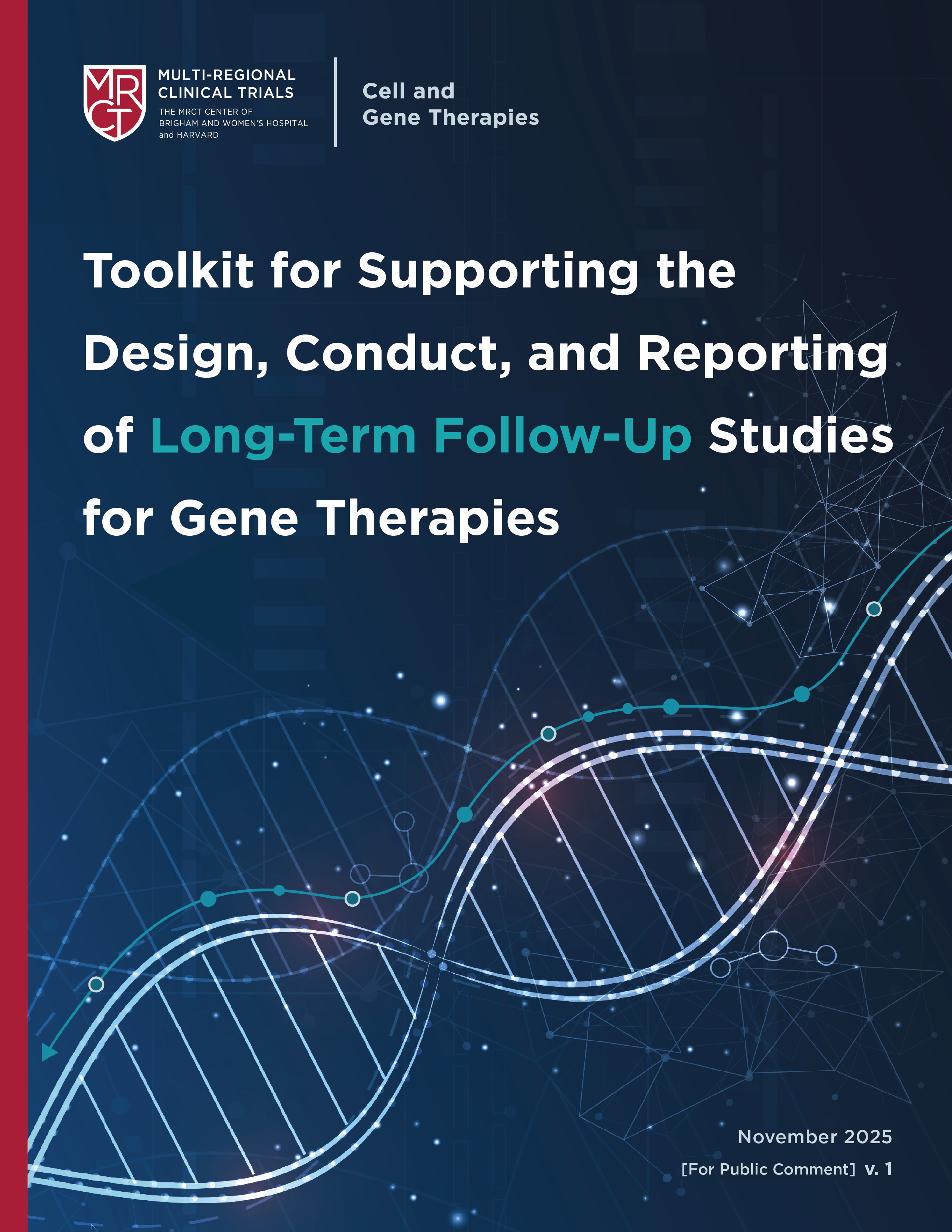
In early November, the MRCT Center released the Toolkit for Supporting the Design, Conduct, and Reporting of Long-Term Follow-Up Studies as a draft for public comment. The resource offers practical, actionable guidance for best practices across long-term follow-up (LTFU) studies for both investigational and approved gene therapies, balancing the need to generate essential long-term safety and efficacy data with the obligation to reduce burden on participants, caregivers, sponsors, and investigators. Its interactive structure—with clickable toolbars, intuitive navigation, and clearly organized sections spanning Guiding Principles, Types of LTFU Studies, Considerations and Recommendations, Key Design Elements for FDA-approved products, regulatory references, glossaries, and appendices—helps users move quickly from concept to implementation.
Stakeholders have emphasized the value of the toolkit’s pragmatic approach. They highlighted its emphasis on engaging patients as partners and ambassadors; applying the Goldilocks principle to right-size expectations; embedding patient-centricity into every stage; and using decentralized approaches when appropriate. They also praised its attention to adaptability, recognizing that program adjustments over time are expected, and its thoughtful integration of real-world data. Importantly, the toolkit encourages teams to consider not only disease-specific factors but also the needs and contexts of patient communities, families, advocacy groups, and global treatment environments.
The Toolkit remains open for public comment. Please share your feedback by Friday, December 19, by emailing us at mrct@bwh.harvard.edu
Explore the Toolkit for Supporting the Design, Conduct, and Reporting of Long-Term Follow-Up Studies and watch the on-demand toolkit release webinar.
EC/IRB Guide to Understanding Post-Trial Continued Access
In early November, the MRCT Center released the EC/IRB Guide for Understanding Post-Trial Continued Access, which aims to assist Ethics Committees (EC) and Institutional Review Boards (IRB) in interpreting their role under Paragraph 34 of the Declaration of Helsinki. Paragraph 34 requires sponsors and researchers to arrange post-trial provisions for “participants who still need an intervention identified as beneficial and reasonably safe.” Exceptions to this must be approved by an EC or IRB, necessitating an understanding of when post-trial, continued access is applicable.
This resource outlines principles and criteria for evaluating when continued access is appropriate. It provides tools and questions to guide equitable decisions, ensuring ethical and transparent approaches to post-trial, continued access decisions. Additional resources and frameworks are available through the MRCT Center’s Post-Trial Responsibilities: Continued Access project page to support ethics committees.
Implementing the MRCT Center’s Clinical Research Glossary
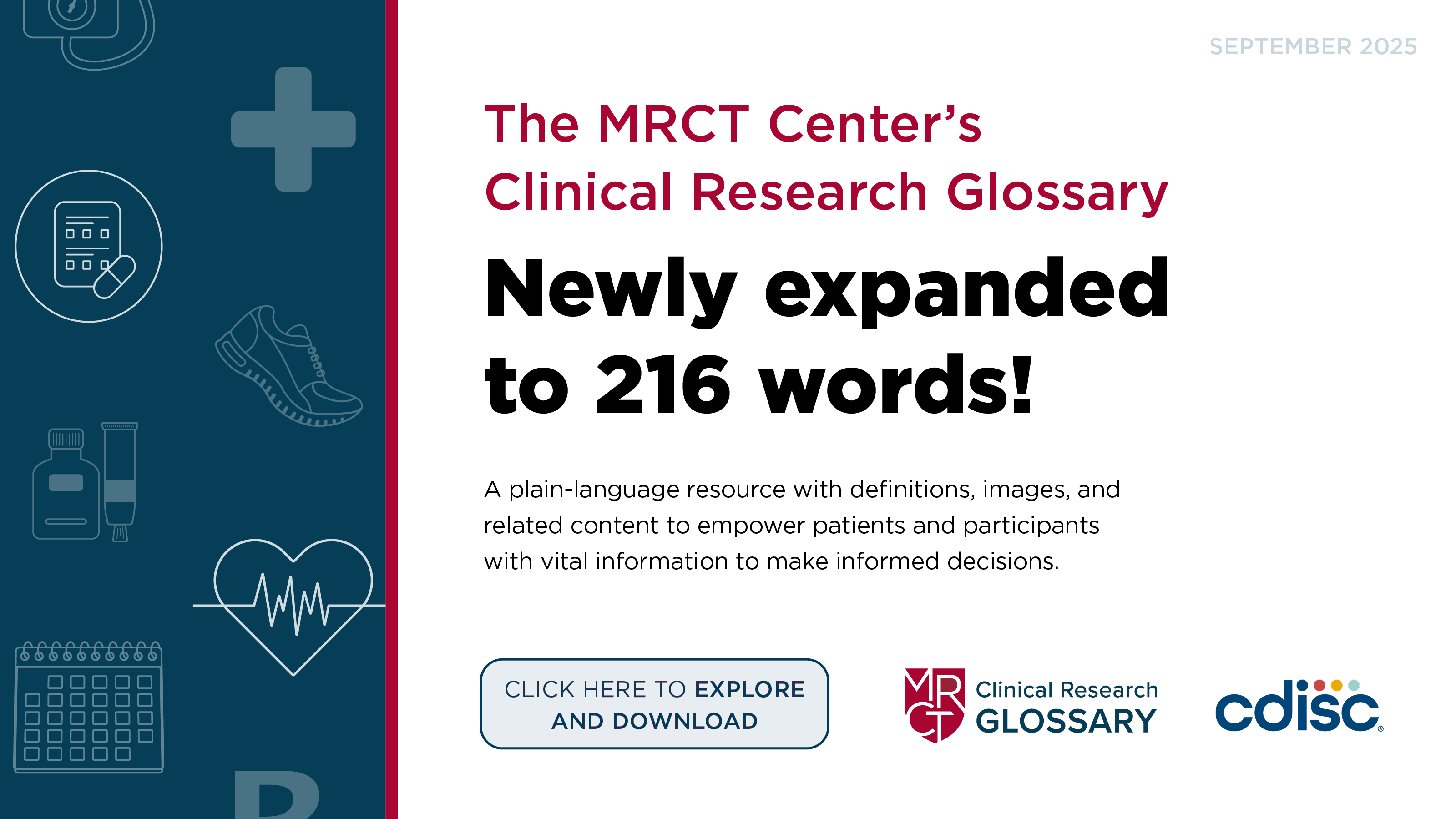
Many organizations are integrating the MRCT Center’s Clinical Research Glossary into their workflows, demonstrating its practical value in improving communication and participant understanding. Across seven published use cases, including two new ones from Pfizer and Biogen, learn more about how the glossary’s 216 plain-language terms, definitions, images, and linked resources are being used to strengthen patient-facing materials, support health-literacy training, and align technical content with global data standards.
These real-world examples underscore the glossary’s impact: clearer explanations, greater confidence among participants and caregivers, and more consistent communication across research teams.
As the glossary continues to grow through annual public review, we invite you to consider how a shared, plain-language vocabulary can advance informed decision-making and more equitable engagement in clinical research. To learn more about the Clinical Research Glossary, get involved, or submit your own use case, please click here.
Upcoming Webinars and Forums
Mitigating Financial Toxicity for Participants in Clinical Trials
Tuesday, December 9 | 10:00–11:00 AM ET
Hosted by the MRCT Center, in collaboration with Equitable Access to Clinical Trials (EACT), a project convened by LUNGevity Foundation.
Clinical trials are vital to advancing medical knowledge and care, yet participation can impose significant financial burdens on participants and their families—from travel and time away from work to uncovered medical and ancillary expenses.
This webinar will examine the sources and impact of these costs and highlight emerging strategies to reduce financial hardship for research volunteers. Presenters will also introduce tools, checklists, and other resources developed through the EACT Project, a collaborative forum advancing financial neutrality in clinical research participation.
Panelists
- Dr. David Gerber, Co-Director, Simmons Comprehensive Cancer Center Office of Education and Training; Professor, University of Texas Southwestern Medical Center
- Wendy K.D. Selig, Founder and CEO, WSCollaborative
Moderator
Dr. Barbara Bierer, Faculty Director, MRCT Center
Joint Task Force for Clinical Trial Competency (JTF): December Biannual Global Meeting
December 10, 1:00 pm – 3:00 pm
The Joint Task Force for Clinical Trial Competency (JTF), anchored at the MRCT Center, develops and disseminates standards and practices for the global clinical research workforce. By fostering a cohesive and collaborative approach, the JTF ensures that professionals have the competencies—the knowledge, skills, and attitudes—needed to conduct safe, ethical, high-quality clinical research.
Join us on December 10, from 1:00–3:00 PM ET, for the JTF Biannual Global Meeting to learn from colleagues around the world who are implementing the JTF Framework in diverse contexts. Presentations will highlight how the Urdu translation of the Framework is advancing clinical research competencies in Pakistan; how professional standards and recognition are being strengthened for Australian clinical trials professionals; and how workforce development is being supported across New Zealand public hospitals. Speakers will also share approaches to designing experiential learning with a focus on JTF competencies at North Carolina Central University, as well as efforts to integrate the Framework into a master’s-level clinical data science training program.
Deploying Digital Twins and Synthetic Data in Evidence Generation
Thursday, January 15, 11:00 AM to 12:00 PM ET.
Please join us on Thursday, January 15, for the third webinar in the MRCT Center’s Digital Twins and Synthetic Data series. This session will examine the appropriate use of digital twins and synthetic data in evidence generation, including their potential role in regulatory submissions.
Panelists will discuss evidence quality, validation, and model transparency, and will reflect on the evolving regulatory landscape for these technologies in clinical research. The session will include a moderated discussion and time for audience Q&A.
Events & Presentations
November 4: Long-Term Follow-Up for Gene Therapies: Toolkit Release webinar. Resources from this webinar, including the Toolkit for Supporting the Design, Conduct, and Reporting of Long-Term Follow-Up Studies, the recording, slides and related resources, are now available on-demand here.
November 4: The MRCT Center and Vivli co-host an ongoing, invitation-only forum focused on the European Health Data Space (EHDS). The discussion continues with stakeholders collaborating on developments and the coordination of work efforts. The November forum, the fifth to date, focused on responses to the TEHDAS2 guidance documents in the form of public consultation in key identified areas, and continued our efforts to guide policy development towards a harmonized data sharing system for secondary use purposes.
November 7-8: The MRCT Center at the PRIM&R 2025 Conference:
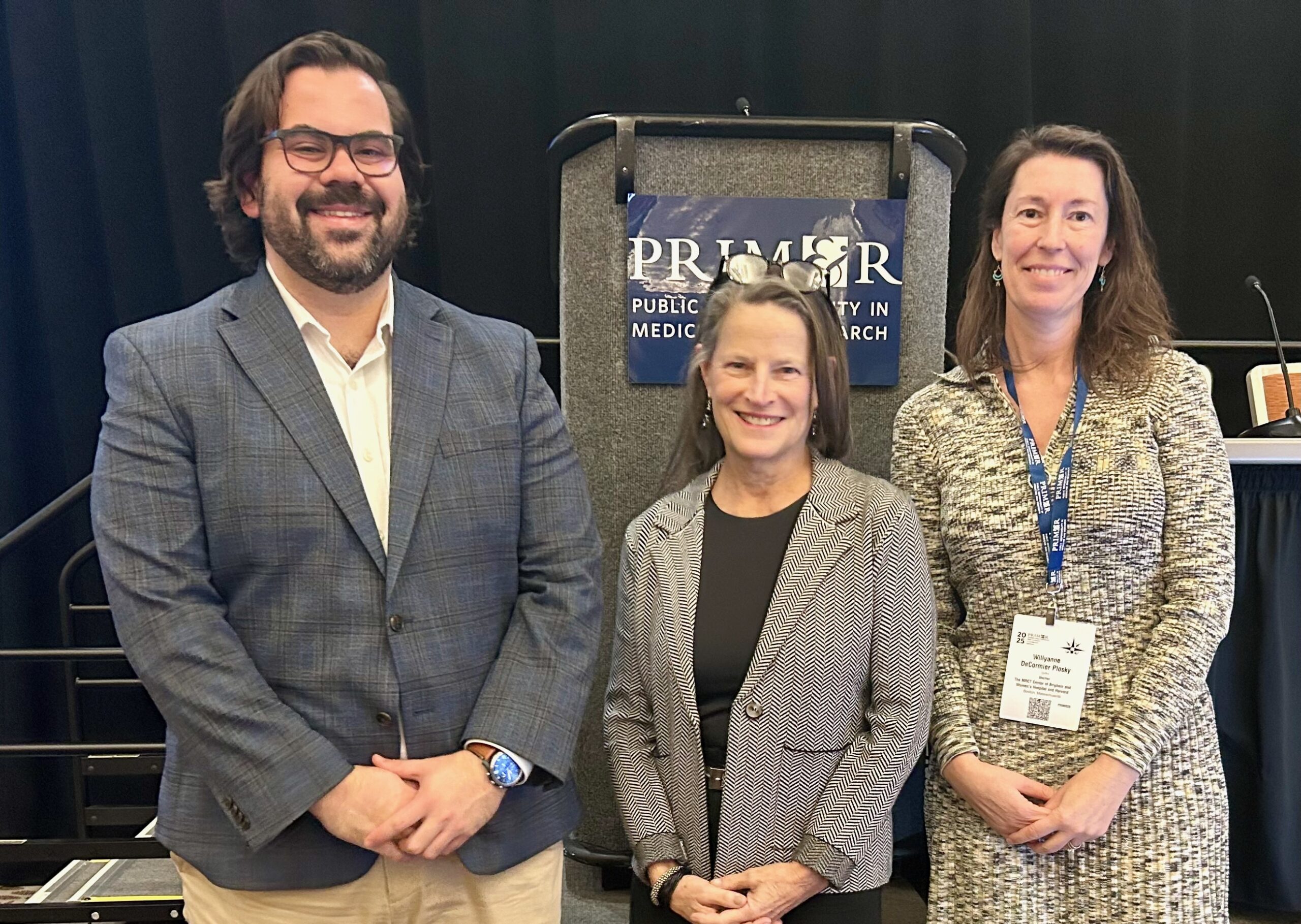
- November 7, 10:30 – 11:45 AM ET: Barbara Bierer and Trevor Baker joined WCG collaborator Donna Synder, Tamiko Eto of Center for AI & Digital Policy (CAIDP), and David Clifford to present “Collaborative Project on Artificial Intelligence (AI) Regulatory and Ethical Review: Insights, Challenges, and Practical Tools.”
- November 8, 12:30 – 1:30 PM ET: Barbara Bierer contributed to a roundtable discussion with Luke Gelinas of Advarra, and Benjamin Silverman and Martha Jones of Mass General Brigham, “Should we still be using Unconsented Biospecimens for Research in 2025?”
- November 8, 12:30 – 1:30 PM ET: Barbara Bierer joined Polly Goodman and Jeremy Lavigne of Harvard University to present “Everything you wanted to know about SMART IRB Agreement Version 3.0.”
- November 8, 12:30 – 1:30 PM ET: Willyanne DeCormier Plosky joined Tiffany Chenneville of the University of South Florida to present “Science Under Siege: Defending Scientific Integrity in a Polarized World.”
November 14: Sylvia Baedorf Kassis was a speaker at the International Society for Medical Publication Professionals (ISMPP) Academy. She co-led interactive sessions on Mastering Plain Language Summaries (PLS) and Plain Language Summaries of Publications (PLSP): Bridging Foundations and Applications.
November 17 and 19: Barbara Bierer conducted a 2-day, 6-hour virtual training with medical professionals from St. Luke’s Medical Center of the Philippines to introduce participants to the purpose and functioning of Data Safety Monitoring Committees (DSMCs). On the second day of the virtual training, Steven Snapinn, Ph.D., presented on biostatistical considerations for DSMC, a discussion moderated by Dr. Bierer.
November 18: AI Digital Twins and Synthetic Data: Practical Use Cases for Clinical Research. This webinar, the second in this series, focused on real-world examples and lessons learned from deploying synthetic data and digital twins across therapeutic areas. Resources, including the recording, slides, and related resources, are now available on-demand here.
November 18: Carolyn Riley Chapman presented an overview of the MRCT Center’s Toolkit for Supporting the Design, Conduct, and Reporting of Long-Term Follow-Up Studies for Gene Therapies at the WCG-hosted webinar Beyond the Trial: Ethical Oversight in Gene Therapy Long-Term Follow-Up.
November 19: Barbara Bierer addressed “Resources for PI oversight in decentralized clinical trials” at the Innovation Evidence Workshop, a full-day meeting in Boston, presented by Medable in collaboration with Tufts Center for the Study of Drug Development at Tufts University School of Medicine.
December 8, 10:00 AM – 12:30 PM: Meeting of the Bioethics Collaborative. Topic: How Much Risk is Too Much? Revisiting the Ethics of Control Arms. For more information about the Bioethics Collaborative and how to join, click here.
December 10, 1:00 – 3:00 PM ET: Joint Task Force for Clinical Trial Competency (JTF): December Biannual Global Meeting. See Spotlight above.
December 15-18: Dr. Barbara Bierer and Sarah White will be visiting Kenya as the fifth country in the TRACE project. Their itinerary includes meetings with the TRACE leadership team and key stakeholders within Kenya, including KEMRI, NACOSTI, PPB, and Moi University’s IRB. This baseline assessment will focus on regulatory and ethics systems coordination and optimization, capacity buildng and training needs, as well as an introduction to the WHO Ethics Benchmarking tool and financial sustainability models.
January 15, 11:00 AM – 12:00 PM ET: Deploying Digital Twins and Synthetic Data in Evidence Generation. See Spotlight above for details.
January 24: Carolyn Riley Chapman will co-lead a workshop on “What’s Special about Expanded Access for Gene and Cell Therapies?” at CUPACon26, NYU Langone Health’s Working Group on Compassionate Use & Preapproval Access (CUPA)’s biannual conference, hosted this year by Boston University School of Law. This workshop will be led in collaboration with Dr. Emma James of Encoded Therapeutics.
January 29: Meeting of the Research, Development, and Regulatory Roundtable (R3). Topics: The HALT Fentanyl Act and its effects on research involving controlled substances; Declaration of Taipei. This meeting is open to sponsors of the Research, Development, and Regulatory Roundtable (R3). For more information about this ongoing forum and how to join, click here.
Publications
November 14: Carolyn Chapman, Mena Shaikh, Ava Glazier, Andrew Creamer, and Barbara Bierer published Ethical, Legal, and Social Issues (ELSI) in Human Somatic Gene Therapy Clinical Research: A Scoping Review in Human Gene Therapy. Dozens of gene therapies have been approved, and hundreds more are in development, prompting the need to better characterize the ethical, legal, and social implications (ELSI) of this emerging therapeutic class. The authors conducted a scoping review to map these issues across the literature, identifying themes related to risk–benefit assessment, engagement and communication, justice and access, ethical trial design, and the influence of financial and regulatory decision-making. The article also discusses potential approaches to address these ELSI as gene-therapy research expands.
MRCT Center Updates

Nandini Krishnamoorthy joined the MRCT Center as a Student Researcher in November 2025. Nandini will be providing support to various projects at the Center.
Nandini is a senior at Tufts University, studying Community Health. Across academic and professional experiences spanning clinical, academic, and community-based settings, Nandini has worked toward a commitment to advancing health equity at the intersection of clinical medicine, global health, and community-based research.
The MRCT Center provides a unique and trusting community to improve the integrity, safety, and rigor of global clinical trials. Join us in our efforts to develop innovative solutions and aligned approaches to global clinical research.
Learn more about becoming an MRCT Center sponsor.