

Save the Date: MRCT Center 2026 Annual Symposium
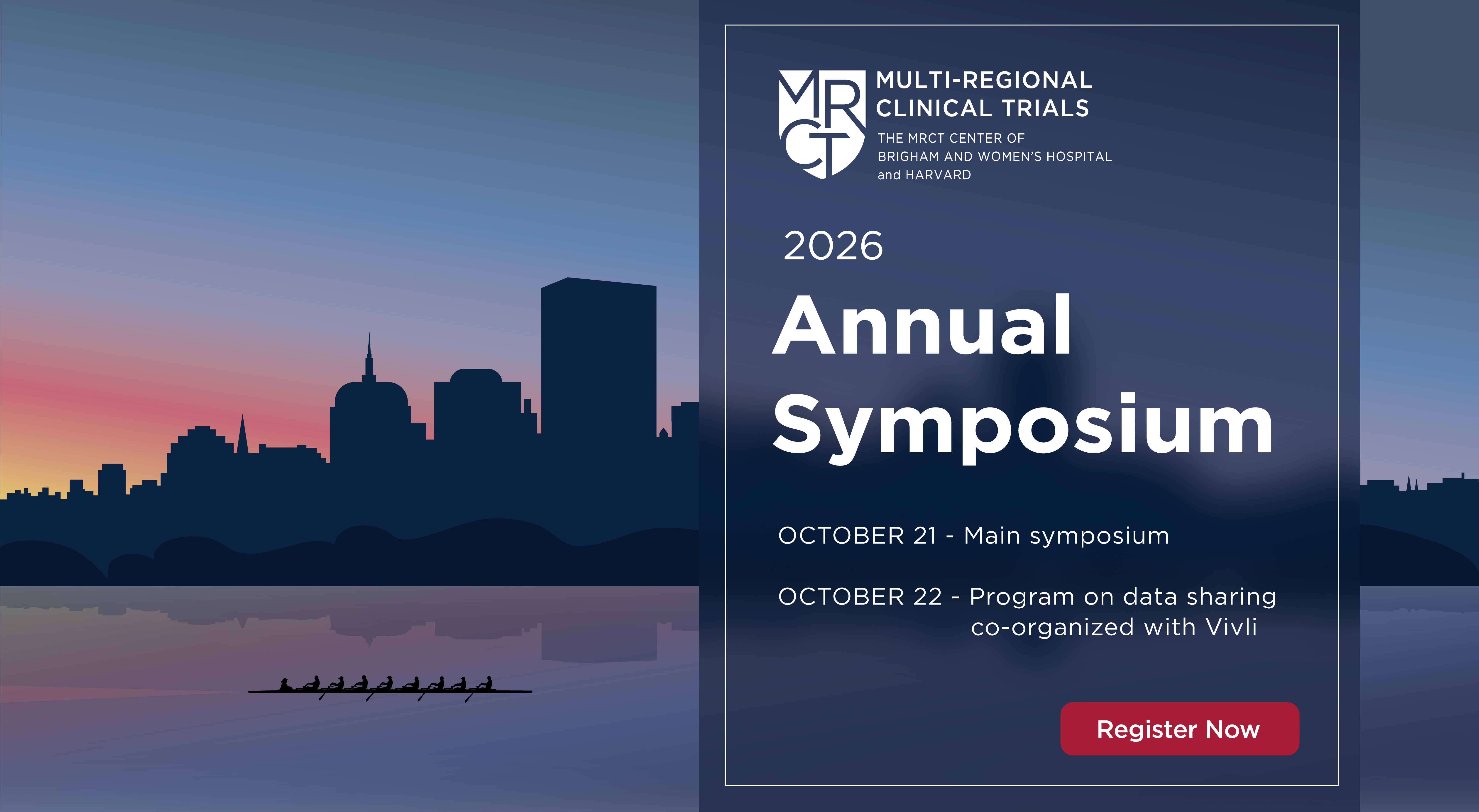
The MRCT Center 2026 Annual Symposium will be held on Wednesday, October 21, at the offices of Ropes & Gray. Join us for a full day of discussions and presentations on ethical, actionable, and practical solutions to today’s global clinical research challenges.
We look forward to announcing our fantastic keynote speaker in the next couple of weeks. Following the keynote address, Wednesday’s panels include:
- Response to the Keynote: Ideation to Implementation – at Scale
- Returning Summary Results to Participants: Lessons from the EU and UK Experience: Optimizing for US Application
- Post-Trial Obligations: An integrated decision model for global clinical trial placement
- MRCT Center Updates: Select initiatives from across our portfolio
On Thursday, October 22, the MRCT Center leads a day dedicated to data sharing, co-organized with Vivli.
The symposium is hybrid, in person in Boston and online, and it is free and open to all. Registration is now open. Attend one day or both, in person or virtually. Speakers and the full agenda will be announced in the coming weeks.
Upcoming Webinars
Just in Time: Responding to the NIH Draft Policy for Sharing Summary Level Study Results
Thursday, September 3, 1:00 to 2:00 PM ET
In response to the August 27 release of the NIH Draft Policy for Sharing Summary Level Study Results with Clinical Research Participants for public comment, MRCT Center Faculty Director Barbara Bierer will present the current landscape, the draft policy, considerations for institutional implementation, and open questions to which the community should respond. Dr. Bierer will share the MRCT Center’s perspectives and invite comments from others. (see below)
Returning summary-level results to participants and the public is foundational to transparency, trustworthiness, and patient-centeredness in clinical research. When finalized, the draft policy will ensure that participants in NIH-funded clinical research receive the results of the studies in which they participate. The MRCT Center applauds the NIH for advancing this work and for our opportunity to partner in it. The draft builds on the April 27 public listening session, “Your Voice Matters: Help Shape a New NIH Policy on Summary Level Study Results,” co-hosted by the MRCT Center and the NIH Office of Science Policy. Comments, submitted through the NIH online comment form, are due October 26, 2026. Broad input is essential: the MRCT Center will submit comments by that date, and we encourage every member of the community to do the same.
Childhood Cancer Academic-Industry Collaborative Platform Trials (C3PT): Toolkit Launch Webinar
Tuesday, September 22, 2026, 10:00 to 11:00 AM ET
This webinar will explore key challenges, opportunities, and best practices for successful partnerships between academia and the pharmaceutical industry to design and deliver platform trials for children and adolescents with cancer.
The MRCT Center, in partnership with ITCC (Innovative Therapies for Children and Adolescents with Cancer), Blood Cancer United, and the Children’s Oncology Group, will release a framework for those planning and delivering platform trials for pediatric oncology. This framework will include a position narrative and the Childhood Cancer Academic-Industry Collaborative Platform Trials (C3PT) Toolkit. The C3PT Toolkit helps users put the framework into practice, with topics such as: assessing whether a platform trial is the appropriate study design; timing of the sponsor and regulatory interactions; academic and industry collaboration models; meaningful patient advocate engagement; intellectual property and contracting considerations; and operational planning and funding approaches.
The C3PT toolkit builds on the outputs of the “Advancing Pediatric Platform Trials: Streamlining Development, Maximizing Impact” workshop and a follow-up Pediatric Oncology Workshop in July 2025, both multi-organizational, collaborative efforts.
The webinar will include opening remarks, a moderated multi-stakeholder discussion, and time for audience Q&A.
Implementing ICH E6(R3): Practical Risk-Proportionate Strategies for IRBs, Investigators, and Study Teams (co-presented with PRIM&R)
Wednesday, September 23, 1:00 to 2:00 PM ET
The MRCT Center is co-presenting a PRIM&R webinar on putting ICH E6(R3) into practice, and CIP credits are available. E6(R3) was adopted in January 2025 (Principles and Annex 1) and June 2026 (Annex 2). Quality by design, fit-for-purpose, risk proportionality, and essentiality of a record are now everyday vocabulary. What does that mean for IRBs, Investigators, and research teams? How do IRBs approach protocol review with a risk-proportionate lens? How do Investigators exercise appropriate oversight of research and determine which essential records should be maintained on file? David Nickerson, Head of Clinical Quality Management at EMD Serono and PhRMA Topic Lead for ICH E6(R3); Rebecca Stanbrook, Consultant at RESaltas GmbH, EFPIA Topic Lead for ICH E6(R3),; and Benjamin C. Silverman, MD, Senior IRB Chair in Human Research Affairs at Mass General Brigham, will lead the panel, moderated by Sarah White, MRCT Center Executive Director.
Related
- Good Clinical Practice in Practice: Implementing ICH E6(R3). In this May 22 webinar, Sarah White moderated a discussion with Cheryl Grandinetti (U.S. FDA), David Nickerson (EMD Serono, PhRMA), and Rebecca Stanbrook (RESaltas GmbH, EFPIA) that covered the guideline’s foundational concepts including Quality by Design, Quality Management, Critical to Quality Factors, and risk proportionality.
- Two modules of the ICH E6(R3) course, Introduction and Foundational Concepts and Informed Consent, are available now in the MRCT Center training library, with three additional modules planned for release before the end of this year.
Proportionate Oversight in Decentralized Trials: New Resources and Practical Tools
Thursday, September 24, 12:00 – 1:00 PM ET
As data capture and trial activities move outside the traditional site, the obligations of the investigator change: how does the investigator exercise oversight over people, such as a home health nurse, a local healthcare provider, or a service provider, remotely? The MRCT Center and Medable, with input from the Investigator Oversight in DCT task force, developed four complementary resources to operationalize remote oversight: Optimizing Decentralized Elements in Clinical Trials (DCTs), the sponsor’s design tool for deciding which activities move off site; the Proportionate Oversight Framework for Clinical Trials with Decentralized Elements, which turns those decisions into an oversight plan calibrated to risk; a model HCP Instruction Sheet, to be completed by both the sponsor and the investigator so local providers know what is being asked of them; and the HCP Check-In Questions for Participants, a consistent approach to participant assessment for HCPs.
The webinar will showcase all four resources and their interrelationship. The project builds on the MRCT Center and Medable’s IRB/EC Considerations for DCT Review.
More Drugs, Faster: Can Clinical Development Keep Up? (hosted by Unlearn)
Monday, September 28, 11:00 AM ET / 8:00 AM PT
MRCT Center Faculty Director Barbara Bierer will join the panel, alongside Jon Walsh (Co-Founder and Chief Scientific Officer, Unlearn) and Tala Fakhouri (Chief AI and Regulatory Strategy Officer, Parexel, previously Associate Director for Data Science and AI Policy at FDA/CDER). As described by Unlearn.AI:
Drug discovery is about to get much faster. In his essay “Policy on the AI Exponential,” Dario Amodei argues that AI will generate more drug candidates, more quickly, than the system built to test and approve them was ever designed to handle. If that’s right, the binding constraint in drug development moves downstream: from discovery to how quickly, and how credibly, trials can be run and reviewed.
A 45-minute moderated conversation will be followed by 15 minutes of live audience Q&A.
Related, on-demand: Daniele Bertolini of Unlearn was a panelist in all four sessions of the MRCT Center’s AI Digital Twins and Synthetic Data series, each moderated by Barbara Bierer, and Tala Fakhouri joined the March 2026 session.
All sessions, including A Framework for AI Adoption and Oversight in Clinical Research, are in the MRCT Center AI webinar library.

Returning Summary Results to Participants: Lessons from the Research Community
Tuesday, October 27, 12-1 PM ET
Celebrating Health Literacy Month, this webinar will focus on returning summary study results to participants as a patient-focused best practice. After an introduction to the newly released NIH policy, contextualized within the global history of returning results, the panel will feature academic researchers discussing the essential elements of sharing their findings with participants, including why and how they do it, and what they have learned along the way.
Attendees will come away with lessons they can incorporate as they consider their own return of results processes.
Public Comment
July 13: The MRCT Center submitted a public comment on the Office of Management and Budget’s proposed rule revising the Uniform Guidance for federal financial assistance (2 C.F.R. Part 200), Docket No. OMB-2026-0034. The comment addresses the two provisions that would most affect international clinical research. It agrees that competent U.S. entities should have priority when research can be done well here but cautions that the proposed “domestic-first framework” would bar the subawards, procurements, and other international elements on which many trials depend for enrollment, biomaterials, equipment, and specialized expertise. It further argues that the proposed prohibition on collaborations with “covered foreign countries” and “covered foreign entities” is undefined and unworkable in practice. Both provisions rest on amorphous terms such as “national interest,” duplicate existing scientific review, and would chill legitimate international collaboration to the detriment of U.S. science and clinical medicine. The MRCT Center urges OMB to give considerably more consideration to the meaning, interpretation, and implementation of any rule of this kind.
August 24: The MRCT Center submitted a public comment to the Office of Inspector General (OIG) and the Department of Health and Human Services (HHS) in response to their request for information on examining whether existing fraud-and-abuse regulations appropriately balance the commitment to program integrity with advancing biomedical research and ensuring access to clinical trials. The MRCT Center fully endorsed the adoption of an AKS safe harbor that permits clinical trial sponsors and other funders to provide funds to compensate and cover costs incurred by clinical trial participants without raising AKS or Beneficiary Inducement CMP concerns.
August 24: The MRCT Center submitted a public comment to FDA on the request for information on the proposed “Expedited Investigational New Drug Pilot Program.” The MRCT Center comments support FDA’s goal of accelerating first-in-human studies but caution that the proposed pilot could unintentionally add complexity, cost, and potential conflicts of interest unless QRI roles, standards, accountability, and interactions with FDA are clearly defined and standardized. The submission recommends a more flexible and inclusive QRI model, stronger safeguards for independence and confidentiality, a centralized review platform, transparent performance metrics, and evaluation based on end-to-end development timelines and participant safety rather than speed alone.
Publications
June 10: Participants are rarely informed of the possibility that a trial may stop early. In “Disclosing the Possibility of Early Trial Termination to Prospective Clinical Trial Participants,” published in The American Journal of Bioethics, Nora Hutchinson, Luke Gelinas, and Barbara Bierer argue that disclosure during the informed consent process would support participant decision-making, temper concerns if termination does occur, and promote transparency and trust in the research enterprise.
June 18: “Expertise of European Clinical Trial Units in Conducting and Managing Cross-Border Pediatric Clinical Trials for Rare Diseases,” published in Therapeutic Innovation & Regulatory Science and led by Begonya Nafria of the Institut de Recerca Sant Joan de Déu with co-author Barbara Bierer, surveyed 43 clinical trial units across 17 European countries on their experience managing international participants in pediatric trials for rare diseases. Those units had received patients from 81 different countries, and the good practice they reported most often was providing written and verbal translation of informed consent documents, patient-reported outcome measures, and quality of life scales when these were not available in a family’s native language. The authors also documented 20 cases of discrimination, most stemming from language requirements written into eligibility criteria, and conclude that routine translation, professional interpretation, and dedicated support structures are needed for equitable access regardless of a child’s native language or nationality.
Events & Presentations
July 31: Willyanne DeCormier Plosky and Blythe Chen joined PRIM&R’s Research Ethics Reimagined podcast to discuss the MRCT Center’s Pregnancy Privacy Protections for Participants (P4) Toolkit, the variability in reproductive health laws across US states, and why it is important to consider and communicate potential impacts on the privacy of pregnancy data collected in routine clinical research. Listen on Apple Podcasts or Spotify.
September 10, 2:35 – 3:10 PM: Barbara Bierer will present “Return of Results to Participants – Regulatory Momentum and What’s Next,” at the Clinical Data Disclosure & Transparency conference in Philadelphia, PA.
September 14: Meeting of the Research, Development, and Regulatory Roundtable (R3) Topic: “Operation TrialBlazer.” This meeting is open to sponsors of the Research, Development, and Regulatory Roundtable (R3). For more information about this ongoing forum and how to join, click here.
September 15: TRACE Bioethics Forum, hosted by Kenya, and open not only to TRACE Project collaborators but also to researchers interested in African ethics and regulatory systems. Topic: Review and oversight of Controlled Human Infection Model (CHIM) studies.
September 15: Sylvia Baedorf Kassis will participate in a panel, “Returning Clinical Trial Data to Patients: From Data Return to Data Understanding,” at the SCDM 2026 Annual Conference in Raleigh, NC.
September 16: Sylvia Baedorf Kassis will present “The Joint Task Force-Patient Partner Project (JTF-P3): Integrating Patient Partnership into Clinical Research Competencies” with Patient Partner co-leader, Linda Hunter, at a Trial Innovation Network Collaboration.
September 22, 10:00 – 11:00 AM ET: Advancing Childhood Cancer Platform Trials: C3PT Toolkit Launch (See Spotlight above)
September 22: Barbara Bierer will participate in a panel to discuss Operation TrialBlazer at the NCATS CTSA Steering Committee meeting in Washington, D.C.
September 23, 1:00 to 2:00 PM ET: Implementing ICH E6(R3): Practical Risk-Proportionate Strategies for IRBs, Investigators, and Study Teams (See Spotlight above)
September 24, 12:00 – 1:00 PM ET: Proportionate Oversight in Decentralized Trials: New Resources and Practical Tools (See Spotlight above)
September 28, 11:00 AM – 12:00 PM: More Drugs, Faster: Can Clinical Development Keep Up?(See Spotlight above)
September 28, 1 -2 PM ET. Barbara Bierer will present “IRB Strengthening and the Future of Research Oversight,” with Holly Fernandez Lynch (University of Pennsylvania) in a virtual PRIM&R webinar briefing. They will discuss proposals to strengthen and reform the IRB system and the broader human subjects research oversight landscape in addition to the impact of current federal initiatives on IRBs, research institutions, and the research ethics community.
September 30: Barbara Bierer will present at the Innovation Evidence Workshop in Basel, Switzerland (invitation only).
October 5, 10:00 AM – 12:30 PM: (note date change) Meeting of the Bioethics Collaborative. Topic: “What’s Mine is Mine and What’s Yours is Yours: Data Ownership and Sovereignty.” For more information about the Bioethics Collaborative and how to join this ongoing forum, click here.
October 5-8: Sylvia Baedorf Kassis will present on returning individual results and data to participants at the Innovation Network Gathering in West Chester, PA.
October 15, 11:20 AM-12:20 PM: Sylvia Baedorf Kassis will present in the opening plenary session during the virtual IACRN 18th Annual Conference entitled “Transforming Clinical Research Through Patient Collaboration.”
October 21 – 22: MRCT Center 2026 Annual Symposium. In-person in Boston or hybrid. Join us for discussions and presentations on ethical, actionable, and practical solutions to today’s global clinical research challenges. (Please see Spotlight above)
October 27, 11:00 AM – 12:00 PM ET: Health Literacy Month webinar: Returning Summary Results to Participants: Lessons from the Research Community (See Spotlight above)
The MRCT Center provides a unique and trusting community to improve the integrity, safety, and rigor of global clinical trials. Join us in our efforts to develop innovative solutions and aligned approaches to global clinical research.
Learn more about becoming an MRCT Center sponsor.