

In the Spotlight
The ICH E6(R3) Guideline for Good Clinical Practice (GCP) modernizes global standards for the ethical and scientific conduct of clinical trials.
To support its interpretation and implementation, the MRCT Center, in collaboration with the International Council for Harmonisation (ICH), is designing and developing a five-module course. The first module, Introduction and Foundational Concepts, has been released on the ICH Training Library and provides a clear orientation to the structure and intent of the Guideline—its principles, annexes, and appendices—and introduces foundational concepts such as quality by design, quality management, critical-to-quality factors, risk proportionality, and fit-for-purpose. This free, self-paced training is designed for investigators and their research teams, providers, sponsors, contract research organizations, IRB/IEC members, and regulators involved in interventional clinical research. Four additional modules are in development and will expand on key sections of the E6(R3) Guideline. The MRCT Center is an ICH Training Associate.
Upcoming Webinars
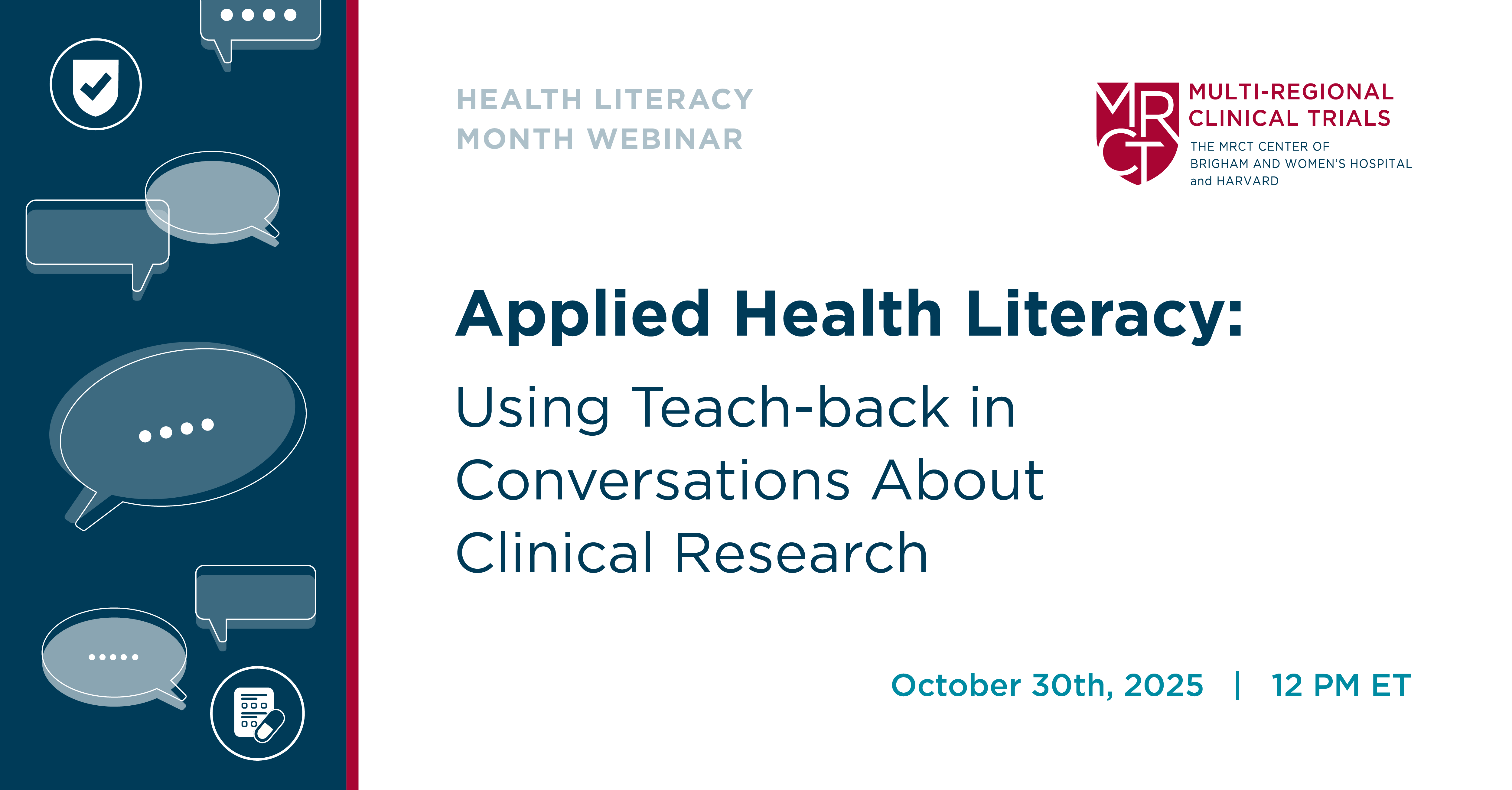
October 30, 12:00 – 1:00 PM ET: Applied Health Literacy: Using Teach-Back in Clinical Research
October is Health Literacy Month! Join us on Thursday, October 30, for the webinar Applied Health Literacy: Using Teach-Back in Conversations About Clinical Research.
Learn the essential elements of Teach-Back, why it matters for safe, equitable care and research, and practical ways to integrate it into clinical research conversations. The session will highlight how study teams can simplify complex information, confirm understanding, and foster dialogue with participants and caregivers throughout recruitment, consent, and beyond.
Registrants will receive tips and resources to apply Teach-Back in everyday research processes.
November 4, 11:00 AM – 12:00 PM ET: Long-Term Follow-Up for Gene Therapies: Toolkit Release
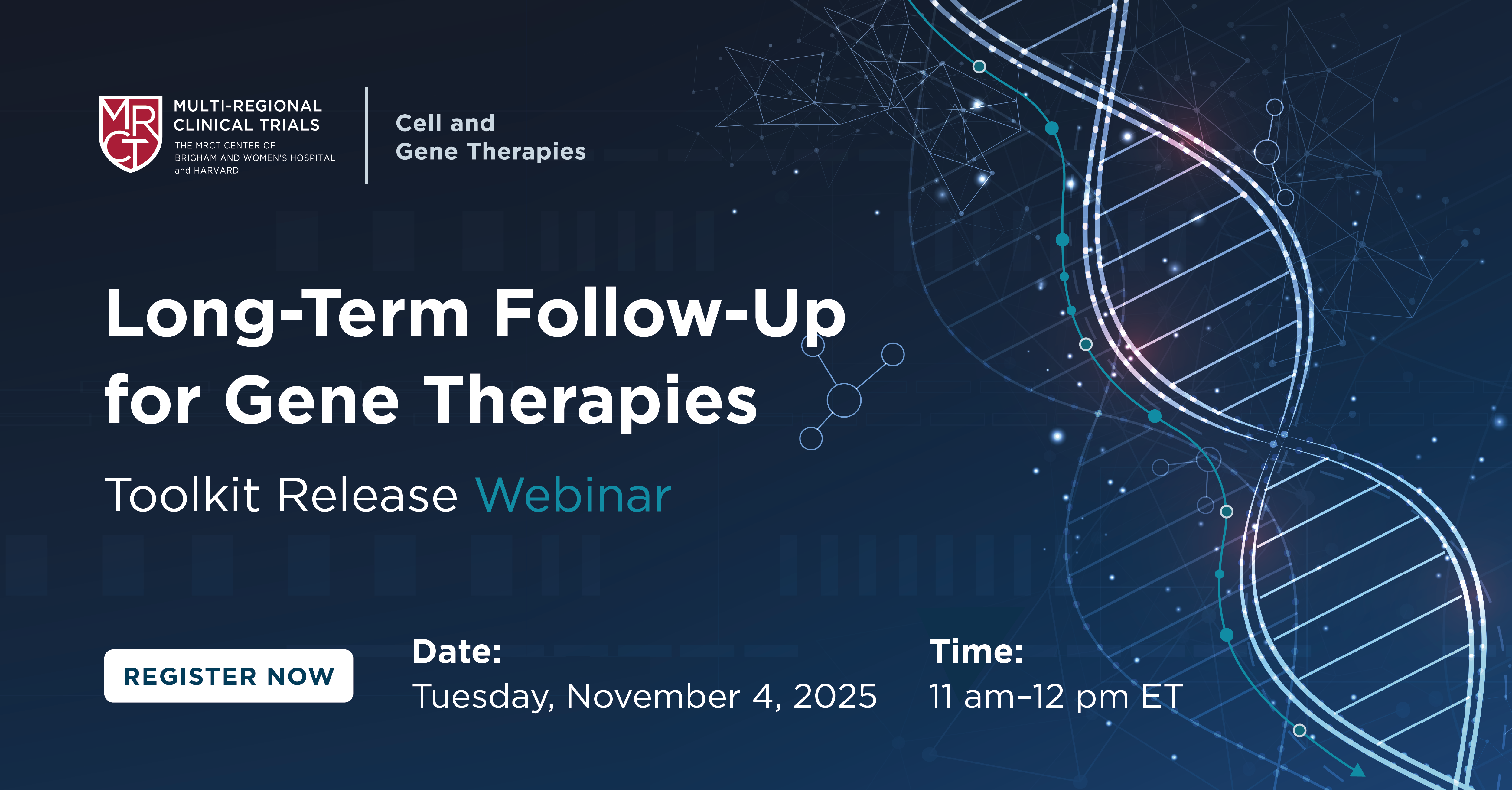
Join us as we mark the public release of the Toolkit for Supporting the Design, Conduct, and Reporting of Long-Term Follow-Up Studies for Gene Therapies. Developed with multi-stakeholder input from industry, academic researchers, patients, patient advocates, and human research protection professionals, the Toolkit provides practical guidance to employ best practices to design and operationalize LTFU studies for both investigational and approved gene therapies.
The session will introduce the Toolkit’s structure and contents, including Guiding Principles, Considerations and Recommendations, and Looking Forward sections. The Toolkit also features other resources, such as key design elements of LTFU studies for FDA-approved gene therapies, international LTFU regulatory guidance, glossaries, and background information on types of LTFU studies.
We will be joined by three panelists who will share their experiences and perspectives and highlight key points and takeaways. There will be time for Q&A with the audience as well.
November 18, 12:00 pm- 1:00 pm ET: AI Digital Twins and Synthetic Data: Practical Use Cases for Clinical Research
This second session in our AI series will focus on real-world applications of digital twins and synthetic data in clinical research. Daniele Bertolini, Unlearn.AI, will discuss how these technologies can reduce reliance on traditional control arms, support Bayesian and single-arm trial designs, and optimize future trial planning and analysis.
The session will also examine emerging opportunities and limitations in applying AI-enabled models to clinical trials and how these approaches may advance trial efficiency and innovation in study design.
December 10, 1:00 pm – 3:00 pm: Joint Task Force for Clinical Trial Competency (JTF): December Biannual Global Meeting
The Joint Task Force for Clinical Trial Competency (JTF), anchored at the MRCT Center, develops and disseminates standards and practices for the global clinical research workforce. By fostering a cohesive and collaborative approach, the JTF ensures that professionals have the competencies—the knowledge, skills, and attitudes—needed to conduct safe, ethical, high-quality clinical research.
Join us on December 10, from 1:00–3:00 PM ET, for the JTF Biannual Global Meeting to learn from colleagues around the world who are implementing the JTF Framework in diverse contexts. Presentations will highlight how the Urdu translation of the Framework is advancing clinical research competencies in Pakistan; how professional standards and recognition are being strengthened for Australian clinical trials professionals; and how workforce development is being supported across New Zealand public hospitals. Speakers will also share approaches to designing experiential learning with a focus on JTF competencies at North Carolina Central University, as well as efforts to integrate the Framework into a master’s-level clinical data science training program.
New Resource for Financial Neutrality in Cancer Trials
The MRCT Center has been part of a collective effort to advance financial neutrality for participants in cancer clinical trials by ensuring that financial support for out-of-pocket patient costs is available. This effort, the Equitable Access to Clinical Trials (EACT) initiative, involves a multi-stakeholder group of patient advocacy organizations, clinical trial site leaders, industry partners, CRO, and IRB colleagues.
A new resource, Advancing Equitable Access to Clinical Trials: Eliminating the Financial Burden for Patients, has been released. This document provides important information, recommendations, and a Call to Action for site personnel to advance financial neutrality in cancer trials.
Events & Presentations
September 11: The MRCT Center’s Artificial Intelligence (AI) and Ethical Research project continues to advance practical guidance for the responsible use of AI in clinical research, anchored by the Framework for Review of Clinical Research Involving Artificial Intelligence. Building on this work, WCG—our collaborator in developing the Framework—hosted a September 11 webinar with Barbara Bierer and Trevor Baker to demonstrate how the Framework can be applied in real-world review and oversight scenarios. Following the session, WCG released a new FAQ to support stakeholders in interpreting and operationalizing the Framework.
September 30: AI Digital Twins and Synthetic Data: Applications to Clinical Trials. The recording, slides, and related resources are now available on demand.
September 30: The MRCT Center and Vivli co-host an ongoing, invite-only forum focused on the European Health Data Space (EHDS), bringing together stakeholders to track developments and coordinate responses. This convening, the fourth in the series to date, prioritized upcoming TEHDAS2 guidance documents for public consultation and developed a strategy for collective feedback and submissions.
October 7: Sarah White joined Jane Williams and Meredith Wilson of Syneos Health, and Kemi Olugemo of Korro Bio, for the panel “Ethics in Action: Building Patient Protection in Clinical Trials Through Therapeutic Expertise” at the Fierce Biotech conference in Boston.
October 22: MRCT Center Annual Symposium. The MRCT Center convened global research stakeholders, both in-person in Boston and online, for its one-day Annual Symposium, “Meeting the Moment,” to advance ethical, actionable, and practical solutions for global clinical trials. John Crowley, President & CEO of the Biotechnology Innovation Organization (BIO), delivered the keynote, setting the stage for discussions on the need for clinical trial reform, rethinking informed consent with artificial intelligence, long-term follow-up for cell and gene therapies, and the path forward for participant-centered innovation. The program concluded with an interactive session on reinventing informed consent, inviting attendees to collaboratively reimagine the consent form and process for today’s research landscape.
October 23: Vivli Annual Meeting, co-hosted with the MRCT Center. “Data in Action: From Contribution to Impact.”
October 24: Trevor Baker, Barbara Bierer, and WCG collaborator Donna Snyder presented “Ethical Oversight of AI in Clinical Research: A Framework and Practical Implications” at the MAGI@home virtual conference.
October 30, 12:00 – 1:00 PM ET: Applied Health Literacy: Using Teach-Back in Clinical Research. See Spotlight above
November 4, 11:00 AM – 12:00 PM ET: Long-Term Follow-Up for Gene Therapies: Toolkit Release Webinar. See Spotlight above.
November 4: The MRCT Center and Vivli co-host an ongoing, invitation-only forum focused on the European Health Data Space (EHDS). The discussion continues with stakeholders collaborating on developments and the coordination of work efforts. The November forum, the fifth to date, will focus on responses to the TEHDAS2 guidance documents in the form of public consultation in key identified areas, and continue our efforts to guide policy development towards a harmonized data sharing system for secondary use purposes.
November 7-8: The MRCT Center at the PRIM&R 2025 Conference:
- November 7, 10:30 – 11:45 AM ET: Barbara Bierer and Trevor Baker will join WCG collaborator Donna Synder, Tamiko Eto of Center for AI & Digital Policy (CAIDP), and David Clifford to present “Collaborative Project on Artificial Intelligence (AI) Regulatory and Ethical Review: Insights, Challenges, and Practical Tools.”
- November 8, 12:30 – 1:30 PM ET: Barbara Bierer will contribute to a roundtable discussion with Luke Gelinas of Advarra, and Benjamin Silverman and Martha Jones of Mass General Brigham, “Should we still be using Unconsented Biospecimens for Research in 2025?”
- November 8, 12:30 – 1:30 PM ET: Barbara Bierer will join Polly Goodman and Jeremy Lavigne of Harvard University to present “Everything you wanted to know about SMART IRB Agreement Version 3.0.”
- November 8, 12:30 – 1:30 PM ET: Willyanne DeCormier Plosky will join Tiffany Chenneville of the University of South Florida to present “Science Under Siege: Defending Scientific Integrity in a Polarized World.”
November 14: Sylvia Baedorf Kassis will be a speaker at the International Society for Medical Publication Professionals (ISMPP) Academy. She will be co-leading interactive sessions on Mastering Plain Language Summaries (PLS) and Plain Language Summaries of Publications (PLSP): Bridging Foundations and Applications.
November 18, 12:00 pm- 1:00 pm ET: AI Digital Twins and Synthetic Data: Practical Use Cases for Clinical Research. See Spotlight above.
December 8, 10:00 AM – 12:30 PM: Meeting of the Bioethics Collaborative. Topic: How Much Risk is Too Much? Revisiting the Ethics of Control Arms. For more information about the Bioethics Collaborative and how to join, click here.
December 10, 1:00 – 3:00 PM ET: Joint Task Force for Clinical Trial Competency (JTF): December Biannual Global Meeting. See Spotlight above.
Publications
October 16: In the article, A Scoping Review of Challenges in Pediatric Health Technology Assessments with a Focus on Pharmaceutical Interventions, published in the International Journal of Technology Assessment in Health Care, authors Nora Hutchinson, Lauren Otterman, Elisa Koppelman, Barbara Bierer, and colleagues highlight the substantial difficulties in incorporating children within the population-wide health technology assessment (HTA) system, as well as the uncertainty accompanying pediatric HTAs due to data constraints, lack of guidance and/or variation in guidance, between HTA bodies.
October 22: In the article “Characteristics of long-term follow-up studies for gene therapies registered on ClinicalTrials.gov,” published in Gene Therapy, co-authors Carolyn Chapman, Emina Berbic, Ava Glazier, and Barbara Bierer describe key characteristics of LTFU gene therapy study protocols registered in ClinicalTrials.gov. Analyzing how registered LTFU studies are currently designed, the results suggest a lack of harmonization in how safety outcomes are monitored and reported across LTFU studies. Standardization and/or harmonization of data and outcome reporting may increase the scientific value of these studies.
The MRCT Center provides a unique and trusting community to improve the integrity, safety, and rigor of global clinical trials. Join us in our efforts to develop innovative solutions and aligned approaches to global clinical research.
Learn more about becoming an MRCT Center sponsor.