

In the Spotlight
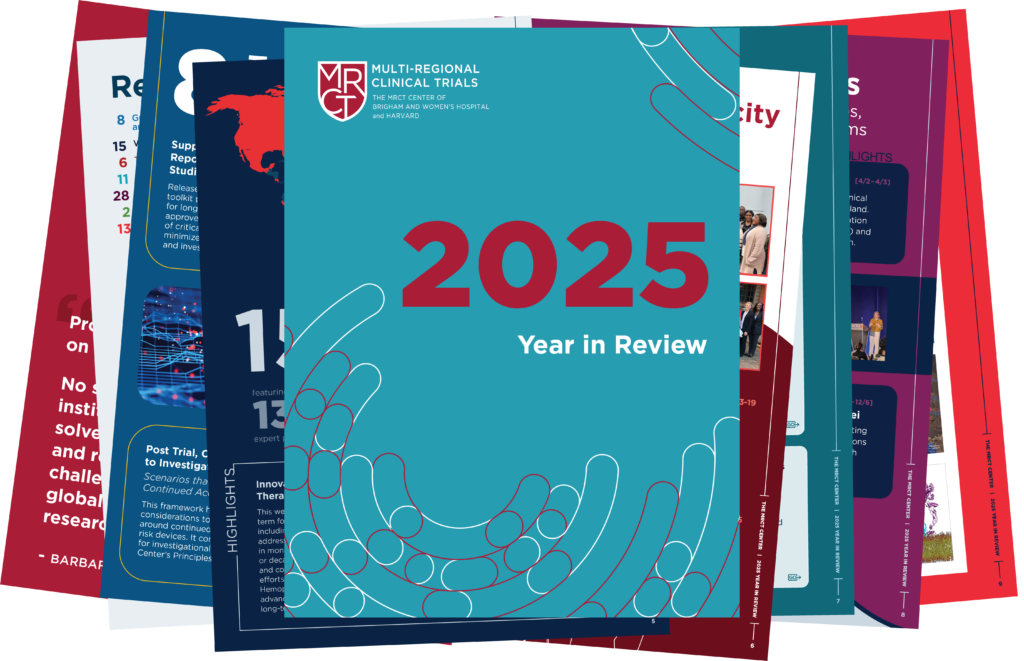
In a year shaped by rapid change, unpredictability, and rising expectations, the MRCT Center remained committed to improving the integrity, safety, and rigor of global clinical trials. Explore the 2025 MRCT Center Year in Review (PDF) to see how the MRCT Center developed practical resources to advance clinical research. It captures key deliverables, partnerships, and measurable momentum—grounded in fit-for-purpose approaches that protect participants, strengthen data integrity, and support trial quality. Whether you are a sponsor, investigator, regulator, ethics committee member, patient, participant, or patient advocate, this brief report highlights practical resources you can use and share.
Click here to read an accompanying letter from MRCT Center leadership.
New Long-Term Follow-Up (LTFU) Toolkit for Gene Therapies
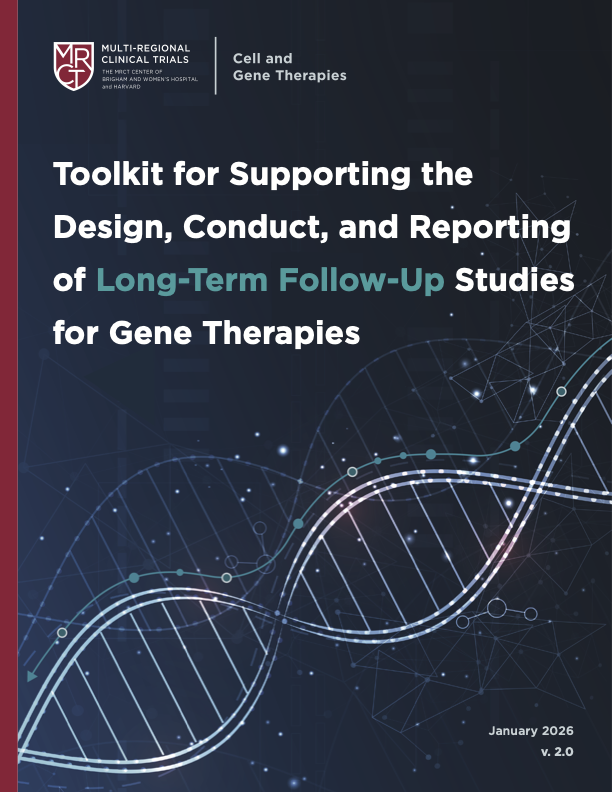
The Toolkit for Supporting the Design and Conduct of Long-Term Follow-Up (LTFU) Studies for Gene Therapies (Version 2.0) helps teams design, plan, conduct, report, and oversee LTFU studies for both investigational and FDA-approved gene therapies. First released as a draft for public comment in November 2025, Version 2.0 adds an Executive Summary and a Patient Resource for patients and caregivers. It balances the need for long-term safety and efficacy data with the obligation to reduce burden on participants, sites, and sponsors. The toolkit is intended for researchers, sponsors, clinicians, regulators, patient advocacy organizations, and research oversight professionals. It includes a special section for patients and participants in or considering LTFU studies. It moves from foundations to implementation through sections on study types, guiding principles, and practical recommendations across objectives and endpoints, consent and retention, safety detection and reporting, data sharing and results dissemination, and operational planning—supported by interactive navigation to help with Toolkit usability. It looks ahead, raising questions that stakeholders should address to strengthen LTFU over time. The pragmatic guidance highlights patient partnership throughout the LTFU lifecycle and promotes a flexible approach that anticipates program change, incorporates real-world data when appropriate, and reflects the needs and contexts of patients and their communities.
Click here to view the Toolkit for Supporting the Design and Conduct of Long-Term Follow-Up (LTFU) Studies for Gene Therapies (Version 2.0).
Prefer to Listen?
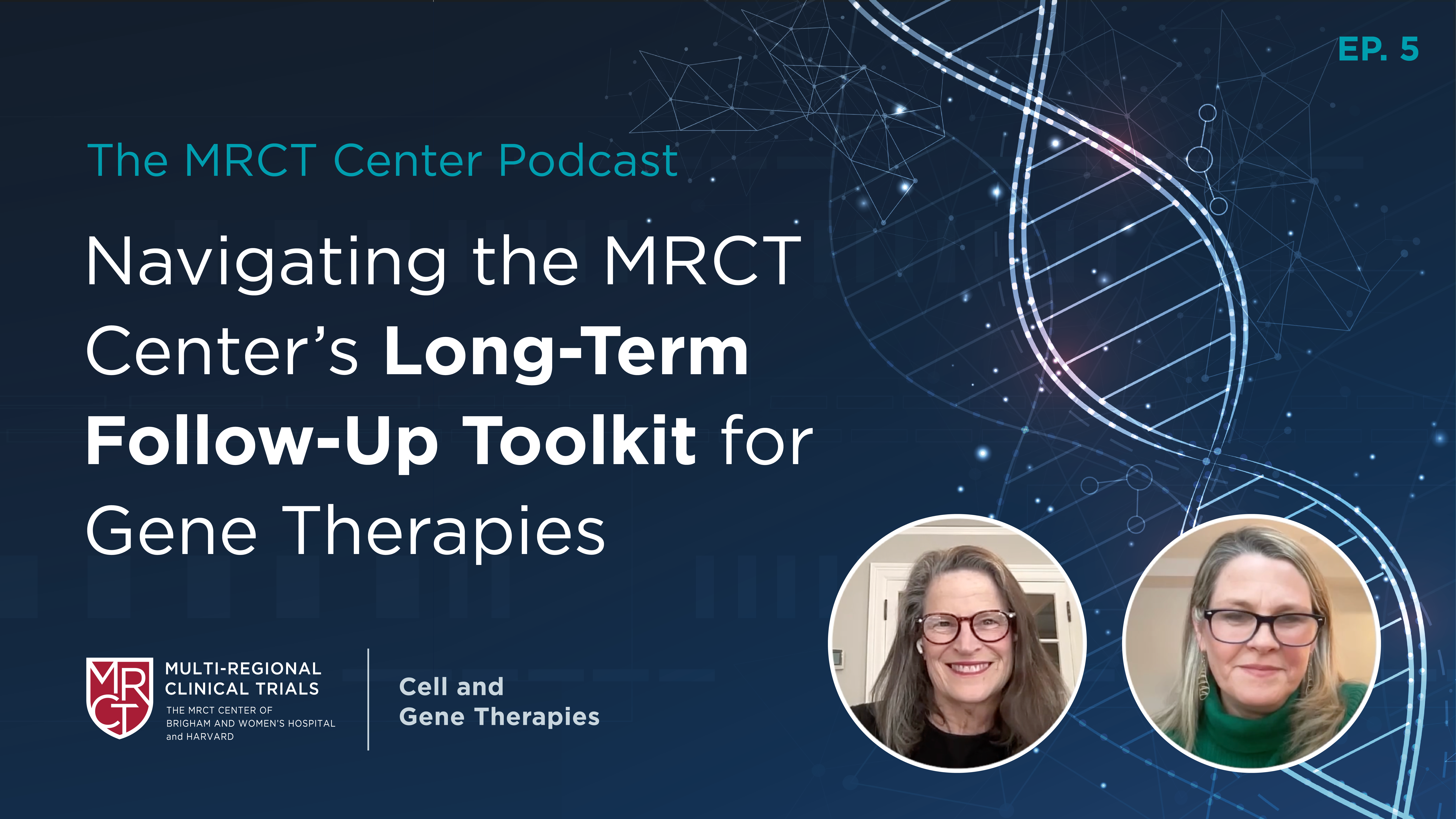
Listen to a podcast discussion with Barbara Bierer and Carolyn Chapman as they discuss the LTFU toolkit.
Available now on Spotify, YouTube, Apple Podcasts, and all streaming platforms. Subscribe to the MRCT Center Podcast to see the full library of conversations.
New On-Demand Trainings
ICH E6(R3): Informed Consent
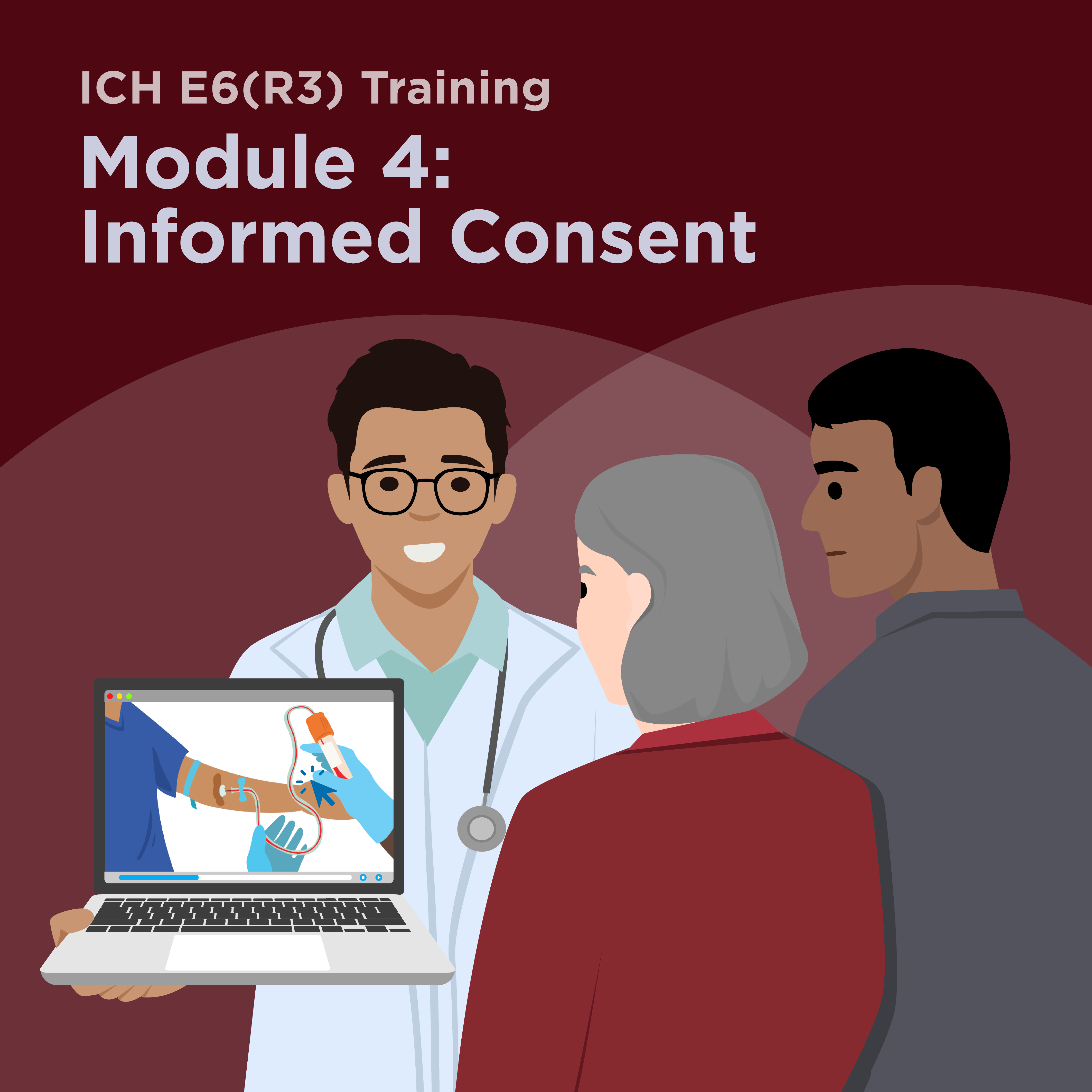
Good Clinical Practice (GCP) is an international, ethical, scientific, and quality standard for the conduct of clinical trials involving human participants. The MRCT Center is developing and designing this course in collaboration with the ICH E6(R3) Expert Working Group (EWG). The course consists of 5 modules that introduce and explain the key concepts of the E6(R3) guideline and is intended for anyone involved in the conduct of an interventional clinical trial. The course links will direct learners to the ICH Training Library website. Courses are free for all registrants.
Module 4 explains ICH E6(R3) expectations for Informed Consent across two short sub-modules, 4.1 and 4.2. It emphasizes that consent is an ongoing process—not a signature—designed to support voluntary, informed decisions through clear, understandable information with time for questions. It clarifies roles and responsibilities and summarizes what consent materials should include, reflecting E6(R3) updates. It then turns to implementation: how to conduct and document consent in practice, including electronic and remote approaches, safeguards for vulnerable participants, re-consent when new information arises, and record retention.
Click here to view this training, as well as other trainings designed and developed by the MRCT Center, including ICH E6(R3) Module 1: Introduction and Foundational Concepts.
Ethics and Review of Interventional Clinical Research: Part 2
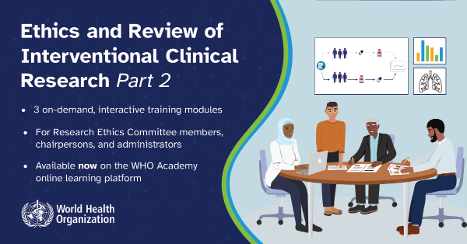
We are delighted to announce that Ethics and Review of Interventional Clinical Research: Part 2 is now available on the WHO Academy online learning platform.
Across 3 video-based modules, paired with interactive case studies and activities, learners will gain practical, in-depth guidance on providing ethical oversight of health-related research involving human participants. By the end of the course, learners will be able to explain how a Research Ethics Committee (REC) provides oversight from initial review through study closure; articulate why robust Standard Operating Procedures (SOPs) are essential to REC operations; describe the roles and responsibilities of other stakeholders involved in clinical research oversight; and identify methods to assess and strengthen REC operations.
This course was designed, developed, and produced by the MRCT Center. The MRCT Center also designed and produced Ethics and Review of Interventional Clinical Research: Part 1—available here.
Click here to start Ethics and Review of Interventional Clinical Research, Part 2.
Implementing the JTF Framework for Workforce Development: Global Use Cases
The Joint Task Force for Clinical Trial Competency (JTF), anchored at the MRCT Center, develops and disseminates standards and practices for the global clinical research workforce. Through an internationally developed framework that defines the knowledge, skills, and attitudes needed for safe, ethical, high-quality research, the JTF supports organizations in strengthening roles, training, and professional development across the clinical trial ecosystem.
At the December JTF Global Biannual Meeting, speakers from 5 countries shared practical, real-world examples of how they are implementing the JTF Framework. In Pakistan, translating the framework into Urdu improved comprehension from 62% to 96% and is now informing job descriptions, investigator selection, and accreditation expectations. In the United States, the University of Cincinnati designed a master’s in clinical data science using the JTF and reduced program length while maintaining comprehensive competency coverage. North Carolina Central University developed a 4-year Clinical Research Sciences program with JTF-aligned internships. New Zealand is developing a national professional development framework to reduce role ambiguity, address workforce variability, and improve retention across public hospitals. In Australia, the REDI GROW program adopted JTF as the “backbone” and shared “international language” for a national Core Competency Framework, aimed at reducing fragmentation and workforce retention.
View the full recording for practical examples of how organizations are using the JTF Framework in education, hiring, and national workforce development.
Related: The JTF Framework is available in 13 languages. The newest translation, Urdu, was added this month. Click here for details.
Upcoming Webinar
Deploying Digital Twins and Synthetic Data in Evidence Generation
Thursday, March 19, 1:00 – 2:00 PM ET
This webinar will examine the use of digital twins and synthetic data in evidence generation, focusing on (1) their emerging applications across the clinical trial lifecycle, including study design, control arm reduction, and single-arm trials, and (2) regulatory expectations and experience. Panelists will discuss how evidence quality, validation approaches, performance benchmarks, and model interpretability shape decision-making, and reflect on how practical and regulatory considerations influence the adoption of these approaches in clinical research. The discussion will draw on use cases, including synthetic controls and power enhancement strategies, and will include a moderated discussion and time for audience Q&A.
Panelists:
- Daniele Bertolini, Principal Scientist, Unlearn.AI
- Tala Fakhouri, Vice President: Consulting, AI & Digital Policy, Real-World Research, Parexel
- Karen Smith, Board of Directors at Context Therapeutics, Skye Bioscience, and Sangamo Therapeutics; Principal and Co-Founder of Boomerang Biopathways.
Moderator: Barbara Bierer, Faculty Director, MRCT Center
Related: This is the third webinar in an ongoing series focused on AI digital twins and synthetic data. Earlier webinars are available on demand:
- AI Digital Twins and Synthetic Data: Applications to Clinical Trials
- AI Digital Twins and Synthetic Data: Practical Use Cases for Clinical Research
2025 Annual Symposium: Recordings now On-Demand
The MRCT Center held its Annual Symposium on October 22, 2025, hosting 100 people in Boston and 580 people virtually. Sessions focused on concrete implementation challenges in global clinical trials, including how to modernize trial operations, reduce inefficiencies, alleviate site and participant burden, reimagine informed consent as an enabling participant-centered process, and adopt the responsible use of AI. The MRCT Center Long-Term Follow-Up Toolkit was introduced (see above).
The panel recordings are now available on demand.
Keynote | John F. Crowley (BIO)
John F. Crowley, President & CEO, Biotechnology Innovation Organization (BIO)
A call for regulatory modernization, trial simplification, and cross-sector partnership to sustain innovation and expand equitable access to medicines worldwide.
Panel | Clinical Trial Reform: The Need for Change and Progress
Kevin Bugin (Amgen); Karen Hartman (Mayo Clinic); Bridgette René McCullough (ACIRAH Health); Ann Meeker-O’Connell (Novartis)
Practical reforms to reduce protocol complexity and site burden, standardize systems, accelerate start-up, and expand patient access through adaptive and decentralized trial designs.
Session | Meeting the Moment in an Evolving Research Environment
Sarah White, Executive Director, MRCT Center
Repositioning the MRCT Center to remain nimble and opportunistic amid regulatory, technological, and operational uncertainty through focused work on access, innovative trial design, data use and protection, patient-centered approaches, responsive forums, global capacity building, and artificial intelligence.
Panel | Rethinking Informed Consent with Artificial Intelligence
Michael Cohen-Wolkowiez (Duke University); Megan Doerr (Sage Bionetworks); Cristin Freeman (Bristol Myers Squibb)
Real-world applications of AI to enhance informed consent, focusing on participant-centered, scalable, and feasible innovation, while respecting ethical and regulatory expectations.
Panel | Cell & Gene Therapy Long-Term Follow-Up (LTFU): Key Deliverables and the Path Forward
Lara Gehl (Bristol Myers Squibb); Daniel Kavanagh (WCG); Pamela Tenaerts (Medable);
Practical applications of the MRCT Center’s LTFU Toolkit to harmonize data, reduce participant burden, integrate decentralized methods, and meet long-term safety and regulatory requirements.
MRCT Center Updates | Select Initiatives
Willyanne DeCormier Plosky; Sarah White; Sylvia Baedorf Kassis; Lisa Koppelman; Barbara Bierer (MRCT Center)
Implementation updates on Representation in Research, capacity building through the TRACE Project, workforce competency standards (JTF), pediatric research, and the European Health Data Space.
Save the date: The 2026 MRCT Center Annual Symposium will take place on Wednesday, October 21, 2026, in Boston. An agenda will be shared in the coming months.
Events & Presentations
December 8: Meeting of the Bioethics Collaborative. Topic: How Much Risk is Too Much? Revisiting the Ethics of Control Arms. For more information about the Bioethics Collaborative and how to join, click here.
December 9: The MRCT Center hosted a webinar on “Mitigating Financial Toxicity for Participants in Clinical Trials,” in collaboration with Equitable Access to Clinical Trials (EACT), a project convened by LUNGevity Foundation. This webinar, led by Dr. Barbara Bierer (MRCT Center), Dr. David Gerber (UT Southwestern), and Wendy Selig (WSCollaborative), examined the sources and impact of these costs and highlighted emerging strategies to reduce financial hardship for research volunteers. Presenters also introduced tools, checklists, and other resources developed through the EACT Project, a collaborative forum advancing financial neutrality in clinical research participation. The recording, slides, and related resources are now available on demand here.
December 10: Joint Task Force for Clinical Trial Competency (JTF): December Global Biannual Meeting. The recording, slides, and related resources are now available on demand here.
December 13-19: Barbara Bierer and Sarah White took part in a strategic convening in Nairobi as part of the TRACE initiative, supporting Kenya’s planned participation in the TRACE Project. The meeting brought together key national authorities, including the National Commission for Science, Technology and Innovation (NACOSTI), the Pharmacy and Poisons Board (PPB), and Institutional Scientific and Ethics Review Committees (ISERCs) from Moi Teaching and Referral Hospital and the Kenya Medical Research Institute (KEMRI), alongside colleagues from Garnet Partners and the Gates Foundation. The meetings centered on advancing Kenya’s ethics and regulatory systems for clinical research. Through open and constructive dialogue, participants strengthened cross-institutional collaboration and alignment, helping to establish a foundation for more consistent, efficient, and trusted clinical research oversight under the TRACE Project. For more about the TRACE Project, click here.
January 23: Willyanne DeCormier Plosky led a discussion of the article “Excluding People With Disabilities From Clinical Research: Eligibility Criteria Lack Clarity And Justification | Health Affairs” at the most recent MGB Disability Employee Inclusion Alliance lunch-and-learn session.
January 24: Carolyn Riley Chapman led a workshop on “What’s Special about Expanded Access for Gene and Cell Therapies?” at CUPACon26, NYU Langone Health’s Working Group on Compassionate Use & Preapproval Access (CUPA)’s biannual conference, hosted this year by Boston University School of Law.

January 29: Meeting of the Research, Development, and Regulatory Roundtable (R3). Topics: The HALT Fentanyl Act & its effect on research involving controlled substances; Executive Order on Increasing Medical Marijuana and Cannabidiol Research and Declaration of Taipei. This meeting is open to sponsors of the Research, Development, and Regulatory Roundtable (R3). For more information about this ongoing forum and how to join, click here.
February 6: Sarah White will address the Clinical Research Interest Group (CRIG) at Harvard University. This group offers opportunities to explore clinical research methodologies, discuss current studies, and collaborate on projects that contribute to improving healthcare outcomes.
March 3: Sylvia Baedorf Kassis will co-lead a workshop at DIA-MASC in Boston, MA, on practical strategies for medical writers to create patient-centric materials, navigate legal and regulatory challenges, and advocate for health literacy-focused processes.
March 4: Barbara Bierer will join a panel of expert speakers at the 11th annual Research Ethics Day conference: The Future of Research Ethics: Threats and Opportunities, hosted by the University of Minnesota’s Consortium on Law and Values. For more information about the Bioethics Collaborative and how to join, click here.
March 19, 1:00 – 2:00 PM ET: Deploying Digital Twins and Synthetic Data in Evidence Generation. See Spotlight above.
March 22-26: Sylvia Baedorf Kassis will be a featured speaker and panelist at PHUSE Connect 2026 in Austin, TX. She will be presenting on strategic approaches to involving patients and participants in the data sciences, the return of individual and study summary results, and public trust in research.
Publications
November 30: The MRCT Center submitted responses to several TEHDAS2 draft guidelines to Health Data Access Bodies offered for public consultation, including one on data minimization, pseudonymization, anonymization, and synthetic data; on implementing opt-out from secondary use of electronic health data; and on notifying individuals of significant findings from the secondary use of health data. The comments highlight opportunities to refine guidance on anonymization and pseudonymization, opt-out management, and notification of significant findings, balancing operational details with scientific utility, and calls to ensure consistent and practical implementation across Member States to support EHDS in achieving its vision of a trusted and effective health data sharing framework.
The MRCT Center provides a unique and trusting community to improve the integrity, safety, and rigor of global clinical trials. Join us in our efforts to develop innovative solutions and aligned approaches to global clinical research.
Learn more about becoming an MRCT Center sponsor.