

In the Spotlight
AI in Clinical Research: From Framework to Practice
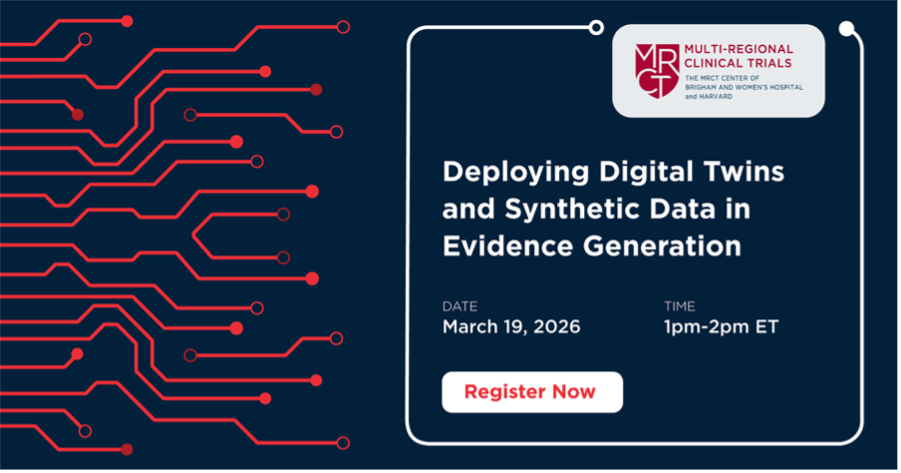
The MRCT Center launched an ongoing webinar series exploring two rapidly evolving technologies reshaping clinical trial design: digital twins and synthetic data. AI Digital Twins and Synthetic Data: Applications to Clinical Trials (September 2025) established foundational definitions and models; AI Digital Twins and Synthetic Data: Practical Use Cases for Clinical Research (November 2025) examined real-world examples, including reducing control arm size, supporting single-arm trials, and enhancing Bayesian statistical analysis. The series continues on March 19 with Deploying Digital Twins and Synthetic Data in Evidence Generation, with additional webinars planned.
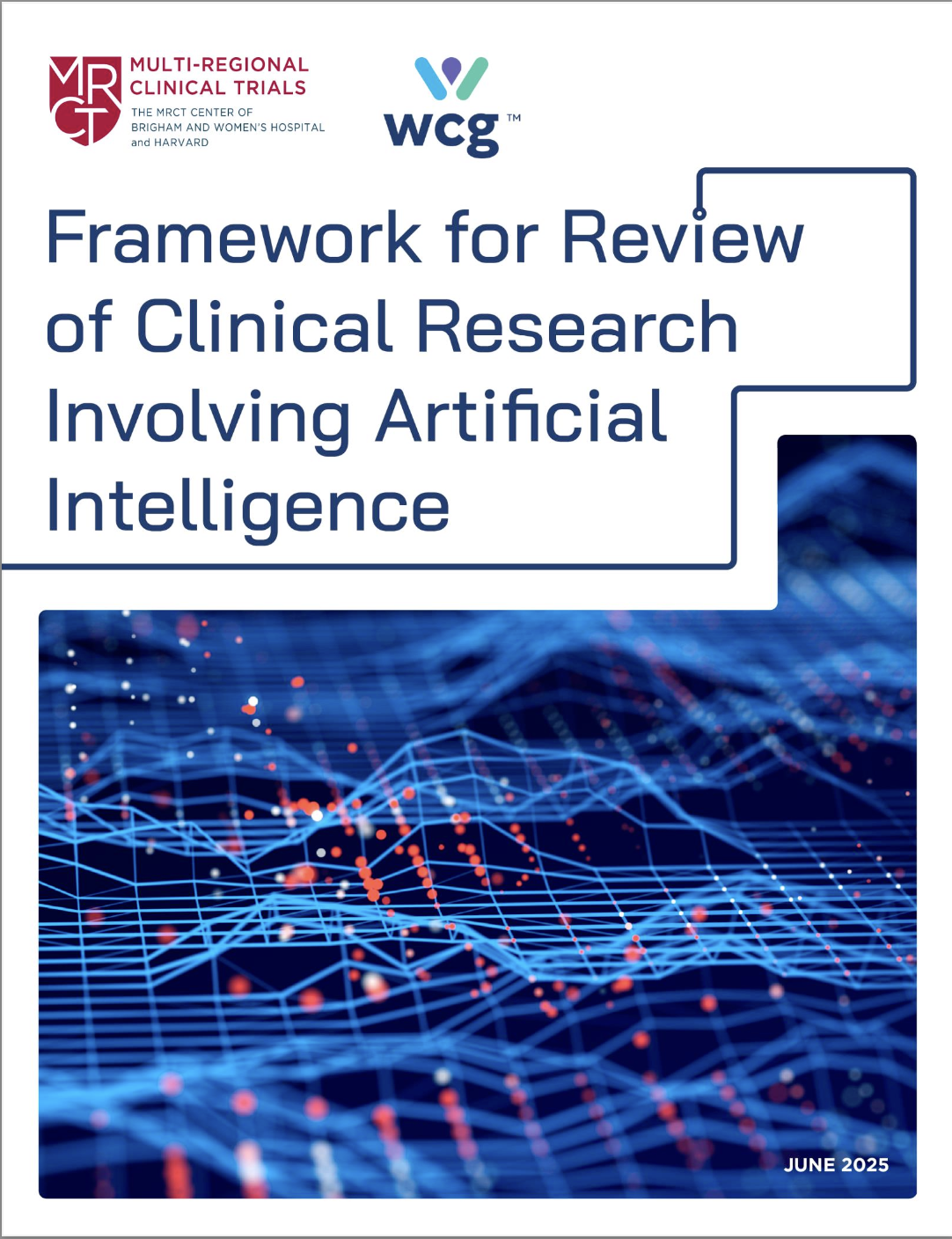
This work is grounded in a foundational resource developed earlier in 2025. In June 2025, the MRCT Center and WCG published the Framework for Review of Clinical Research Involving Artificial Intelligence, developed by a multidisciplinary task force to help IRBs navigate the ethical and regulatory dimensions of AI in research. The Framework takes a structured, practical approach to IRB review across the full lifecycle of AI development, from early data collection through clinical deployment, addressing bias, transparency, informed consent, human oversight, and more.
Since its launch, the work has continued. The task force is now developing a series of case studies to bring the Framework to life in real-world review scenarios — coming soon.
Looking ahead, the MRCT Center’s AI work in 2026 will expand its focus to the administration of clinical research itself, addressing how AI is being used in study design, protocol development, site selection, recruitment, data monitoring, and safety signal detection. The Task Force focusing on “Reimaging Informed Consent” has also been initiated. Stay tuned and please reach out.
The MRCT Center’s AI work is built for implementation, giving sponsors, research teams, and regulatory oversight bodies the practical frameworks they need to move forward with confidence.
TRACE Project: Strengthening Clinical Trial Ethics Across Africa
The MRCT Center remains deeply engaged in the TRACE (Trial Regulatory and Clinical Ethics Optimization) project partnership, a collaborative initiative that aims to strengthen clinical trial ethics capacity across Sub-Saharan Africa. Building on the momentum established in 2025 with Nigeria, Rwanda, Zimbabwe, and Tanzania, the partnership has expanded in 2026 to include Kenya. The MRCT Center supports the distinct needs of each country, focused on capacity building and financial sustainability, with particular attention to registration, accreditation pathways, in-country reliance, and sustainable financing models. In parallel, the MRCT Center team has developed harmonized foundational training and is now working on advanced training and post-approval monitoring activities. These resources can be applied consistently across partner countries while remaining responsive to local contexts and priorities.
In the year since the project began, the MRCT Center has conducted in-country visits with representatives from national regulatory agencies, national ethics committees, institutional ethics committees, and other stakeholders central to clinical trial approval and oversight. These engagements were instrumental in building relationships, identifying country-specific needs, and laying the groundwork for sustained collaboration. Looking ahead, the partnership will continue with MRCT Center colleagues traveling to Zimbabwe in June 2026 for a Core Group meeting to assess progress, address emerging priorities, and chart the path forward.
Explore the MRCT Center’s On-Demand Webinar Library
With 15 webinars hosted in 2025 alone — drawing 5,494 unique registrants from 64 countries — the MRCT Center’s on-demand library has become a substantive resource for clinical research professionals worldwide. Whether you’re catching up on a session you missed or exploring a topic for the first time, recordings are freely available on the MRCT Center website and on our YouTube channel.
Recent sessions cover a range of pressing issues in clinical research:
Mitigating Financial Toxicity for Participants in Clinical Trials (December 2025) examines best practice considerations and recommendations for sponsors, trial sites, and research teams navigating the real costs of trial participation.
Long-Term Follow-Up for Gene Therapies: Toolkit Release (November 2025) introduces the MRCT Center’s newly released toolkit and the practical guidance it offers for sponsors, investigators, ethics committees, patient advocacy groups, participants, and their caregivers.
Applied Health Literacy: Using Teach-Back in Conversations about Clinical Research (October 2025) offers hands-on strategies for improving how research teams communicate with participants.
Continued Access to Investigational Products: Guiding Equitable and Fair Decisions (September 2025) addresses one of the most ethically complex moments in a clinical trial — what happens after it ends.
Browse the full library here.
Upcoming Webinar
Deploying Digital Twins and Synthetic Data in Evidence Generation
Thursday, March 19, 1:00 – 2:00 PM ET
This webinar will examine the use of digital twins and synthetic data in evidence generation, focusing on (1) their emerging applications across the clinical trial lifecycle, including study design, and (2) regulatory expectations and experience. Panelists will discuss how evidence quality, validation approaches, performance benchmarks, and model interpretability shape decision-making, and reflect on how practical and regulatory considerations influence the adoption of these approaches in clinical research. The discussion will draw on use cases, including synthetic controls and power enhancement strategies, and will include a moderated discussion and time for audience Q&A.
Panelists:
- Daniele Bertolini, Principal Scientist, Unlearn.AI
- Tala Fakhouri, Vice President: Consulting, AI & Digital Policy, Real-World Research, Parexel
- Karen Smith, Board of Directors at Context Therapeutics, Skye Bioscience, and Sangamo Therapeutics; Principal and Co-Founder of Boomerang Biopathways.
Moderator: Barbara Bierer, Faculty Director, MRCT Center
Related: This is the third webinar in an ongoing series focused on AI digital twins and synthetic data. Earlier webinars are available on demand:
- AI Digital Twins and Synthetic Data: Applications to Clinical Trials
- AI Digital Twins and Synthetic Data: Practical Use Cases for Clinical Research
Events & Presentations
February 6: Sarah White addressed the Clinical Research Interest Group (CRIG) at Harvard University. This group offers opportunities to explore clinical research methodologies, discuss current studies, and collaborate on projects that contribute to improving healthcare outcomes.
March 3: Sylvia Baedorf Kassis will co-lead a workshop at DIA-MASC in Boston, MA, on practical strategies for medical writers to create patient-centric materials, navigate legal and regulatory challenges, and advocate for health literacy-focused processes.
March 4: Barbara Bierer will join a panel of expert speakers at the 11th annual Research Ethics Day conference: The Future of Research Ethics: Threats and Opportunities, hosted by the University of Minnesota’s Consortium on Law and Values. For more information about the Bioethics Collaborative and how to join, click here.
March 12-13: Willyanne DeCormier Plosky and Blythe Chen will co-present “Pregnancy Privacy Protections in an Evolving Legal Landscape” at the 10th Annual Reproductive Ethics Conference at The Hastings Center for Bioethics.
March 19, 1:00 – 2:00 PM ET: Deploying Digital Twins and Synthetic Data in Evidence Generation. See Spotlight above.
March 22-26: Sylvia Baedorf Kassis will be a featured speaker and panelist at PHUSE Connect 2026 in Austin, TX. She will be presenting on strategic approaches to involving patients and participants in the data sciences, the return of individual and study summary results, and public trust in research.
April 7: The MRCT Center and Vivli co-host an ongoing, invitation-only forum focused on the European Health Data Space (EHDS). This forum will focus on preparing for the third and last wave of TEHDAS2 consultations, continuing efforts to guide policy development toward a harmonized data-sharing system for secondary use.
Publications
February 10: Barbara Bierer and colleagues published a summary of their 2025 American Society for Clinical Pharmacology and Therapeutics Patient Forum panel discussion in Clinical Pharmacology and Therapeutics, highlighting actionable insights to ensure that representation in clinical trials reflects those most affected by the disease.
February 24: Barbara Bierer, Ava Glazier, and Willyanne DeCormier Plosky published “Disclosure of Pregnancy-Related Privacy Risks in Clinical Research Post-Dobbs” in NEJM Evidence. The review examines how routine clinical research practices — such as pregnancy testing, contraception requirements, and incidental pregnancy reporting — have created new privacy risks for participants, clinicians, and investigators following the 2022 Dobbs v. Jackson Women’s Health Organization decision and offers practical guidance for investigators and IRBs navigating this shifting legal landscape.
The MRCT Center provides a unique and trusting community to improve the integrity, safety, and rigor of global clinical trials. Join us in our efforts to develop innovative solutions and aligned approaches to global clinical research.
Learn more about becoming an MRCT Center sponsor.